


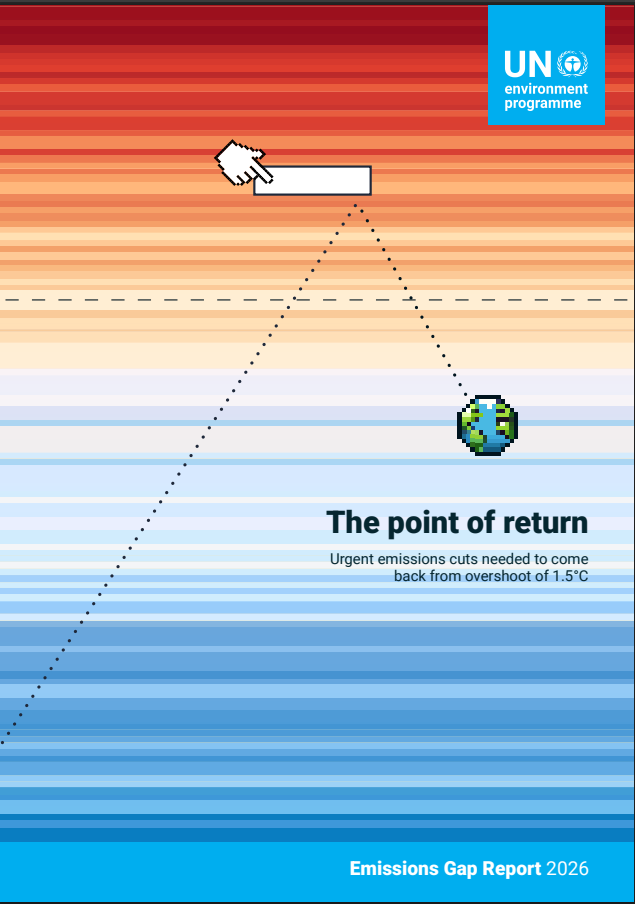
For 17 years, the United Nations has published its Emissions Gap Report comparing progress between current national climate pledges and the emissions cuts needed to limit warming below the Paris Agreement’s 2°C (3.6°F) goals, and to pursue 1.5° (2.7°F). Released today, the latest edition, titled "The Point of Return," states that greenhouse gas emissions slowed among the world's 20 richest nations in 2025. But the U.S., which has abandoned its own climate pledge, was an outlier, with a 2.4% increase in emissions. Coming from the world's No. 2 current emitter, the nation with the largest cumulative emissions — 17% of the world total since 1850 — and with twice the per capita emissions of the EU, the American retreat means more future warming than would otherwise be the case. And right now we have some leaders — tyrants and tycoons — who are gleeful about it because the profits are soaring from extracting and burning hydrocarbons.
The report's central conclusion is grim: The world has now lost its chance to prevent a significant overshoot of the 1.5°C threshold. Not because the necessary technologies don't exist. Not because scientists failed to explain the consequences. But because, despite decades of accumulating evidence and repeated promises, governments — hampered and threatened by powerful fossil fuel interests — haven't cut greenhouse gas emissions fast enough to avert what they have known was coming. And it appears that, repeating longstanding practice, the COP31 climate conference opening in less than two weeks in Antalya, Türkiye, won't change that.
Alexander C. Kaufman at Heatmap writes this morning:
El Niño is giving us a taste of what the warming we have locked in as a species will feel like. Just look at the extreme weather that raged this summer in the form of storms and heat waves as the cyclical weather pattern drove up temperature averages past 1.5 degrees Celsius above pre-industrial levels. That’s the maximum warming benchmark set in the 2015 Paris Agreement, later reinforced in a landmark 2018 United Nations report. Now the latest data from the UN Environment Programme shows that we’re well on our way to making this year’s El Niño the new norm. A report released Wednesday suggests the current trajectory of emissions means the “lowest possible” warming scenario would lead to global temperatures peaking at about 1.7 degrees to 1.8 degrees by midcentury before potentially returning to 1.5 degrees by 2100. To put the world on that pathway, global emissions would need to fall by 18% in the next three years relative to 2025 levels. Then 45% by 2035. Then another 69% by 2040.
As Inger Andersen, executive director of the U.N. Environment Program, told Fiona Harvey of The Guardian today, “[We used to say] there’s still an opportunity if we make this herculean effort [to stay within the 1.5°C limit. It’s now clear the herculean effort was not made. We procrastinated, and now we are saying this window has closed.” But there's still hope," she added, “We can make the overshoot as brief and as short as possible. It’s not time to throw in the towel and give up. This is about how to find our way back, as shortly and quickly as possible.”
From the report:
Exceedance does not mark a single uniform state of risk. Every additional fraction of a degree and additional year of warming above 1.5°C raises the risk of irreversible changes including in ice sheets, permafrost carbon, ocean circulation and coral systems, along with devastating human impacts. The task now, therefore, is not only to ensure that global warming stays well below 2°C, but to minimize the duration and magnitude of overshoot and establish a credible return path to 1.5°C by the end of the century.
This year’s report responds to this new reality by providing an initial assessment of such new overshoot pathways. It redefines the emissions gap against a ‘lowest possible’ 1.5°C overshoot scenario, which assumes that stringent mitigation action starts from 2025 and is characterized by limiting peak warming to 1.7–1.8°C with 66 per cent chance, and returning global mean temperatures to or below 1.5°C by 2100 with around a 50 per cent chance. This scenario is still aligned with the long-term temperature goal of the Paris Agreement to limit global warming to well below 2°C, while pursuing 1.5°C. To get on such a pathway, global greenhouse gas (GHG) emissions must be reduced by 18 per cent by 2030, 45 per cent by 2035 and 69 per cent by 2040, all relative to 2025 levels. By contrast, the full implementation of the new nationally determined contributions (NDCs) submitted by around two thirds of all countries would reduce emissions by 5–8 per cent by 2030 and 11–15 per cent by 2035 relative to 2025 levels.
Some of the report's other principal findings:
- The temperature projections are appalling. Existing policies put the planet on a trajectory toward 2.8°C (5°F) of warming this century. Fully implemented national pledges would still produce around 2.6°C (4.7°F). Even fulfilling longer-term net-zero commitments would put warming around 2.1°C (3.8°F).
- The remaining pathway is punishingly difficult. Rapid cuts could theoretically limit warming to 1.7°C-1.8°C by midcentury, followed by a decline to 1.5°C by 2100. But that scenario has only about a 50% probability of success and requires removing and permanently storing roughly 320 billion metric tons of carbon dioxide this century. Whether that can be achieved at the required scale remains profoundly uncertain.
- Fossil fuels have to retreat much faster. Coal-fired electricity generation would need to fall at least 75% by 2035 and be effectively eliminated by 2040. Methane emissions would have to decline at least 25% by 2035 and 40% by 2040. These aren't optional would-like-to-haves but essential components of a serious climate strategy.
There's been progress, some of it impressive. Since the Paris Agreement was adopted 11 years ago, renewable electricity capacity has expanded three times faster than earlier projections, with solar installations growing seven times faster. UNEP reviewed more than 220 climate-policy evaluations and found abundant evidence that regulations, public investment, and economic incentives can produce meaningful emissions reductions. But those advances remain insufficient to overcome the continued extraction and combustion of coal, oil, and natural gas. And while the spread of solar, wind and new hydro to generate clean electricity has been significantly faster than expected, it's far from fast enough. And electricity is only one component that must be decarbonized.
Longtime readers may recognize a wretched pattern. As I wrote in my November 2023 assessment of the UN's 14th edition of emissions report titled, "Broken Record," national pledges at the time could put the planet on a 2.9°C trajectory by century's end. Had serious reductions begun in 2010, the report said, the annual cuts needed to keep 1.5°C within reach would have been just 3.3%. By 2023, that requirement had exploded to 8.7% annually through 2030.
Of that 2023 freport, Candy Ofime, Amnesty International’s legal adviser on climate justice said:
“The fossil fuel industry generates enormous wealth for relatively few corporate actors and states, which have a vested interest in blocking a just transition to renewable energy, and silencing opponents. These efforts endanger everyone’s right to a clean, healthy and sustainable environment. Fossil fuels are finite and trying to extract every last drop of oil, cubic foot of fossil gas, or tonne of coal prolongs and worsens the enormous damage they have already caused. Alternatives are at hand and renewable energy output is growing fast but much more investment is needed. COP28 must set a fast and equitable course for a sustainable future free of fossil fuels.”
That "must" didn't happen.
Now UNEP tells us the opportunity for avoiding substantial overshoot is gone, and returning to 1.5°C depends partly on carbon-removal technologies that have never operated at anything approaching the required scale. The gamble grows more reckless while the stakes are becoming more terrible.
The injustice embedded in this failure is impossible to overstate. Industrialized nations built extraordinary wealth by burning fossil fuels for generations. Many poorer countries, responsible for a comparatively tiny share of historical emissions, now face some of the worst consequences of the climate crisis: crop failures, lethal heat, disappearing glaciers, ruined fisheries, and floods that can erase decades of development in a single night. Yet these same countries are expected to finance their own protection while wealthy governments offer inadequate assistance, often as loans that deepen existing debt.
This isn't merely an environmental failure. It's an immense transfer of risk from the wealthy to the vulnerable, from today's beneficiaries of fossil-fueled prosperity to people not yet born. Meanwhile, the mega-corporations that profit from extracting and selling the fuels driving the catastrophe continue investing in new production, defending their government subsidies, and financing fierce political resistance to measures that would threaten their business models. The profits are concentrated. The damage is distributed across continents and generations.
By abandoning the Paris Agreement and dismantling federal climate policies, the Trump regime has increased the world's projected warming. Its determination to prolong fossil-fuel dependence with its juvenile "drill, baby, drill" mantra is not merely an American domestic policy calamity. Consequences cross every national border even as Trump 2.0 bars the crossing of the U.S.-Mexico border by people, ever more of them seeking to escape climate change impacts.
None of this lets other major emitters off the hook. China remains the largest annual emitter, and governments from Europe to India continue making compromises with fossil-fuel interests that our already over-burdened atmosphere cannot afford. But the United States, with its enormous historical responsibility and unmatched financial and technological resources, has particular obligations it is now repudiating.
What's most infuriating about all this is that the means of cutting emissions are increasingly affordable and proven. The principal obstacles are not scientific ignorance or a shortage of engineering ingenuity. They are political choices, entrenched financial interests, grotesquely unequal access to capital, and the willingness of powerful institutions to treat mass suffering decades from now as an acceptable price for protecting profits today. Especially grotesque given that decarbonizing means better health, a friendlier environment, and potentially a fairer global and domestic economy.
Seventeen reports have documented the widening distance between what governments and those they govern know must be done and what they are prepared to do. Each year of delay consumes another portion of the world's dwindling "carbon budget," condemning current and future generations to harsher conditions and more desperate remedies. The fracking company ex-CEO Chris Wright — who heads the Department of Energy — is one of the many leaders making bad decisions and sneering at scientific warnings who will, of course, not bear anything resembling the full consequences of their actions.
The atmosphere doesn't recognize political excuses, corporate balance sheets, or promises deferred until after the next election. It accepts the emissions. Accumulates the heat. Delivers the punches. The bill for our prolonged, calculated recklessness and greed is already hitting hard and will be collected for centuries.
On the campaign trail, the Democrats have mostly hushed themselves on the climate crisis. This is understandable (though deeply frustrating) as a tactical move in a world where a poll of what people are extremely concerned about doesn't include climate among its top 13 issues. But when the election is over, that hushing needs to be replaced by shouting at the local, state, and federal levels. Being quiet because people aren't worried about something existentially worrying is not leadership, it is cowardice.
Tick-tock, tick-tock.












Comments
We want Uncharted Blue to be a welcoming and progressive space.
Before commenting, make sure you've read our Community Guidelines.