More than a few reporters were only able to describe the ferocious catastrophe that killed hundreds in Nepal by comparing it to a scene from an apocalyptic movie. They had no real-life reference, and the hoary cliché "it looked like a war zone" has been rubbed smooth by overuse. OMG! no matter how many exclamation points are attached doesn't begin to cut it. Anyone who has seen the videos of water, mud, boulders, and debris speeding down the valley lahar-like — enveloping landscape, buildings, and fleeing people — can identify with how hard it can be to translate gasps into equally expressive words.
The abruptness of this horror, whose impacts are still unfolding and whose death toll is yet unknown, naturally commands attention because it arrived ka-boom all at once. Escapes were determined by luck and desperation because there was no time to prepare. The death count could double. As rescues continue and the cries of mourning rise, scientists are still investigating what specifically triggered the collapse of a gigantic chunk of glacier that launched the cataclysm.
One thing we already know is that a much larger glacially related disaster won't arrive in one terrifying rush. It's already happening at a much slower, but accelerating pace, year after year. And the ultimate tally of damage and death will be far, far worse than the horror that happened in the Lhende Khola valley.
Mountains are the planet’s water towers. Snow and glacier ice accumulate water during cold months and years and release it during warmer ones, precisely when farms, cities, and ecosystems often need it most. UNESCO’s 2025 World Water Development Report found that about 2 billion people depend on mountain waters and that mountains supply 55% to 60% of global annual freshwater flows. The IPCC estimates that two-thirds of the world’s irrigated agriculture depends on important contributions from mountain runoff.
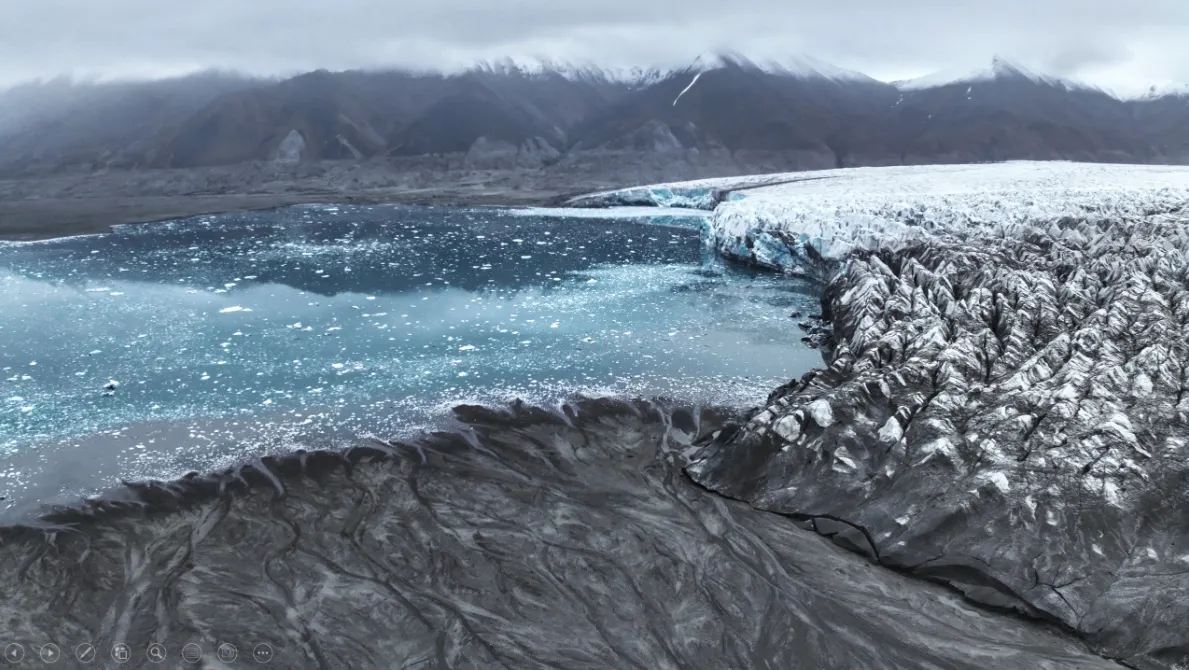
Earth’s mountain glaciers — not counting the enormous Greenland and Antarctic ice sheets — lost an average 273 billion metric tons of ice every year between 2000 and 2023, according to a study in Nature. The rate of loss accelerated 36% between the first and second halves of that period. In those 23 years, the planet lost about 5% of its glacier ice, with losses far greater in some regions. Higher elevations, including in the Himalayas, have warmed nearly 50% faster than the global mean since 1950.
A 2023 study in Science projected that even if warming were held to 1.5° degrees C (2.7°F) above the preindustrial level, roughly 49% of the world’s individual glaciers would disappear by 2100. At an unlikely 4°C (7.2°F) degrees, the loss rises to about 83%. A Nature Climate Change study published in 2025 reached an even more vivid conclusion. On the 2.7°C (4.86°F) warming trajectory it examined — that's the path most scientists estimate we're now on — about one-fifth of today’s glaciers would still exist at the end of the century.
For a while, melting glaciers can increase river flow. Then comes what glaciologists call "peak water." The amount of potential meltwater obviously declines as the glacier shrinks. The IPCC says many glacier-fed basins have already passed this point.
For agriculture, the arrival time of melt water matters almost as much as the total amount. A Nature Sustainability study of the Indo-Gangetic Plain found that in the Indus basin during the crucial pre-monsoon season, as much as 60% of irrigation withdrawals originate in mountain snow and glacier melt, and that water contributes an estimated additional 11% to total crop production. Another study, in Nature Climate Change, identified snowmelt-dependent agricultural hot spots across High Mountain Asia, Central Asia, the southern Andes, and elsewhere.
Nor will the consequences stop at the farm gate. The Indus Basin Irrigation System waters rice and cotton, crops deeply embedded in Pakistan’s export economy. Pakistan exported about $4.2 billion worth of rice in 2024, according to the World Bank. Cotton, meanwhile, supplies the textile industry whose products constitute several of the country’s largest export categories. Scientists studying the Ganges-Brahmaputra basin likewise warn that declining glacier meltwater can become crucial during the water-scarce, pre-monsoon season when cash crops are growing. Shrinking or increasingly erratic mountain runoff can therefore simultaneously reduce local food supplies, cut export earnings, and push commodity prices higher thousands of miles away. Farmers will be hammered. Global trade won’t insulate the rest of us from disappearing glaciers. It'll transmit some of the shock.
The diminished dry-season flows means straining drinking-water supplies, curtailing hydropower, altering rivers, damaging aquatic ecosystems, and fostering competition over water resources already stretched thin by drought and population growth. The burden, of course, will fall hardest not on the nations that burned the most coal, oil, and gas, but on those whose contribution to the climate crisis has typically been minuscule.
As glaciers shrink, meltwater can pool in new or expanding lakes, many held back by loose piles of rock and sediment rather than solid dams. Retreating ice removes support from steep mountain walls, while warming thaws permafrost that has helped cement fractured rock together. This can release an avalanche, landslide, or an ice collapse that sends water and debris over or through those barriers. Although the Nepali event was a bit different, a 2023 Nature Communications study estimated that 15 million people worldwide are exposed to the prospect of getting buried in one of these so-called glacial-lake outburst floods. Of those, 9.3 million live in High Mountain Asia. India, Pakistan, Peru and China alone account for more than half the global population at risk.
The exact cause of any single incident requires detective work. The trajectory of the underlying risk doesn't. The Hindu Kush Himalaya shows the scale of what's coming. An assessment by the International Center for Integrated Mountain Development found that glacier loss there accelerated 65% in 2011–2020 compared with the previous decade and warned that as much as 80% of the region’s glacier volume could disappear by 2100. The consequences will reach far beyond isolated mountain villages, disrupting the water, food, and energy systems on which huge populations across Asia depend.
Then there's the ocean. The Nature glacier assessment found that melting mountain glaciers raised global sea level about 18 millimeters between 2000 and 2023. The Science study projected another roughly 9 to 15 centimeters of sea-level rise from glaciers alone by 2100, depending on warming. Add thermal expansion of seawater and the vastly larger Greenland and Antarctic ice sheets, and every additional centimeter raises the platform from which storm surges attack coastal communities. From 2002-2022, Greenland had a net loss of 5 trillion metric tons of ice.
There is no credible single number for how many people the disappearance of the world’s glaciers will ultimately kill. Deaths will be scattered among floods, landslides, crop failures, water shortages, disease, displacement, and conflicts sharpened by scarcity. That makes the destruction less dramatic than a wall of mud roaring down a Himalayan valley, but no less real.
Science does offer one piece of good news, if that word can still be used here: glacier loss is strongly tied to how much hotter we make the planet. Every fraction of a degree avoided saves ice, water, ecosystems, and lives. We've already sentenced most glaciers to death. We can still save a few. It's a toss-up whether we will.






Comments
We want Uncharted Blue to be a welcoming and progressive space.
Before commenting, make sure you've read our Community Guidelines.