“The Colorado (River) Basin, then, is a few years away from permanent drought, and it will have to make do with whatever nature decrees the flow shall be.” — Marc Reisner, Cadillac Desert: The American West and Its Disappearing Water (1986)
"Mní wičhóni” — Lakota for “water is life.”
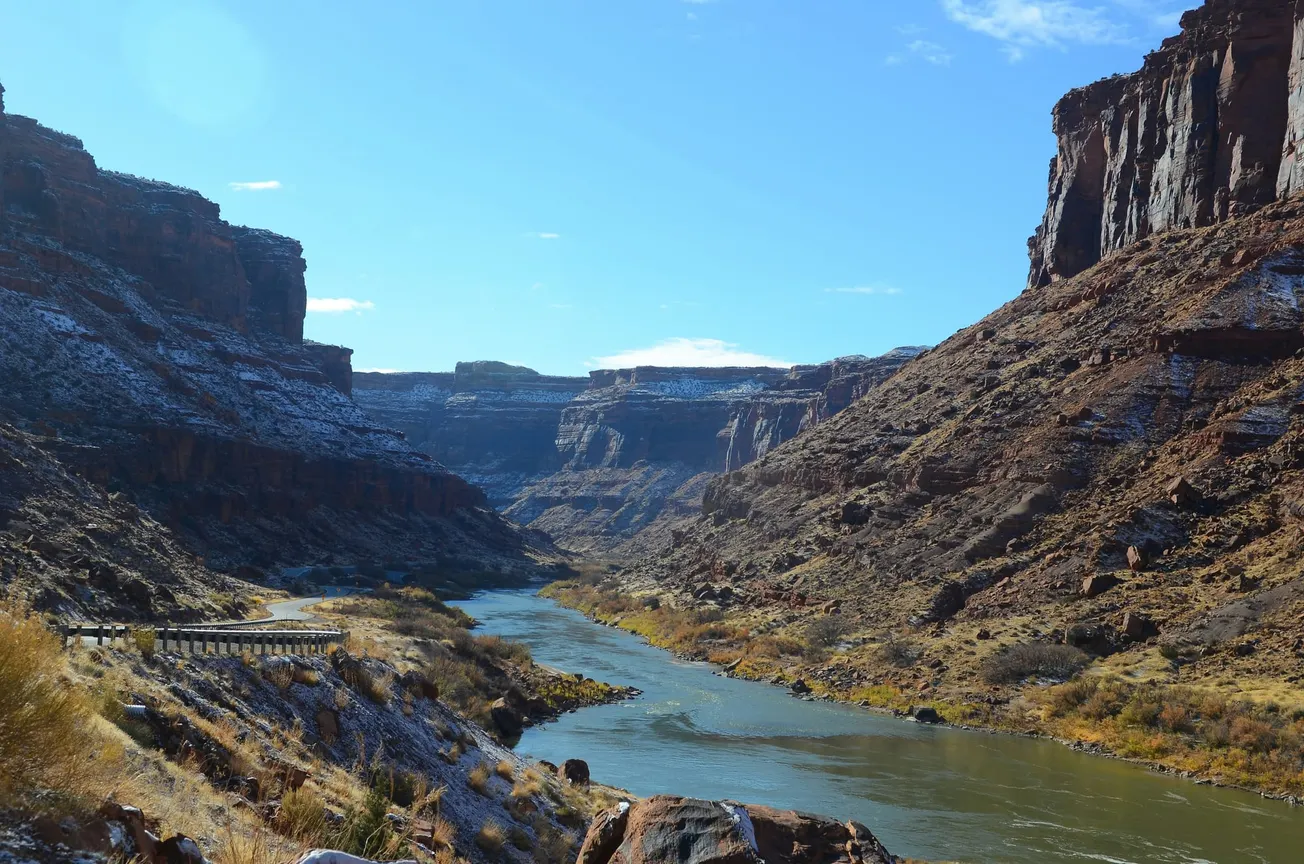
Summer 1982, after three decades living in Colorado, much of that time spent outdoors, I finally joined seven friends and acquaintances for something I had always wanted to do. For 16 days, we alternately paddled gently and roared down the Green River, then the Colorado River, through some of the most stunning natural wonders on the planet to the head of Lake Powell. Truly one of the most exhausting, exhilarating, and humbling experiences of my life. It sparked in me an eternal love of deserts and desert-adjacent places. They are not desolate wastelands. But their ecosystems are fragile, even if the life-forms surviving in them are resilient.
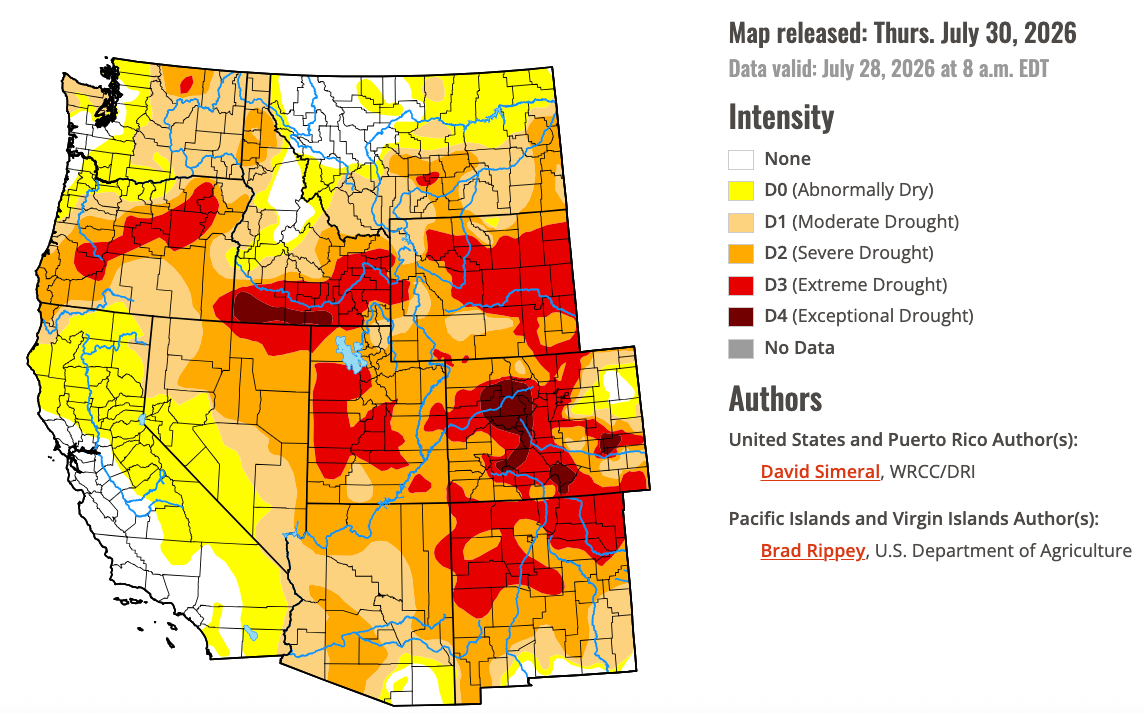
In the Southwest, these ecosystems are now under heavy stress from a quarter-century-long drought intensified by the climate crisis. Together, they have reduced the average Colorado River flow by nearly 20% since the turn of the 21st Century. The decline affects 40 million people in the United States and Mexico who depend on the river.
Lake Powell is the second-largest human-made reservoir in the United States, the sixth largest in the Western Hemisphere. The Glen Canyon Dam that has held back the lake's water since 1963 is, its foes have said for decades, a disaster, ecologically, archeologically, and otherwise, a project built of concrete, steel, and hubris. It was undertaken to provide a partner for Hoover Dam, which holds back Lake Mead. This was to ensure enough water was stored in wet years to meet in dry years the water allocation levels that the four Colorado River Upper Basin states of Colorado, Wyoming, Utah, and New Mexico owed under a century-old agreement governing deliveries to the Lower Basin states of Arizona, Nevada, and California. The two reservoirs are inextricably entangled with the lives and livelihoods of those millions of people and businesses.
As it turns out, the water allocations—laid out in the 1922 Colorado River Compact—were overly generous. A U.S. Geological Survey hydrologist who measured the river's flow more than 100 years ago warned that might be the case. He urged more caution about how big a bucket each state should be allowed to fill. And was ignored. Since then, the ballooning of agricultural, commercial, and residential development in all those states— 85% of whose territory is desert or semi-arid—has been partially premised on the promise of a never-ending supply of water, with some hydroelectric power thrown into the bargain. That promise might have proved true if it had been done with a light touch. But “take it easy” has never been part of the Manifest Destiny zeitgeist. If something is a good thing, then a super-duper-jumbo-ultra-ginormous version must be a great thing. And thus did the Southwest grow. The Phoenix metropolitan area quintupled to 5 million people in 60 years. Irrigated alfalfa is now grown in the desert.
My bones are too brittle and my reflexes too slow for a repeat ride down the Green and Colorado. But friends said it might be a lot tougher this year anyway. In early June, a couple of them sent photos of 14,000-foot Colorado mountains showing barely a hint of snow. When I took that river trip four decades ago, snow in the high country could linger many feet deep well into August. In fact, in the year after my trip, 1983, there was such a record-breaking season of snowfall—more than twice the average in parts of the Rockies—that those two colossal dams built by the federal Bureau of Reclamation to protect against floods, provide electricity, and smooth out the year-to-year variability of river flow, were nearly overtopped, and their spillways sustained structural damage.
This year, the river flow is at a record low. Lake Powell and Lake Mead each have dwindled to barely 30% of capacity. They're approaching the "dead pool" level at which they can no longer provide hydropower. These aren't sudden anomalies. This is the way things have been heading for decades. From 1975 to 1999, the Colorado River's natural flow hovered around an average of about 15 million acre-feet (MAF) a year, one acre-foot equaling 325,851 gallons. That was already well below the 17-to-18 MAF originally calculated to be available when the river compact was developed. The river had been overdrawn for a long time. However, since 2000, the annual average has fallen to about 12.4 MAF—a sustained decline of roughly 17%. Nobody will be surprised if it dwindles even more.
The worst part of this news is that, despite literally decades of warnings that something had to change or there would someday be a calamitous reckoning, only modest adjustments were made over the years, even as those who made them conceded they wouldn't be adequate. Since the seven compact states had in the past year failed to reach a mutual agreement on how to continue fulfilling the provisions of who gets what under the century-old arrangement, the bureau stepped in Friday and released its final proposal for operating the river system after current rules expire.
The bottom line: If the dry-out continues, California, Arizona, and Nevada could be forced each year through 2036 to cut their water consumption by 3 million acre-feet annually, almost a trillion gallons, enough to serve 25 million people. The bureau notes that the plan stresses flexibility and leaves room for the states themselves to work out future arrangements without bureau intervention.
It would be unfair to suggest that state and federal officials have done nothing to deal with dwindling Colorado River resources. They have, but their efforts have proved far from adequate. As a consequence, in addition to countless negotiating sessions, the authorities in charge and many of the people affected have no doubt spent sleepless nights wondering how the situation will ultimately pan out. All the more since water-dependent development in agriculture, industry, and residential expansion has continued in both the upper and lower parts of the basin.
Adding to this situation, there's far too little acknowledgment in policy circles that a rapidly changing climate isn't likely to reach stasis, a “new normal,” as long as we continue to pump gobs of greenhouse gases into our already overburdened atmosphere. If the current Southwest drought could be tied to an expectation that we will soon cycle into a few hundred wetter years before the next super-dry spell, then we could shelve this matter alongside other less-urgent worries. After all, that wet winter 43 years ago and others in the longer historical record indicate another wet period will come. But such optimism ignores the climate crisis that overlays a megadrought in a cycle that long predates industrialization. What is on the other side of the equals sign when you add out-of-control human-caused climate disruption to natural climate shifts?
It's getting hotter. Permanently so in terms of human life spans. "Mega" might not remain an adequate prefix for what's happening. The Colorado River Basin—and the whole Southwest—may not be headed for a wetter future in the lifetimes of anybody born this century. If so, energy-intensive desalination plants, pipelines, cloud seeding, and heightened conservation won't be enough to make up the difference.
When Congress approved Hoover Dam in 1928, creating Lake Mead, there was little worry about Colorado River water deficits. Scientists only had good flow data back to 1895, so determining the presence of a trend was difficult. The period chosen to determine future flow ran from 1895 to 1922, which was far wetter than average. By 1956, when Congress green-lighted Glen Canyon Dam, the evidence showed average flow was already less than what was allocated. This was confirmed repeatedly with fresh data throughout the 1970s and 1980s. More recent studies indicate that megadroughts are typical in the region. Tree-ring studies show that the current drought—now 26 years old—is drier than any since at least the Great Drought of 1276-1299. That dry-out 800 years ago forced a southward migration of the Ancestral Pueblo and other Native peoples, including those who abandoned Mesa Verde's cliff dwellings. The Great Drought broadly overlaps the same ground as the Colorado River Basin.
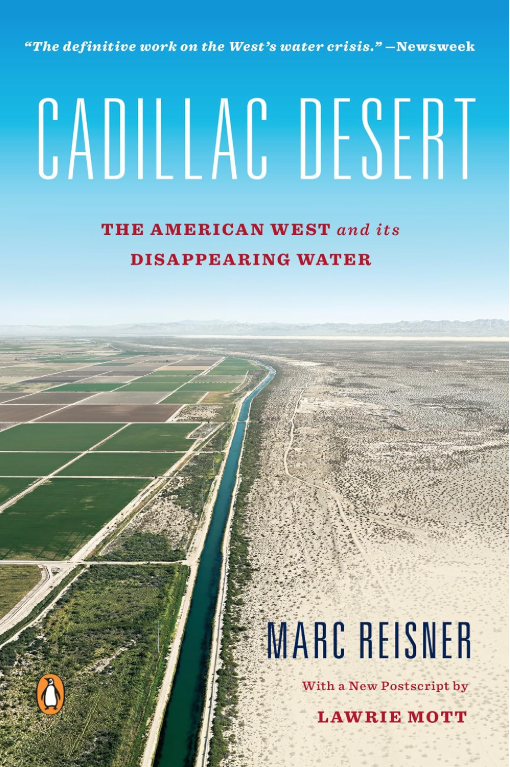
Marc Reisner's brilliant, prescient Cadillac Desert was published in 1986, before climate change had become the organizing principle of every serious discussion about water in the American West. He wrote before the term “megadrought” entered the public vocabulary. Before Lake Mead acquired its now-famous “bathtub ring” showing how high the water had been not long ago. Decades before the Bureau of Reclamation found itself preparing to force the most sweeping reductions in Colorado River deliveries since the states first carved out their portions. Reisner predicted the crisis now unfolding with unsettling precision. The engineers had accomplished feats that bordered on the miraculous. They bent rivers around mountains, carved canals through deserts, and made possible giant cities and agricultural powerhouses. Hoover Dam, Glen Canyon Dam, the All-American Canal, the Central Arizona Project—these became monuments to a national conviction that every obstacle yielded to enough concrete, steel, and federal appropriations.
Reisner's great insight was that these giant marvels of the Southwest had been built at an extraordinarily wet moment in the Colorado River's history. This abundance had been taken for its eternal character. Everything built for decades afterward rested on the illusion that the flow was stable when averaged over a handful of years. Cities multiplied. Millions of acres of farmland came under irrigation. Political expectations hardened into legal entitlements. Growth became destiny. The bureau did what it had always done: promise that one more dam, one more diversion, one more canal could postpone the reckoning a little longer. For decades, it worked—or appeared to.
There was an attitude suffusing the bureau. Reisner wrote that in the 1920s, at a banquet recalled years later by Horace Albright, then superintendent of Yosemite National Park, William Mulholland, the legendary chief engineer of the Los Angeles Aqueduct, had said:
“Well, I’ll tell you. You know this new photographic process they’ve invented? It’s called Pathé. It makes everything seem lifelike. The hues and coloration are magnificent. Well, then, what I would do, if I were custodian of your park, is I’d hire a dozen of the best photographers in the world. I’d build them cabins in Yosemite Valley and pay them something and give them all the film they wanted. I’d say, ‘This park is yours. It’s yours for one year. I want you to take photographs in every season. I want you to capture all the colors, all the waterfalls, all the snow, and all the majesty. I especially want you to photograph the rivers. In the early summer, when the Merced River roars, I want to see that.’ And then I’d leave them be. And in a year I’d come back, and take their film, and send it out and have it developed and treated by Pathé. And then I would print the pictures in thousands of books and send them to every library. I would urge every magazine in the country to print them and tell every gallery and museum to hang them. I would make certain that every American saw them. And then,” Mulholland said slowly, with what Albright remembered as a vulpine grin, “and then do you know what I would do? I’d go in there and build a dam from one side of that valley to the other and stop the goddamned waste!”
For nearly a century, the bureau measured success by expansion: more water delivered, more land irrigated, more cities supplied. Today, it decides whose deliveries will be cut, whose expectations must shrink, and how to manage decline without provoking economic or political collapse. The agency that once promised abundance has become the referee of scarcity.
Forty years ago, Reisner looked across the river basin and saw civilization pretending it had conquered a desert. He pointed out:
“Throughout its history, the conservation movement had been little more than a minor nuisance to the water-development interests in the American West. They had, after all, twice managed to invade National Parks with dams; they had decimated the greatest salmon fishery in the world, in the Columbia River; they had taken the Serengeti of North America—the virgin Central Valley of California, with its thousands of grizzly bears and immense clouds of migratory waterfowl and its million and a half antelope and tule elk—and transformed it into a banal palatinate of industrial agriculture.”
Amid all this destruction, the bureau had promised more water than the river could ever reliably provide and in the process greatly altered ecosystems benefiting some humans but not many other creatures. What Reisner only partly foresaw was who all would be asked to pay the bill when those promises came up short. Once again, it was and is the Indian nations being told to wait, to negotiate, to compromise, while others argue over water that was allocated generations before many Indigenous water rights were even acknowledged. Today, the bureau has proposed the deepest restructuring of Colorado River operations in decades. This is largely viewed as a contest only among states. In deliberations over future water allocations, tribal nations are too often treated as nuisances rather than sovereign peoples. That's one of the oldest habits in the American West.
Many tribes still lack the infrastructure to use the water to which courts have long recognized they are entitled. Without access, they must lease their water rights to others because canals, pumps, and pipelines were built for farms and cities instead of Native communities. In the richest country on Earth, some Navajo families still haul drinking water while alfalfa fields hundreds of miles away receive subsidized irrigation. The promise of the dams was never a promise to the tribes.
Beyond this latest crisis, water policy cannot depend solely on bigger conservation targets or new allocation formulas. It cannot go on without recognizing that tribal nations aren't a special interest competing for leftovers. Many hold knowledge of living with aridity stretching back centuries, in many places millennia. Long before the first federal survey crews drove their stakes into the Colorado Plateau, Native peoples had already learned the lesson the Bureau of Reclamation is only now being forced to acknowledge: a river, even a dammed one, is not an unlimited resource. It's a living system with constraints that demand humility as much as ingenuity.
The Hohokam people engineered hundreds of miles of canals through the Salt and Gila river valleys of what is now Arizona, among the most sophisticated irrigation works in North America before European contact. Pueblo communities developed and maintained the canals the Spanish called acequias, an irrigation system that distributed water according to communal rules and reciprocal obligations rather than maximizing consumption. Many are still in use. Across the Colorado Basin and the broader Southwest, long before the arrival of Europeans, Indigenous peoples employed floodwater farming, spring protection, seasonal movement, terracing, check dams, and careful watershed stewardship, adapting their communities to the rhythms of the land instead of insisting that the land conform to their ambitions. Those systems were not perfect, nor were they immune to drought or social conflict. But they reflected a fundamentally different premise from those who built the dams: prosperity depended upon staying within the river's capacity to give.
For roughly a century, the Bureau of Reclamation and its backers promised that concrete, pumps, and political muscle could free the Colorado River from the constraints of climate and geography. The result was an astonishing achievement of engineering. Today, as state and federal officials decide which allocations must shrink and which expectations must yield, the question is no longer whether we possess the engineering skill to move water wherever we wish. It is whether we possess the wisdom to live, at last, within the means of the river itself.
OTHER THINGS TO READ:
Hoover Dam Approaches a Hydropower Cliff
Colorado River Water Woes Threaten Arizona’s AI Boom




Comments
We want Uncharted Blue to be a welcoming and progressive space.
Before commenting, make sure you've read our Community Guidelines.