


The Environmental Protection Agency was created to, among other things, protect Americans from pollution. Under Donald Trump and EPA Administrator Lee Zeldin, it is being repurposed as something closer to a concierge service for polluters. In the latest installment of its efforts to gut environmental regulations, the regime reportedly will today issue its final rule that erases federal limits on carbon pollution from fossil-fuel power plants. Electricity generation is already the nation’s second-largest source of planet-heating pollution. Expect lawsuits.
President Barack Obama tried in 2015 to put limits on power plants' carbon pollution in place but was blocked by the courts. President Joe Biden successfully imposed limits by deliberately designing them to work around the judicial ruling by regulating emissions at individual plants rather than recreating Obama’s systemwide approach that courts had given the thumbs-down.
No replacement rule. No lesser carbon limit. No pretense that coal and methane gas plants ought to restrain the heat-trapping waste they dump into the atmosphere. As with previous Trump decisions, the policy is, in effect: Burn what you want. The climate can eat it. And the people can just lump it.
This is not ordinary deregulation, the ancient ritual in which industry complains that a rule costs too much and its political servants shave it down. Trump’s EPA has gone further, declaring the pollution itself legally insignificant.
The maneuver did not come out of nowhere. Seven months ago, Zeldin took a sledgehammer to the scientific and legal foundation of federal climate regulation by rescinding EPA’s 2009 endangerment finding. This had been a decade-long goal of the rightwing and an item for action in Project 2025. Issued after the Supreme Court ruled in Massachusetts v. EPA (2007) that said the agency must restrict greenhouse gas emissions if they are determined to be harmful air pollutants under the Clean Air Act, the EPA did so determine. It said carbon dioxide and five other heat-trapping gases threaten the health and welfare of current and future generations. And therefore, it was obligated to regulate them.
Nothing in atmospheric chemistry has changed between 2009 and 2026. Carbon dioxide did not suddenly stop warming the planet. Wildfires, floods, droughts, rising seas, and lethal heat did not disappear. Rather the contrary, as we've all seen. What changed is who controls the EPA. The fossil fuel industry clearly has the upper hand. On Feb. 12, 2026, when Zeldin revoked the endangerment finding, he also cut back on greenhouse-gas standards for cars and trucks that depended on it — proudly advertising the act as the “single largest deregulatory action in U.S. history.”
The New Republic described that move as gutting EPA’s power to fight climate change; Lisa Patel of the Medical Society Consortium on Climate and Health said it “prioritizes the profits of big oil and gas companies and polluters over clean air and water” and human health.
The scam behind killing power-plant standards is almost verbatim the attack on vehicle emissions regulation. EPA argued then that regulating those tailpipe emissions could make only a tiny measurable difference in eventual global temperature, so the agency need not regulate them. Now it says U.S. power plants also produce too small a portion of global greenhouse pollution to “significantly contribute” to the danger. Follow that logic to its destination and practically nobody on Earth is responsible for climate change: not this power plant, not that refinery, not these cars, not those oil wells, because each is only a fraction of the whole. It is a regulatory version of Everybody did it, therefore nobody did it — an argument that would make virtually any cumulative pollution problem impossible to regulate. EPA has not disproved the danger. It has devised an excuse for refusing to do anything about it.
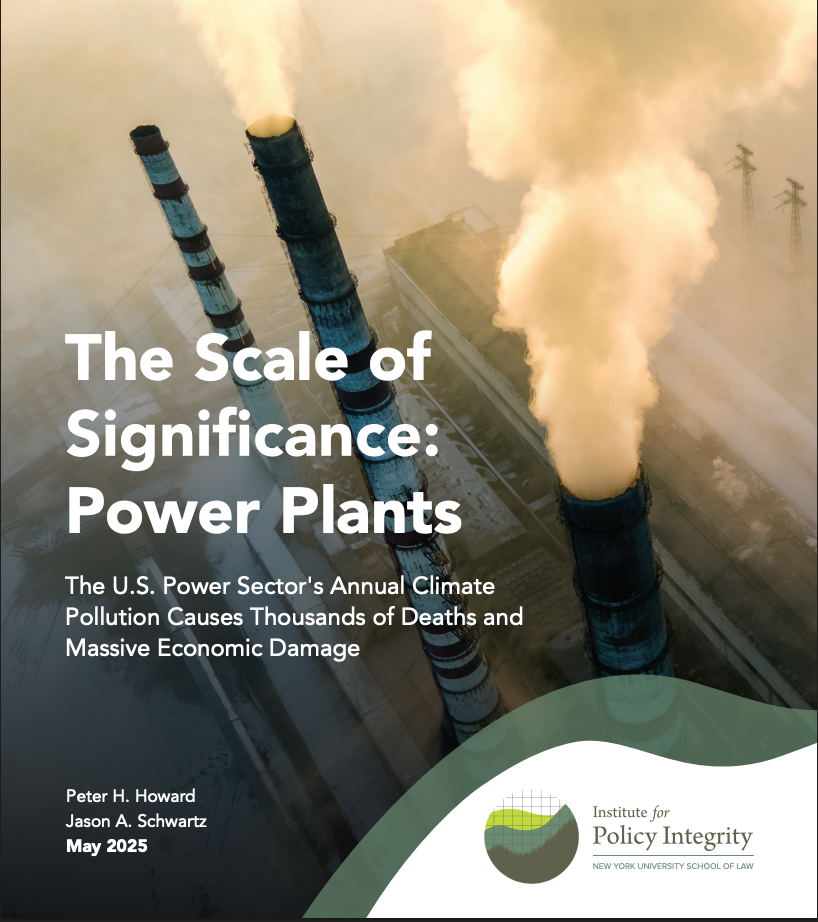
Heatmap’s Emily Pontecorvo points out the subterfuge buried in that too-small-to- regulate arithmetic: Electricity accounts for about 25% of U.S. greenhouse-gas emissions, and American power plants have produced roughly 5% of global climate pollution over the past 30 years. If the U.S. power sector were a country, an NYU Institute for Policy Integrity analysis found, it would be the world’s sixth-largest emitter. David Doniger of the Natural Resources Defense Council has called EPA’s logic a “wacky reversal and a wacky interpretation of the Clean Air Act.”
It is the moral mathematics of the getaway driver: My share of the crime was just a fraction of the total, so why hold me responsible?
The Biden rule Trump is scrapping was hardly revolutionary. It sensibly required the longest-running coal plants and heavily used new gas plants to make deep reductions in carbon pollution, relying heavily on carbon capture, or retire on a timetable. EPA projected the standards would prevent 1.38 billion metric tons of carbon pollution through 2047 and produce as much as $370 billion in climate and public-health benefits. In 2035 alone, the agency estimated the standards could prevent up to 1,200 premature deaths, 1,900 new cases of asthma and 360,000 instances of asthma symptoms.
Those are not abstractions. They are lungs. Hearts. Children missing school. Workers missing shifts. Families sitting in emergency rooms while some utility executive’s compliance costs appear on the other side of a spreadsheet.
Zeldin prefers the spreadsheet to the people and the environment. When he proposed the repeal in June 2025, he advertised $19 billion in savings to the power industry over 20 years. Inside Climate News reported that EPA’s own analyses of the carbon and mercury rollbacks told a rather less convenient story: industry savings from the pair of repeals was dwarfed by an estimated $130 billion in increased public-health costs. Asked how he could justify that arithmetic, Zeldin replied, “How do you justify not doing this action?”
Meanwhile, this same regime that worships at the altar of the “free market” is trying to use presidential emergency powers to force aging coal plants to stay open. It hasn't been smooth sailing. On Sept. 11, a unanimous federal appeals court struck down an Energy Department order keeping Michigan’s J.H. Campbell coal plant running, finding the administration exceeded its authority. That same day, Energy Secretary Chris Wright issued another emergency order directing Washington state’s Centralia coal plant to remain available through Dec. 11. Ysabelle Kempe at Canary Media writes:
So far, the Trump administration has leveraged federal emergency powers to force seven old fossil-fueled power plants — all but one of them coal-fired — to stay online, claiming that they are crucial to maintaining grid reliability. The thing is, state regulators, utilities, and grid operators had already deemed those polluting facilities unnecessary and spent years planning for their retirement. Some plants are even broken or have sat idle because the grid doesn’t actually need their pricey power.
Coal is a really expensive source of energy, and everyday Americans will likely be the ones to foot the bill for President Donald Trump’s crusade to prop up the faltering industry. The total cost of the administration’s stay-open orders sits at roughly $552 million as of Sept. 14, according to a running tally from the Sierra Club.
So, Mr. Zeldin, spare us the hymn to cheap energy and consumer freedom.
The planet will not succumb to your legal wordplay. Carbon dioxide does not stop trapping heat because an EPA lawyer declares America’s contribution “insignificant.” Floodwater does not ask whether a coal plant’s emissions crossed some newly invented statutory threshold. A heat wave kills without caring who won the argument at the Supreme Court. Physics keeps the books. And unlike your version of the EPA, it doesn't cook them.














Comments
We want Uncharted Blue to be a welcoming and progressive space.
Before commenting, make sure you've read our Community Guidelines.