

In August 2020, the Senate Intelligence Committee released the final volume of a long-running investigation to little fanfare. At the time, the Democratic convention was in full swing, with Joe Biden receiving the party's nomination on the same day the report appeared. Not even a line about the report appeared on the New York Times front page.
A full year and a half after the Mueller report had proven to be disappointingly incomplete, the news media seemed to have little appetite for a warmed-over senate report on an election now in the rearview window, or a president who had by then sunk to a 38% approval rating. In the middle of a raging pandemic that killed 30,000 Americans that month, the report was mostly lost amid the panic. The Republicans then in charge of Senate, including committee chair Marco Rubio, were happy to see their work go down with barely a ripple..
Which was a shame. Because that report on Russian interference in the 2016 election seemed to confirm every theory and rumor that had circulated over the previous four years.
The Committee found that the Russian government engaged in an aggressive, multi-faceted effort to influence, or attempt to influence, the outcome of the 2016 presidential election.
The Russians undertook this intervention "to benefit then-candidate Donald Trump." Trump campaign manager Paul Manafort met repeatedly with Russian oligarchs such as Oleg Deripaska and Kremlin intelligence officer Konstantin Kilimnik. And what he offered them was clear six years ago:
Manafort also discussed with Kilimnik a peace plan for eastern Ukraine that benefited the·Kremlin. At Yanukovych's direction, Kilimnik sought Manafort's assistance with the plan. Manafort continued to work with Kilimnik on the plan—
The remaining details of this agreement are redacted. What's not redacted is what Trump's team was offered—derogatory information about Hillary Clinton. This information was "eagerly" sought by Trump and his team.
After Trump's win in the election, Manafort continued to meet with Kilimnik, and to share with the Russians classified information provided to Trump. Working with the Russians, Manafort helped develop details of a "peace plan for Europe“ on terms thar boosted Russia. In particular, Manafort promised to use his contacts and Trump's new position to "undermine the Ukrainian government."
Taken as a whole, Manafort's high-level access and willingness to share information with individuals closely affiliated with the Russian intelligence services, particularly Kilimnik, represents a grave counterintelligence threat.
Russia didn't just interfere in the 2016 election in order to put a weak, greedy, and easily influenced man into the White House—though that was certainly part of it. The primary thing Vladimir Putin sought from Trump in 2016 was using the leverage of the United States to force Ukraine into surrendering its territory to Russia.
That has not changed.
What Trump is doing now is a fulfillment of promises he made to Putin a decade ago. Because "Russia, Russia, Russia" was always very real, real, real.
Fox News may be little more than an auxiliary wing of Trump's propaganda team, but even they are having a hard time finding anything good about Trump's deal to buy Russian diesel, his overt betrayal of Ukraine, and his eagerness to assist his old partner, Putin.
The administration's decision to temporarily ease restrictions on Russian diesel has drawn opposition from Republicans on Capitol Hill and skepticism over whether the move will meaningfully lower prices for Americans.
Meanwhile, Russia has offered few public signs of concessions in return.
The amount Trump promises to buy is so small that it cannot possibly affect the price of diesel in the United States. However, it's a nice payday for Putin. The first tranche will inject $450 million into Russia's failing economy. The full deal will hand over roughly $6.4 billion—money that will go straight into attacking Ukraine.
Trump's suspension of sanctions against Russia also means that other nations are no longer under any threat of consequences for snapping up Russian diesel. None of this is likely to have any affect on the overall market for diesel fuel. However, it will "bolster Russia economically and further strain transatlantic unity."
Following the announcement of his purchase, Trump declared an "energy ceasefire" that permitted the killing of civilians but protected oil wells, which is certainly among the most perverse ideas in the history of warfare in any age. But Putin promptly ignored Trump's pretense of being in charge and carried on his campaign of attacking both Ukrainian infrastructure and civilians.
Trump then colluded with Elon Musk to deprive Ukraine of both intelligence and the internet services necessary to protect Ukrainian citizens against Russian missiles. Musk has blamed Trump for crippling military Starlink in Ukraine. Trump has blamed Musk. But it seems that both were involved in this deep betrayal of trust that has already cost Ukrainian lives.
It's clear that all this was done to assist Putin. But there's one question no one seems to be asking: Why now?
Why would Trump unfold this act of sheer duplicity just weeks before the midterm elections when even the dimmest of dim bulbs had to understand that throwing support to Putin would not be popular, even with his own party. His capitulation to Putin has attracted the ire of several Republicans who know their voters aren't thrilled about supporting a nation that's helping Iran kill American troops.
Trump was already aware enough to say that he was delaying further attacks on Iran until after the midterms. Why not wait on making his deal with Russia?
Here’s one good possibility. This is an area of eastern Ukraine at the beginning of September.
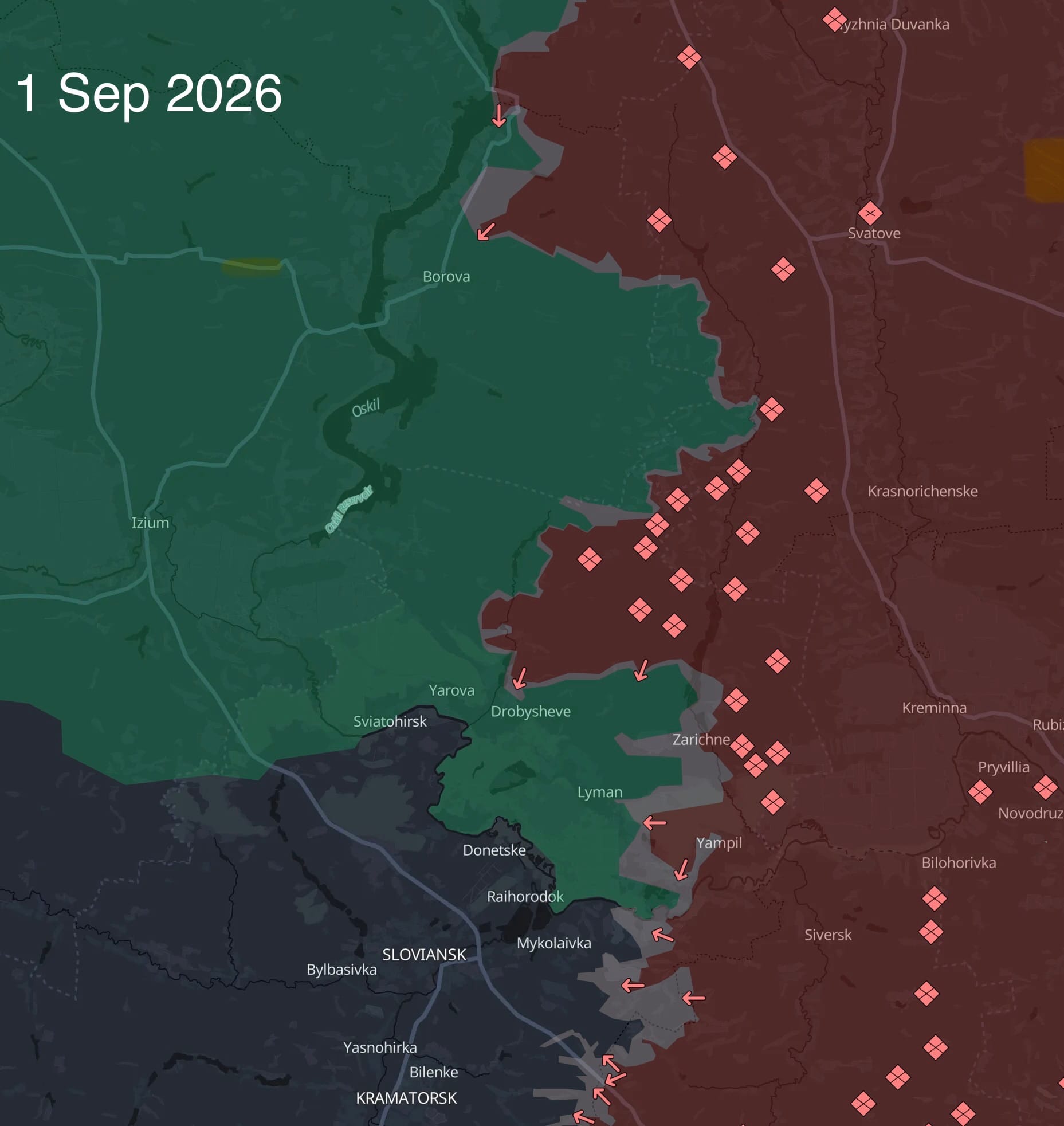
Those who have followed this war for some time may recognize the green area as the some of the territory liberated by Ukraine in its lightning counteroffensive in the fall of 2022. In 2024, Russia renewed its attacks of the Kharkiv region, recapturing some of the liberated territory. Throughout 2026, Russian forces have conducted a grinding advance in the area north of Lyman, creating the large salient near the center of the map. Russia surged forces into this area, planning to retake Lyman and surrounding villages.
Only that’s not what happened. Because this is how that area looks today.
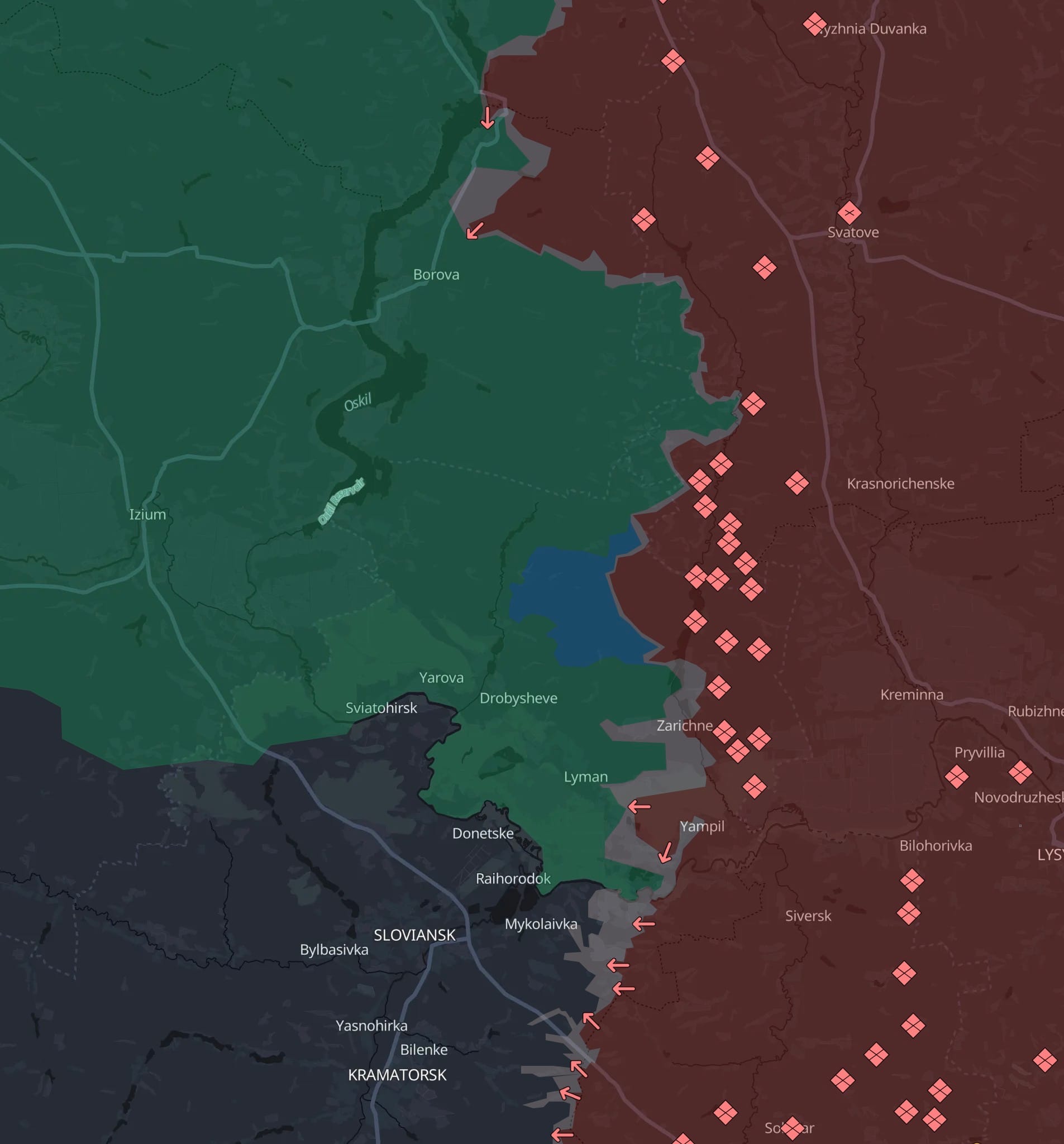
Operation Vivaldi, conducted in four phases over September and October, has resulted in over 3,000 Russian casualties and the liberation of at least 16 towns and villages. Ukrainian forces fell on the salient from three sides, tearing it apart, capturing hundreds of Russian prisoners, and taking back over 270 sq. kilometers.
Beyond its immediate and obvious success, the importance of Operation Vivaldi can’t be overstated. This was the first operation, on either side, that showcased new tactical innovations using a mix of drones and combined arms. This was a new model of warefare.
To achieve this victory, Ukraine’s 3rd Army united electric warfare that suppressed the operation of Russian drones, FPV and high speed drones hitting targets at varying distances, and ground drones breaking trail for the human forces behind them. Some of those ground drones were even carried to the front by companion aerial drones.
Ukraine’s victory was decisive. For the first time since FPV drones began to dominate the battlefield, one of the combatants has found a way to advance quickly without taking sustainable casualties, in spite of opposing drone defenses
Vivaldi was a trial run. Ukraine can do it again. Better. Larger. And Russia is unprepared to face large scale deployment of these Ukrainian tactics.
Why is Donald Trump showcasing his amoral betrayal right now? Because right now is when Vladimir Putin needs him. Whatever leverage Putin holds over Trump, it seems likely it got used.









Comments
We want Uncharted Blue to be a welcoming and progressive space.
Before commenting, make sure you've read our Community Guidelines.