
From Jacobin to The Bulwark, from The Lever to Politico, from The New York Times to The Guardian and from what seems like half the world's politically focused Substacks, Tuesday's wondrous victory at the polls has generated a mountain of what-Democrats-should-do-now and what-Democrats-must-not-do-now commentary.
I'm not whining about it. The generational disaster we just saw unfold for a Republican Party traveling the racist, fascist, misogynist, classist, imperialist road deserves serious evaluation, not just reiteration of confirmation bias. Was this a victory for progressive Democrats? Yes. Was it a victory for moderate Democrats? Yes. That conundrum is going to ignite a lot of wrangling between now and January when the massive new majority is sworn in. And well beyond. Expect sparks. Democratic Party division, in various forms, is ancient in political terms, more than a century old. In each era, it plays out differently, but with echoes. It's anyone's guess — and there's a lot of guessing going on — how this division will affect the broad party unity that brought victory this year and is essential if a repeat blunami is to be had in 2028.
Today I'm not going to add to your saturation levels with any of the big-picture stuff, but focus instead on a change that has barely gotten a mention, but still matters.
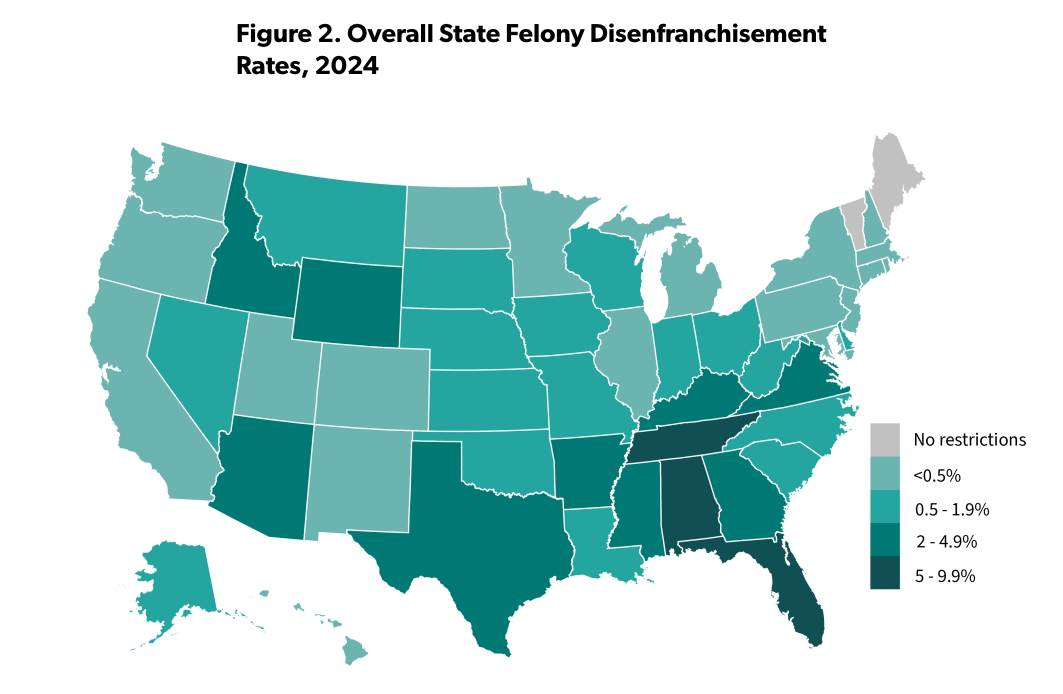
In Virginia this week, citizens voted 57% to 44% for Question 3, which demolished a constitutional system of lifetime disenfranchisement for people convicted of felonies, rooted in the state's Jim Crow constitution of 1902. Since then, only the governor has been able to restore an individual's voting rights. Beginning January 1, only those felons still incarcerated will be barred from voting. After release, their voting rights will be restored automatically.
That brings Virginia into line with a large majority of the country. Forty states provide automatic restoration of voting rights to at least some people convicted of felonies, although the requirements vary considerably. Maine and Vermont, along with Washington, D.C., never take away the right to vote in the first place. But Mississippi and Tennessee retain constitutional provisions for lifetime disenfranchisement following a felony conviction, and other states, including five former slave states, aren't much better.
Felony disenfranchisement was not invented by the former Confederacy. It has antecedents in English law and existed in parts of the United States decades before the Civil War. But after Reconstruction was crushed 150 years ago, Southern political leaders deliberately transformed criminal disenfranchisement into a legal method of suppressing Black voting. Many of the restrictions imposed during that era survived the civil rights victories of the 1960s.
Mississippi's Constitution of 1890 got the ball rolling. Delegates selected crimes for lifetime disenfranchisement based partly on racist assumptions about which offenses Black people were more likely to commit. It was a calculated effort to legally reestablish antebellum white domination while avoiding explicit racial qualifications for voting.
Mississippi's system became an influential model elsewhere in the South. And it worked. Black political participation plummeted. This suppression was backed up with violence or the threat of it. The ballot box was surrounded by a wall of restrictions, intimidation, and terror designed to ensure that emancipation would not mean political equality. In June 1964, some 28,500 Black Mississippians were registered to vote — just 6.7% of the state's roughly 425,000 eligible Black voters. By comparison, 500,000 white Mississippians were registered, representing about 70% of eligible white voters. At the time, the Ku Klux Klan was still killing people who tried to persuade Black people to register to vote.
The felony voting ban wasn't the only factor in suppressing the Black vote, but an integral part of the system of American apartheid. The ban remains on the books today although courts and state officials have modified its application over the decades. For those still permanently disqualified, restoration requires either a gubernatorial pardon or a two-thirds vote of both chambers of the state legislature. A 2021 report submitted to Congress by the Southern Poverty Law Center found that only 335 of 166,494 Mississippians who had completed felony sentences between 2000 and 2015 had had their voting rights restored. In the 28 years from 1997 through 2024, the legislature restored voting rights to only 207 people. In 2025, not one of the 96 individual restoration bills introduced made it through the legislature.
Prison reformers are the loneliest activists in the world, a man who had long been one once told me. It's not easy to find allies. Even some of your friends look askance. Some of the people your efforts help are deeply unsavory. So restoring voting rights to people convicted of felonies is scarcely anyone's top priority at any time, much less when we're in the grips of multiple crises, from corruption to climate change, from unaffordable groceries to unacceptable health care premiums, from neighborhood-destroying, electricity- and water-gobbling data centers to a 1% whose wealth is beyond obscene while kids are thrown off food stamps. But the scale of felony disenfranchisement should command more attention than it gets.
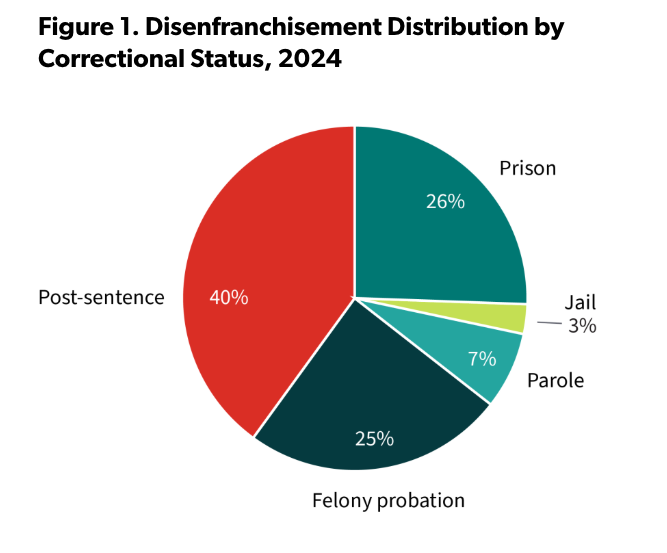
In its 2024 Locked Out report The Sentencing Project estimated that 4 million Americans had been stripped of voting rights because of felony convictions. Nearly three-quarters were not incarcerated. Indeed, 40% had fully completed their sentences, yet were still barred from voting. These are people working, raising families, paying taxes, serving their communities, and living under laws they have no say in making.
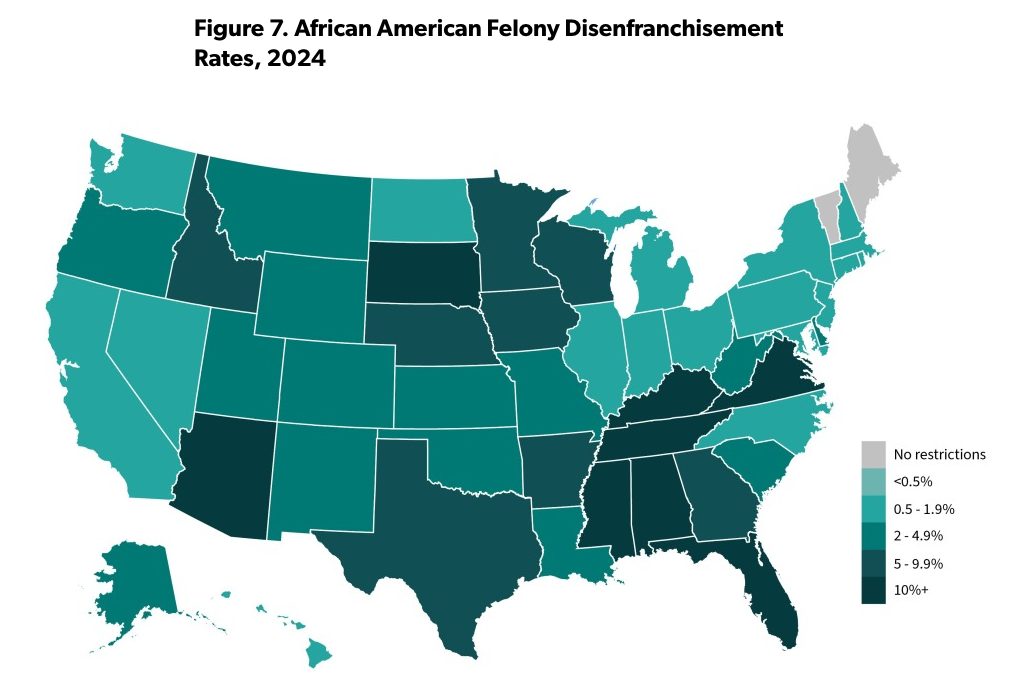
The burden is far from equally distributed. The study estimated that 4.5% of voting-age Black Americans were disenfranchised, compared with 1.7% of the overall voting-eligible population. In Florida, the figure for Black adults was nearly 13%. These disparities reflect not only the history of voting restrictions, but also the racial inequities embedded throughout the criminal justice system. A conviction that might mean several years of incarceration can afterward impose decades of political silence.
Virginia's amendment is therefore a welcome advance. But eight states still have policies that require additional burdensome procedures to restore voting rights, and several others retain narrow exceptions to otherwise automatic restoration.
Five of those eight — Alabama, Delaware, Florida, Mississippi and Tennessee —were slave states. The other three are Alaska, Arkansas, and Louisiana. Arizona, Iowa, Kentucky, and Wyoming also retain significant restrictions or exceptions, even though some people convicted of felonies qualify for automatic restoration.
In Alabama, a conviction for a felony involving what the state calls moral turpitude can mean losing voting rights indefinitely. Most people convicted of disqualifying crimes must apply to the state Board of Pardons and Paroles for restoration after completing their sentences and meeting financial requirements. Certain serious convictions require a governor's pardon. The state's use of the subjectively defined moral turpitude has a long and ugly history. Only in 2017 did legislators finally specify which crimes that actually covers.
Delaware automatically restores voting rights after sentence completion for most felonies, but people convicted of murder, bribery, and certain sexual offenses face permanent exclusion unless pardoned. Florida's voters overwhelmingly approved Amendment 4 in 2018, restoring voting rights after completion of sentence for most people convicted of felonies. However, Republican Gov. Ron DeSantis and the legislature subsequently made payment of outstanding court-imposed fines, fees, and restitution part of the eligibility requirements. A person who cannot pay remains unable to vote, even after serving every day of incarceration and mandated supervision after release.
Tennessee has an especially convoluted system, with eligibility depending on the offense and when the conviction occurred. Some people can seek restoration through the courts, subject to conditions that may include payment of restitution and compliance with child-support orders. Others are permanently barred. In some cases, even a pardon is insufficient.
In Arizona, most people with a first felony conviction automatically regain voting rights after satisfying sentence requirements, including restitution, but those with multiple felony convictions generally must seek judicial restoration. Wyoming automatically restores rights for many nonviolent felony convictions, but excludes others and imposes different procedures depending on when and where the conviction occurred.
In two states, executive orders have overridden harsher restoration rules. In Iowa, Republican Gov. Kim Reynolds made headlines with her 2020 executive order restoring rights after completion of sentence for most felony convictions, except homicide offenses. That's still the way of things in the Hawkeye state.
However, Kentucky's record on the matter demonstrates the problem with executive orders. In 2019, Democratic governor Andy Beshear issued an order restoring voting rights to most people convicted of nonviolent felonies who had completed their sentences. This was the second time round for such a move. In November 2015, Andy Beshear's father, then-Gov. Steve Beshear, issued a similar order, only to have his Republican successor, Matt Bevin, rescind it less than a month later. Four years afterward, Andy Beshear defeated Bevin and reimposed the policy. That's the problem with leaving a fundamental constitutional right to the whims of whoever occupies the governor's mansion.
The arguments against automatic restoration are familiar. Opponents say that losing the right to vote is an appropriate consequence of serious criminal behavior, that people should demonstrate rehabilitation, and that obligations to victims should be satisfied before political rights return. During Virginia's amendment debate, Republican House Minority Leader Terry Kilgore said he would have preferred distinctions between violent and nonviolent crimes and requirements for paying restitution. "I think the end result is going to be that we're going to leave our victims and our state high and dry," Kilgore said.
These objections deserve examination, but none establishes why voting should be withheld after incarceration. Restitution remains legally enforceable whether or not somebody can vote. Neither a prison sentence nor a felony conviction makes a citizen immune from taxation, public policy decisions, or the other obligations of citizenship. There is no persuasive reason to believe that denying somebody a ballot somehow strengthens their rehabilitation.
People returning from prison are expected to find jobs, support families, obey laws, participate constructively in their communities, and become responsible citizens. This clashes with states that tell them they cannot participate in the most basic act of citizenship. They are deemed responsible enough to pay taxes but not responsible enough to help choose the officials who levy them.
Virginia Democratic Del. Cia Price put the matter plainly during the campaign: "When someone walks out from incarceration, they have moved on into the next phase of their lives, and I think that that is important that they come back to our communities as full citizens."
There is also the question of who gets to decide whether someone has been sufficiently rehabilitated. Governors? Parole boards? Judges? Politicians who know nothing about the person seeking restoration except the entry in a criminal record? Making voting contingent on individual approval transforms a right into a favor bestowed by officials who can be arbitrary, indifferent, or politically motivated.
The United States is unusual among democracies in the breadth and persistence of its felony disenfranchisement laws. Canada permits incarcerated prisoners to vote. So do several European countries, while others impose restrictions that generally are more limited than lifetime exclusion. Maine and Vermont have demonstrated for generations that allowing people to vote from prison is compatible with functioning elections and criminal justice systems.
No one needs to pretend that people convicted of serious crimes are harmless or that victims' suffering is inconsequential. Criminal punishment serves legitimate purposes. But denying a person the right to vote for years or decades or forever after imprisonment accomplishes nothing that those purposes can justify. Nor should the right depend on whether a former prisoner can afford to pay a legal debt that another, more affluent prisoner could settle immediately.
The right to vote is not a certificate of good behavior. It is not a prize for pleasing a governor or a reward reserved for people who have never broken the law. Democracy does not require citizens to be virtuous, admirable or even particularly sensible before they can participate. If it did, there would be a great many empty chairs in Congress.
Virginia has taken an important step toward recognizing the distinction. Its voters have removed from the governor's hands the power to decide which formerly incarcerated citizens may participate in elections. The remaining states should too.
The vast majority of incarcerated people eventually return to our communities whether politicians approve of them or not. They live with the laws enacted in their names, the taxes imposed on their earnings, and the decisions made about the futures of their children. Denying them a ballot does not make the rest of us safer.









Comments
We want Uncharted Blue to be a welcoming and progressive space.
Before commenting, make sure you've read our Community Guidelines.