

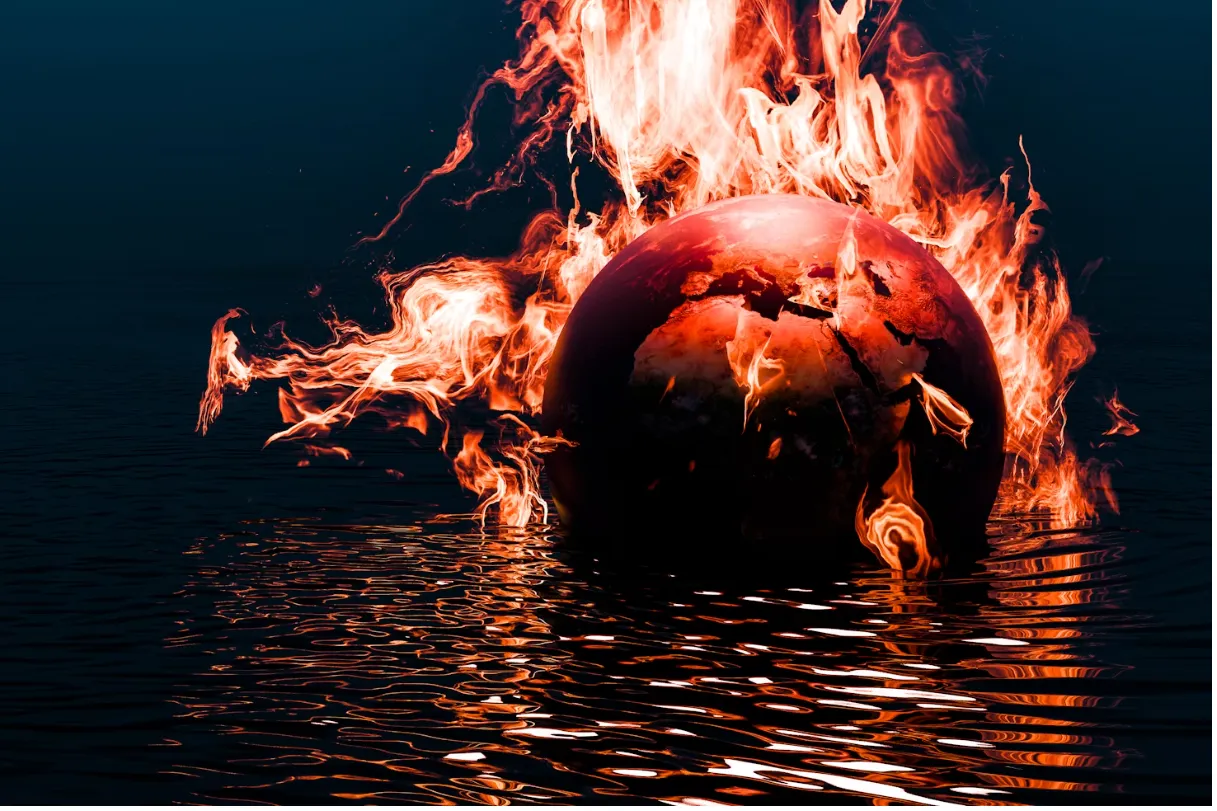
Yes, you could've cooked eggs on your car hood.
The heatwave that put the triple‑digit sizzle on the central and eastern United States and canceled numerous July 4 public events over the three-day weekend moved to the Southwest and West Monday. Extreme temperatures remained high in the Southeast, especially Florida and the other southern coastal states. Texas, Southern California and Arizona saw above-normal temperatures for this time of year. The National Weather Service warned of extreme heat for millions of people in those regions with Phoenix hitting 107 °F (42°C) at Monday noon. While the Northeast and Midwest are seeing cooler temperatures after the blistering previous few days, flood threats are on the rise there because of wetter conditions.
That, of course, is weather. Before long, the record-smashing temperatures of this summer's weather will be overtaken by another summer's records. Then another and another. That's climate.
Now, there are still stubborn folks who just can't pry themselves out of their dogma who will tell you we've always had hot days. Soooo, nothing to see here. Yadda-yadda-know-nada. In a study by the World Weather Attribution, scientists concluded that the July 4 event would have been "virtually impossible" without human-caused climate change. The researchers concluded that what would once have been roughly a 1-in-200-year event has become far more likely because the planet has already warmed about 1.4°C (2.5°F) from greenhouse gas emissions. The heatwave was, they asserted, substantially hotter than it would have been in a world without human-caused warming.
According to a Nature Reviews study:
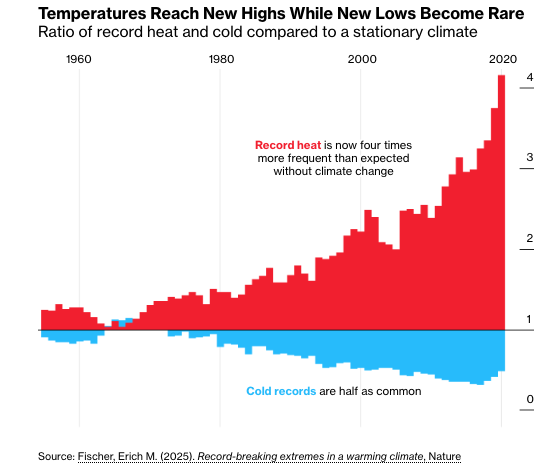
Many climate variables have witnessed changes in their record-breaking frequency. For example, all-time daily hot records on land are more than four times higher in 2016–2024 than expected without climate change, and all-time cold records two times lower; similarly, daily maximum precipitation records and monthly dryness records are more than 40% and 10% higher, respectively.
Climatologist Katharine Hayhoe urged her readers to use the heatwave as an opener to discuss the climate crisis with friends, workmates, and family:
Heatwaves aren’t new. But I’m a climate scientist, and I can tell you heatwaves like this are virtually impossible without fossil fuel pollution. Not only that, but when extreme weather hits, research shows that connecting it to climate change helps people understand why it matters. And you know who the most trusted people to do that are? Not scientists. You! Yes, people we know are the most effective messengers to have these conversations. So if you’re worried about what’s happening and how extreme heat puts us at risk—talk about it!
At Bloomberg, Eric Roston and Hayley Warren reported:
“We could call them super-extremes or mega-extremes,” said Tim Lenton, chair in climate change and Earth system science at the University of Exeter. “We’re starting to see extremes on a spatial scale and a magnitude that’s really surprising.”[...]
“Extreme events are so far outside anything we have expected,” said Friederike Otto, an Imperial College London climate scientist and co-founder of World Weather Attribution. “It’s not so important whether it’s what we expected as experts. It’s whether it’s what we expect as people on the ground.
“Climate change is here, it’s already impacting the things we enjoy in our everyday lives, and it will continue to get worse the longer we drag out the inevitable transition to net zero emissions.”
But, c'mon, scientists? What do they know?
Now it's true that attributing the cause or severity of a specific weather event to climate change is a disputatious endeavor. But scientists are following the data as best they can, and the dogmatists — like the professional deniers and clowns in the White House, Energy and Interior departments — follow the money and cherry-pick or lie about the data. That language —"virtually impossible" — isn't rhetorical flourish. It's a technical finding.
What's increasingly unsettling — even to scientists who have spent decades sounding the alert about climate change — is how the records are falling. They are not merely inching past previous highs as in the past. Increasingly, they are vaulting over them. Bloomberg highlighted this growing unease among climate researchers, who are watching heat records tumble with a frequency and intensity that increasingly strain statistical expectations. The concern is echoed across the scientific literature and by organizations including the World Meteorological Organization, the European Union's Copernicus Climate Change Service, as well as the World Weather Attribution consortium. Their message is remarkably consistent: Today's extremes are becoming tomorrow's normal, and yesterday's "unprecedented" is becoming disturbingly our new reality.
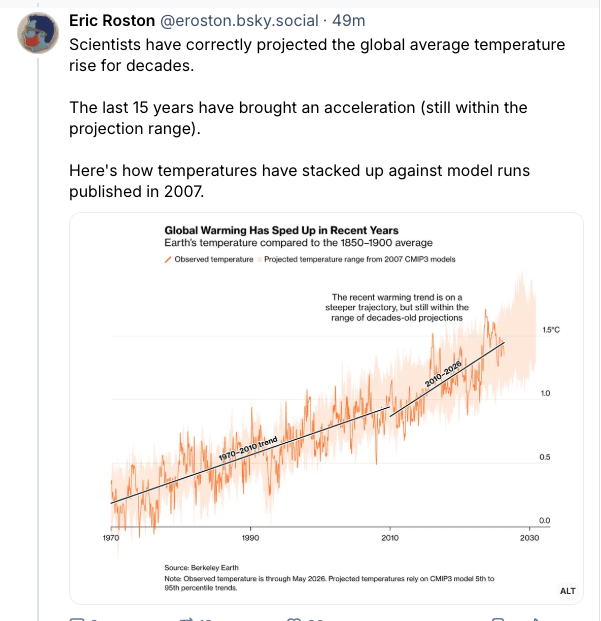
For years, climate scientists warned us that global warming would "load the dice," making heatwaves more frequent. That metaphor remains useful, but it no longer tells the whole story. It's one thing when a river overtops its banks once in a century. It's another when each successive flood occurring once-in-20 years or once-in-five years reaches farther inland, erasing what everyone thought was safe ground. Climate scientists are increasingly confronting a similar reality. Records are not merely being broken. They are being broken by jaw-dropping margins. Not exceeding what scientists thought was possible. Such temperatures are still well within their long-term predictions. But not expected so soon. Flukes or accelerating to a new normal? Depends on whom you ask.
Scientists are trained to hedge conclusions, quantify uncertainty, and avoid rhetorical excess. So when they begin describing entire classes of weather events as essentially impossible in the climate we or our parents knew, it should command more attention than jut another headline announcing a new temperature record. Instead, climate reporting has declined, just as climate action and talk by Democratic candidates has fallen after rising during President Biden's term.
Heat harm possesses a political invisibility that hurricanes, floods, and wildfires do not. Television cameras can linger on collapsed bridges or burning neighborhoods. They cannot easily capture the elderly woman whose apartment never cools below 90 degrees overnight, the farmworker whose kidneys slowly fail after years of dangerous heat exposure, or the warehouse employee whose body simply reaches its limit. Heat kills quietly.
That quietness allows governments to underestimate it, news organizations to underplay it, and voters to treat it as little more than an unpleasant inconvenience. Something to let the paramedics deal with. Yet extreme heat has become one of the deadliest weather hazards on Earth. The latest Lancet Countdown estimates that heat now claims about 546,000 lives worldwide each year — roughly one person every minute. Recent European heat waves alone have been linked to thousands of excess deaths, while July's North American heat dome has already produced dozens of confirmed fatalities and placed millions under dangerous heat alerts.
Nor is everyone equally exposed. Climate change is one of history's largest engines of environmental inequality. Wealth buys insulation, efficient air conditioning, backup generators, shaded neighborhoods, vacation homes, and the freedom to avoid outdoor labor during dangerous afternoons. Poverty buys asphalt, aging apartments, thin tree canopies, crowded housing, and jobs that often cannot be performed from the comfort of a climate-controlled office.
A warming planet is amplifying old injustices. The geography of suffering follows familiar lines. American neighborhoods redlined by racism generations ago often remain several degrees hotter than wealthier communities because they have fewer parks and trees. Agricultural workers, construction crews and delivery drivers face escalating health risks while performing work that keeps everyone else's lives functioning. Schools without modern cooling systems become dangerous learning environments precisely for children least able to escape them. Obviously, other nations have similar as well as unique situations of their own in this matter.
Meanwhile, governments proudly announce new heat warning systems while simultaneously approving additional oil and gas development whose emissions make future warnings necessary.
Adaptation is essential, but adaptation without rapid emissions reductions resembles plunking larger buckets under an increasingly damaged roof. Europe illustrates the contradiction vividly. It remains a leader on climate policy, yet Reuters recently reported that adaptation spending there still lags far behind what mounting risks demand. Transportation systems buckle, power grids strain, snowpacks vanish weeks earlier than normal, and workplaces lose billions in productivity, even as many buildings remain poorly designed for a hotter climate.
In the United States federal support for climate resilience remains uneven, workplace heat protections are incomplete and too many communities still treat cooling centers as emergency measures instead of permanent public infrastructure. Sometimes it's more hostility than neglect. The wizards running Florida state government passed legislation forbidding local jurisdictions from passing worker-protecting heat ordinances.
The World Meteorological Organization warns that the currently developing El Niño, layered atop long-term greenhouse warming, raises the likelihood of global temperature records growing even faster over the next few years. Copernicus reports that ocean temperatures remain extraordinarily high, storing immense quantities of heat that will continue influencing weather around the globe.
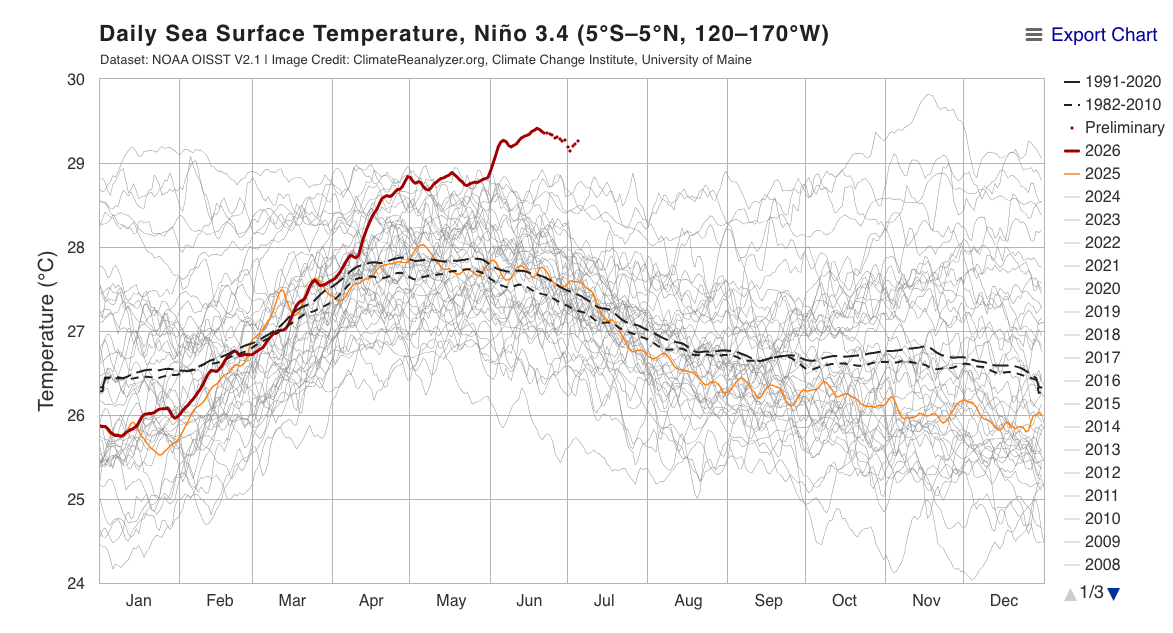
These are not isolated anomalies. They are components of an accelerating system. Because the most dangerous misconception about extreme heat is that it represents a temporary emergency from which society eventually recovers. Increasingly, the evidence suggests something different. We are not enduring an unusually hot period. We are living through the opening chapters of a new climate era. The developing new normal could very well not be normal for long.
Unfortunately, we have a wrecking crew running the federal executive branch. Olivia Rosane at Common Dreams noted that on July 2, Energy Secretary and former fracking CEO Chris Wright was slumming around on social media to say the Trump regime would end subsidies for new wind and solar on July 4. There was talk the same day from Donald Trump himself about how much he's doing to speed the way for more oil and gas development even as the United States is the world's largest producer of both.
Climate scientist Rebekah Jones responded: “During a record heatwave, no less. Fossil fuel industries have received $549 BILLION in direct subsidies, and $7 TRILLION in tax benefits. They average $30 billion per year in upfront taxpayer money. All of renewable energy received $400 million per year from 1994-2009.”
Adaptation is not an option. It's essential to survival. There are concrete solutions to the growing heat. Some are cheap and easy and can be done instantly. Some are expensive and tough and will take years, even decades to achieve. Here's an incomplete list:
Strengthen workplace heat standards. Expand urban tree cover where it is needed most. Retrofit public housing before luxury developments. Treat reliable cooling as critical public-health infrastructure rather than a private consumer choice. Accelerate renewable energy deployment while ending subsidies that prolong fossil-fuel dependence. Design cities for the climate we are entering instead of the one we inherited.
But as long we continue filling the atmosphere with the chemical byproducts from our zeal for turning every resource into a commodity, mere adaptation is a snare and a delusion. Clean energy installations, wind and particularly solar, are expanding globally at an impressive pace. But the International Renewable Energy Agency and the International Energy Agency have both pointed out that this transition is still significantly slower than it needs to be. Plus, emissions are still rising. And corporations and nations are retreating from what was already too-modest of efforts to reduce them.
You think this heatwave was bad? Just wait. This isn't just another climate story. It's a labor story. A housing story. A public health story. A civil rights story. And as Hayhoe notes, a sit around the dinner table story. We need to keep talking about this. And act.











Comments
We want Uncharted Blue to be a welcoming and progressive space.
Before commenting, make sure you've read our Community Guidelines.