

If you've been a regular observer of clean energy news for the past 18 months, you may have caught a hint of whiplash.
On the one hand, the Trump regime has been methodically working to cripple the expansion of renewable energy in the United States. Climate science-denying, dirty-energy stooges have been implanted to lead the Environmental Protection Agency, Department of Interior, and Department of Energy. Incentives for EVs and renewable power projects have been deep-sixed, grants have been slashed, and regulatory moves have been piling obstacles on the path to clean energy electrification. This is costing Americans big time. Meanwhile, White House favoritism is paving an eight-lane highway for the oil and gas industry. Even coal gets a lane.
The cost of this is not small, according to Dan McCarthy at Canary Media:
Between January 2025, when Trump took office for his second term, and May 2026, a total of 216 major clean energy generation and manufacturing projects were scrapped, closed, or downsized, according to a new report from the business-focused advocacy group E2.
Those cancellations, driven in large part by the Trump administration’s hostility toward clean energy, have resulted in the loss of nearly half a million potential jobs, E2 found. Just over a tenth of those would have been permanent roles at clean energy facilities, while the rest would have been either temporary construction jobs or steady work in roles supporting the sector, from selling building materials to serving food at restaurants near a new factory.

On the other hand, worldwide renewable electrification is speeding ahead, with new solar, wind, and battery installations still breaking records. Even in the United States, that expansion is happening for solar despite Trump's policies, although at a slower pace than would have been the case had the Trump gang not arrived on the scene. Solar — especially when paired with battery storage — is not only clean but increasingly the cheapest and fastest form of new generation. Economics is trumping Trump in many cases. Hurrah to that. But much of the damage he's causing has yet to hit home. Meanwhile, he's still ordering the erasure of climate and energy data and hampering or buying off wind projects with billions being paid out in what amounts to bribes.
Every administration chooses winners and losers. Since 1913, the U.S. government has chosen to promote a fossil fuel economy through regulation, incentives, and infrastructure spending. More than a century of it. The industry has provided a mountain of benefits in transportation, medicine, manufacturing, agriculture, a plethora of the other aspects of modern life. Along with that, plenty of jobs. It has also killed millions of people with pollution, tainted beaches and rivers, left behind millions of old oil wells still belching methane, menaced downstream communities with toxic coal ash pits, and is now altering the climate at an accelerated pace. Plus there's war. Oil has rarely been the sole cause of modern wars, but it has repeatedly shaped their geography, their financing, their strategic logic, and their human toll. The clash in the Hormuz Strait demonstrates this once again.
The Biden administration chose differently. The Inflation Reduction Act of 2022 included more incentives and other funding for renewable-energy and associated projects than any previous administration had come close to. It also had a little money and regulatory assistance for fossil fuels because the IRA was a continuation of the "all of the above" energy stance embraced, in varying degrees, by nearly every president of the past 50 years.
Biden's wasn't, however, the first administration to give renewables a financial boost.
In 1978, President Jimmy Carter pushed a Congress still wondering how to deal with a repeat of the 1973-74 Arab oil embargo to pass the National Energy Act. It included incentives for solar, wind, geothermal, and conservation. But, as an all-of-the-above policy, the NEA also provided financial and regulatory help for coal, oil, natural gas, and synthetic fuels.
In 1992, under President H.W. Bush, in the wake of the founding of the Intergovernmental Panel on Climate Change, Congress passed the Energy Policy Act. It included a production tax credit for wind power installations. But it also included incentives and reforms affecting oil, natural gas, coal, and nuclear power.
President Bill Clinton extended the wind credit and added more money for renewables research, development and commercialization. In 1997, he announced the Million Solar Roofs Initiative, with the goal of installing that many by 2010. The numerical goal wasn't met, but the effort helped normalize rooftop solar at a time before the industry became mainstream. He did not retreat from the existing incentives for fossil fuels and pushed forward the 1997–2002 Outer Continental Shelf oil and gas leasing program.
In 2005, under President George W. Bush, Congress expanded the investment tax credit for commercial solar from 10% to 30% and created a residential solar credit. This change became one of the principal foundations of the modern American solar industry. Having been extended three times despite Republican opposition, the ITC was still with us until this year. But Bush, like his dad, was an oil man, and he continued longstanding credits and regulatory advantage for the fossil fuel industry.
Barack Obama got Congress to (barely) pass the American Recovery and Reinvestment Act of 2009, a massive stimulus to boost the U.S. out of the Great Recession. Just over 11% of that funding, about $90 billion, went to clean-energy investments, including renewable power, grid modernization, electric vehicles, batteries, efficiency, and related technologies. It was the single largest amount for that purpose until the IRA directed $370 billion at creating an entire clean-energy ecosystem. But Obama too chose an all-of-the-above policy as his predecessors had done, supporting the natural-gas industry, and more domestic drilling for oil offshore. He argued with environmentalist critics that the administration's fossil fuel support was needed to get the votes for renewables.
Backed by petro-lords and their political marionettes, Trump seeks to kill all-of-the-above policy, not by eliminating dirty fossil fuels, but by expanding them while putting both thumbs on the scale against their replacements. Even Ronald Reagan, who slashed conservation and renewable-energy programs while championing oil, gas, coal, and nuclear power, did not go as far as the current regime in using federal power to sabotage America's clean energy future.
As always with The Donald, there's greed involved. Through direct and Super PAC contributions, fossil fuel interests fed his campaign $96 million two years ago. Then there's the grudge. Trump's maniacal hatred for wind turbines originates from his unsuccessful clash with Scottish regulators who approved an offshore wind farm that he felt would "destroy the view" from his new golf course near Aberdeen. And there's just plain old stupidity.
The world is moving toward a fresh paradigm. Adoption of renewables is accelerating. Whether this green transformation will ultimately succeed in the face of the climate crisis that scientists tell us also is accelerating remains uncertain. Despite the encouraging global gains in renewables, we have a long, long way to go. There's no going back. The Trump regime nonetheless is bent on turning the U.S. into a dirty energy backwater. For example, Trump has dismantled much of the IRA's expansion of the long-running, very productive Investment Tax Credit, terminated the residential solar credit years early, and sharply curtailed the commercial credit through accelerated deadlines and restrictive eligibility rules.
The philosophical argument behind this, fluffed by the Heritage Foundation and so many others, declares this just gets government out of the way and lets markets work. As if the oil industry is wholly market-based when it's still favored with the 1913 intangible drilling cost deduction, among other subsidies.
If we did "just let markets work," the clean energy industry wouldn't even exist at anything like its current scale. By advantaging the obsolete but powerful dirty energy paradigm, the regime is shifting economic and health risks onto ordinary Americans while shielding politically favored industries that are killing us and altering the climate in ways homo sapiens have never before seen. The regime promises energy dominance and abundance. It promises a future overflowing with cheap and dirty American energy while undermining clean-energy projects being rapidly built in the EU, China, India, and Australia, with ever more stirrings for solar in Africa, where nearly 47% of the sub-Saharan population has no regular access to electricity.
The United States meanwhile has entered an era of surging electricity demand unlike anything seen in decades. Artificial-intelligence data centers consume power on the scale of cities. Manufacturers are electrifying factories. Air conditioners are running longer as the climate crisis delivers hotter summers and more dangerous heat waves. Utilities from coast to coast are warning that the country needs more generating capacity, more transmission lines and more efficient use of the electricity it already produces. The Trump regime is guaranteeing that much of the needed capacity will come from high-carbon, high-cost, polluting sources instead of the alternatives.
Even when it comes to the obvious advantages of efficiency, Trump policy is designed to defeat something as obvious as showing Americans what they can do to save money on their electrical bills. As the still-unreleased Epstein pedofiles demonstrate, obliterating information is a high priority at the White House. What is not measured cannot be used by critics as evidence backing adoption of new policies.
For consumers facing bigger electricity bills, more efficient appliances make a difference. Because of that the Department of Energy had long hosted webpages in its "energy saver" section that provided advice on energy and cost-saving measures. Included were tips on “weatherstripping,” measures to keep cool at home during the summer, and choosing efficient appliances. Americans were using this guidance because it worked. But Amy Qin and Flávio Pessoa at The Guardian report that 1,662 of these webpages were removed as of July 3. More than 300 of the webpages had more than 160,000 page views in the past 30 days, according to the newspaper's analysis of government web traffic data from the General Services Administration. Their disappearance coincided with the regime’s proposal to weaken appliance-efficiency standards that have saved households billions of dollars over the years.
“Just absurd" is how Itai Vardi, who manages research at the Energy and Policy Institute, a non-profit fossil fuel and utility watchdog, characterizes the proposed rule and website deletions. “It’s ironic that the Trump administration and Republicans love to talk about consumer choice as a tenet of American freedom, but they’re actually taking that away," Vardi told The Guardian. “What they’re doing here is rolling back the rules on energy efficiency, but also trying to hide helpful tips and information for the public, and it’s going to cost people more money.”

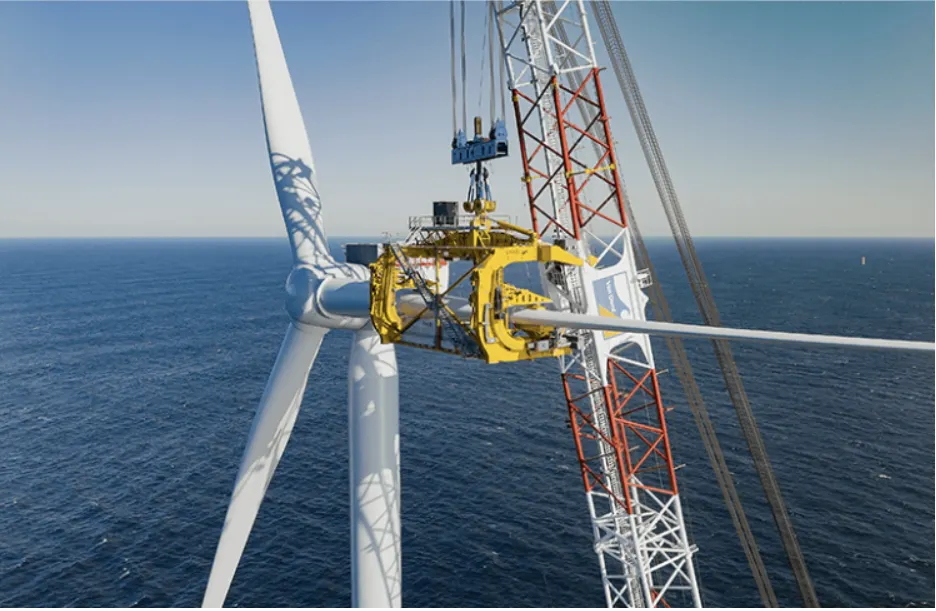
While erasing useful data continues, the attack on wind projects has been growing. Trump's attempt to block offshore wind farms, including including one that was only a single turbine away from completion was stopped by the federal courts. Trump then shifted from direct stop-work orders to other means of slowing the industry — including buying back leases for $2.6 billion, tightening tax incentives, and using administrative reviews to impede new development." Offshore wind isn't the only target, as Austin Corona at Grist reports.
The Pentagon has long reviewed wind projects located near military installations, requiring developers to modify turbine placement or adopt technical measures to reduce radar interference. It was an imperfect but functioning system. According to developers, that process has largely ground to a halt. The Defense Department says the explosion of drone warfare requires a comprehensive reassessment of wind turbines near military facilities.
National-security concerns deserve serious attention. But serious reviews usually produce clear standards, technical recommendations, and predictable timetables. What has emerged instead is an open-ended freeze affecting more than 150 wind projects capable of generating roughly 44 gigawatts of electricity. For comparison, that's enough to power 13 million average American homes, and a bit more capacity than Argentina has from all energy sources, clean and dirty. Write Corona:
Wind developers say they’ve incurred $2 billion in additional costs as a result of the freeze and that the administration’s new narrative is just the latest excuse to shut down their industry. Some may already have missed a July 4 construction deadline to qualify for federal tax credits under the One Big Beautiful Bill Act, the 2025 law that phased out several clean energy incentives.
The regime has found something slipperier and, in many cases, more effective than upfront cancellations. Delay. Building infrastructure depends on financing deadlines, supply contracts, tax incentives, and construction schedules. Miss enough of those milestones and investors walk away. A permit delayed long enough becomes a project canceled without anyone ever having to defend the decision publicly. Bureaucratic inertia becomes a kind of silent veto, one with no signature, no roll-call vote, and no obvious political culprit.
Some industry decisions undoubtedly reflect market realities, particularly in the electric-vehicle sector. But markets do not grow wild like weeds, untouched by politics. They are fenced, fertilized, and irrigated by law. Investors calculate risk, and this regime has transformed political uncertainty over energy into an instrument of industrial policy. Companies no longer know which tax credits will survive, which permits will be issued, or which technologies may become the next target of presidential hostility. Many have concluded that investing elsewhere is the safer bet. The uncertainty is not an unfortunate byproduct of policy. It is the policy.
This is not simply a fight over what should be done about climate and energy. It's a contest over who bears the costs of building 21st Century economy. The Trump regime’s answer is clear. Government will continue to shape markets, but the rewards will flow toward politically protected industries while the environmental damage, health harms, safety risks, climate disruption, and economic consequences get pushed off onto everyone else.
***
OTHER THINGS TO READ
The Trump Energy Agenda Means Astronomical Bills and Smoky Skies by Bill McKibben
Motivated by ignorance, ego, and greed, Trump's anti-wind, pro-coal policies will add $650bn to Americans' energy bills during the next 15 years by Meteor Blades
One Year Since the One Big Beautiful Bill: An Economic Impact Analysis Of America’s Clean Economy by E2
Solar Energy Is Booming — Despite Trump’s Best Efforts









Comments
We want Uncharted Blue to be a welcoming and progressive space.
Before commenting, make sure you've read our Community Guidelines.