

If grinding up the bones of our ancestors and burning them to fund data centers would enrich even a handful of people, there are forces that would eagerly get their marionettes in government to subsidize the excavators. Unfortunately, those forces are already digging up ancient deposits of past life, recklessly consuming them and spewing the byproducts as if the dire consequences remained unknown.
We've got a growing Trumpian death toll from war, murder, and social spending cuts, the Constitution is bleeding out with the knives still unsheathed, and a chaotic foreign policy operating on ego, ignorance, and greed is sowing distrust and disgust among allies and glee among adversaries. Just 117 days left until the general election, and we don't know how much Trump and his minions will meddle with the midterms, just that he will. Defeating them requires focus and unity.
So why then talk about energy and climate now? Because, as I've noted before, energy and climate stories are all labor stories. Housing stories. Public health stories. Civil rights stories. Affordability stories. Big attention is being paid to affordability in the 2026 Democratic campaigns, as well it should, as it should have been more in 2024. And the Trump regime is killing affordability, short-term and long. That needs to be woven into campaign stories.
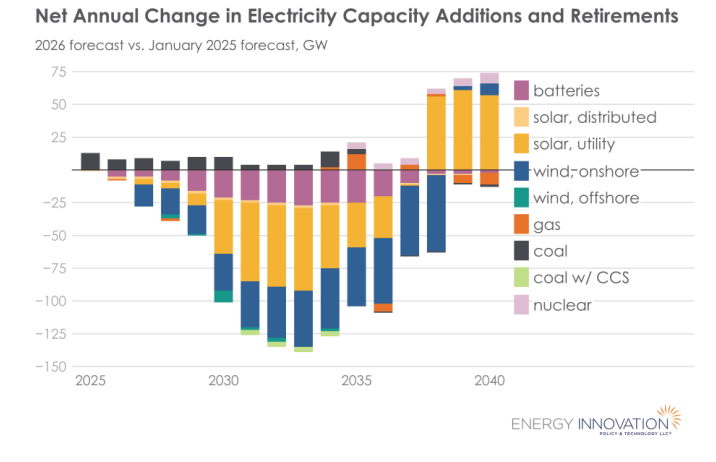
The regime has justified its rollback of Biden-era clean-energy policies as a necessary corrective — one that would lower energy prices, unleash domestic production, and free the economy from supposedly burdensome regulations. But a new analysis by Robbie Orvis and Daniel O'Brien released from the nonpartisan think tank Energy Innovation Wednesday reaches the opposite conclusion. According to their modeling, the cumulative effect of the regime's executive actions, regulatory reversals, and legislative changes since January 2025 "will increase energy prices, slow economic growth and job creation, increase air pollution and healthcare costs, and worsen grid reliability.”
Total tab: $650 billion in additional energy bills by 2040. It's a sweeping rebuke to claims that dismantling clean-energy incentives would reduce costs for American families.
The report states: “Slowing down electrification and domestic energy manufacturing will lower [gross domestic product] in all years, totaling $2.3 trillion cumulative lost GDP, with effects flowing into other economic sectors. The US economy will lose $150 billion in GDP in 2030, peaking at a $250 billion net loss in 2032, then reverting to losses of $200 billion in 2035 and $120 billion in 2040."
Meanwhile, as reported in The Guardian Friday, the Trump regime has paid %2.7 billion of tax money to smash wind power and 1.13 billion to coal power. In the past four months, the Department of Interior has paid four companies to cancel eight offshore wind projects and replace them with fossil-fuel projects.
“Trump is getting Americans coming and going,” said Jay Inslee, the former governor of Washington state and a Trump detractor. “He’s forcing higher power bills on them by blocking clean energy, then he’s fattening the wallets of his cronies – all with billions of our tax dollars.” [...]
As it has worked to suppress offshore wind, which experts say should be a key part of any climate plan, the Trump administration has bolstered coal, the dirtiest and most expensive fossil fuel. In September, the Department of Energy announced it would spend $625m to “expand and extend the life of” coal-fired power plants, allocating $350m to “modernize” coal plants, $175m to fund coal projects powering rural communities, and $50m to upgrade wastewater management systems to extend coal plants’ lifespans.
Last month, the agency also set aside up to $500m from the Defense Production Act to “expand and reinvigorate” the capacity of 13 coal plants, and to help build a coal export terminal in Oakland, California. A week later, the department announced an additional $3.6m to “refurbish or retrofit” nine existing coal plants.
Among the principal findings, Energy Innovation projects that the policy changes will:
• Increase household costs for electricity and fuel by an average of $460 a year by 2035.
• Push gasoline prices higher over time by slowing efficiency improvements and reducing competition from electric vehicles.
• Meanwhile, “Slowing down electrification and domestic energy manufacturing will lower [gross domestic product] in all years, totaling $2.3 trillion cumulative lost GDP, with effects flowing into other economic sectors." That slowdown will cost the United States more than 800,000 jobs annually as investment in manufacturing, construction and clean-energy industries declines.
• Increase healthcare costs by $43 billion ($4 billion a year by 2030), worsening air pollution and causing thousands of additional premature deaths linked to soot and smog. The report argues that these health impacts should be viewed as economic costs every bit as real as higher electric bills or lost manufacturing jobs.
• Make the electric grid less reliable by slowing construction of new generating capacity just as electricity demand from AI, data centers, electrified transportation, and new manufacturing continues to accelerate.
Taken together, the report argues that these outcomes are not independent problems but parts of the same economic chain reaction. Slower investment means fewer new power plants, transmission lines, and factories. Reduced supply places upward pressure on electricity prices precisely as demand begins climbing faster than it has in decades. Higher energy costs ripple through the economy, raising expenses for households and businesses alike while reducing U.S. competitiveness internationally.
For Wall Street, that competitiveness may prove to be one of the report's most significant themes. As James Murray reported for Energy Monitor, in late 2023, the International Energy Agency projected that global clean-technology manufacturing could nearly triple to roughly $650 billion annually by 2030, driven by expanding markets for batteries, solar equipment, electric vehicles, and other low-carbon technologies. The race, in other words, is no longer about whether the clean-energy economy will exist. It already does. The contest is over where those factories will be built, where supply chains will develop, and which countries will capture the investment, jobs, and export markets.
Like every large-scale economic model, Energy Innovation's analysis depends on assumptions about fuel prices, technology costs, consumer behavior, and investment decisions for the next decade and a half. Critics will undoubtedly dispute some of those assumptions and argue that markets will adjust differently than the model projects. But uncertainty cuts both ways. The report seeks to estimate the direction and magnitude of policy changes rather than predict the future with mathematical precision, and its broader conclusions rest on familiar economic relationships involving supply, demand, and capital investment. Indeed, the authors suggest their estimates may be conservative because they do not fully capture every economic headwind now facing the energy sector. Their analysis does not explicitly model the broader inflationary effects of tariffs or the continuing economic consequences of international instability that has already affected fuel markets.
At a time when electricity demand is accelerating, when other nations are racing to dominate the industries of the future and when climate change continues driving record heat, floods, and wildfires, does it make economic sense — whether you think capitalism or socialism is the way forward — to discourage investment in the ever-cheaper, fastest-growing sources of new energy? Energy Innovation's answer is unequivocal. Rather than producing cheaper, more abundant energy, the policies of Trump 2.0 will leave Americans paying more, breathing dirtier air, and watching an increasing share of tomorrow's energy economy being built somewhere else. In other words, like a pranking frat boy, Donald Trump short-sheeted us.
The antidote to this can only come about once the federal government changes hands. When it does, repairing all the damage inflicted by the regime needs to include restoring sanity to U.S. energy and climate policies. That requires going a lot further than the Inflation Reduction Act did, and it requires an end to letting fossil fuel barons and their partners dictate our energy future.
Crossposted from The Journal of Uncharted Blue Places
You can catch me at meteorblades.bsky.social












Comments
We want Uncharted Blue to be a welcoming and progressive space.
Before commenting, make sure you've read our Community Guidelines.