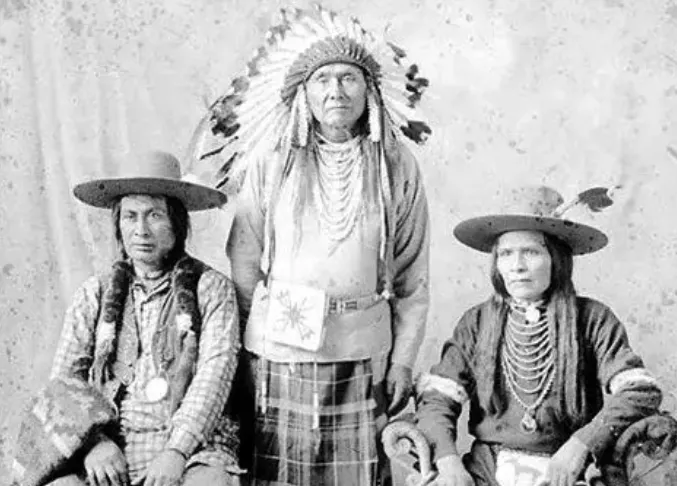
The alleged last words of Ogala Lakota war chief Crazy Horse (Tȟašúŋke Witkó) were delivered, it is said, to the Hunkpapa Lakota resistance leader Sitting Bull (Tȟatȟáŋka Íyotake) around a campfire while smoking the sacred pipe. This alleged conversation occurred four days before the surrendering Crazy Horse was killed by bayonet in May 1877 at Fort Robinson in Nebraska. It was only 11 months after the Pyrrhic victory of the Lakota-Cheyenne over the 7th Cavalry at the Little Big Horn. Those purported last words have for about 50 years been called "The Prophecy of Crazy Horse."
Just a few problems. Not only was Sitting Bull in Canada at the time Crazy Horse was killed after surrendering, there also is no record of those words being written down in 1877 or appearing anywhere anytime until the second half of the 20th Century. And, indeed, the phrases sound suspiciously like a romanticized New Age version of what idealized American Indians are supposed to sound like. The most popular version — yes, there is more than one — includes:
"Upon suffering beyond suffering, the Red Nation shall rise again and it shall be a blessing for a sick world..."
and the most-quoted passage:
"I see a time of seven generations when all the colors of mankind will gather under the sacred Tree of Life..."
and:
"the young white ones will come to those of my people and ask for this wisdom."
Supposedly, these words come from oral tradition, from a grandmother who witnessed the ritual and heard the talk and passed it along. Oral tradition should never be dismissed as worthless. But this particular example just doesn't pass the smell test. If it had been an oral tradition, it would have over the decades been widely told to Oglala people long before the words gained 1960s-'70s attention. And there simply was no such tradition.
Crazy Horse never said those words anymore than he looks like the far-from- completed image of him that has been being carved out of the granite of the Black Hills for the past 78 years. No verified photo or portrait of him exists even though there are hundreds of Sitting Bull. Scholars know true details about his life, but the popular perception is loaded with mis- and disinformation. His is far from the only case.
We, of course, live in an era when the generation of fake news is a multi-billion industry. The product is becoming more polished, more convincing, more perilous all the time. When it comes to Indigenous Americans, however, the fake news has been pumped out for decades. We've had everything from Buffalo Bill's Wild West Show and 60 years of racist films to Rush Limbaugh's claiming critics were wrong to say there was a genocide against Native tribes because not all of them were wiped out. Just as many right-wingers today assert that descendants of enslaved people are better off that their ancestors were snatched from Africa and brought here, there are those who claim Natives are better off that our lands, culture, and religions were stolen and those not murdered or killed by disease got "civilized."
But vicious fake news about American Indians isn't the only problem. Years ago, I read The Patriot Chiefs. In addition to background histories of nine Native leaders, the admiring white historian Alvin Josephy includes what has come down to us as their speeches. These are frequently are compelling. However, each of these leaders spoke in his own language. An interpreter — not always fluent — translated into English, French, Spanish. Some later recorded the translation, often from memory, rarely from notes. Later editors and historians translated and edited the record again. By modern standards, that's a terribly shaky chain of custody.
Take the resistance leader Tecumseh. Many of the famous speeches attributed to him were recorded by Americans who did not speak Shawnee. What we possess is not verbatim transcripts but English rendering of what listeners believed he said. The same is true of Pontiac (Ottawa), Osceola (Seminole), and others. I'm not out to trash Josephy's book. In many ways, it's excellent. But it nonetheless promotes fabrications.
More insidious these days is popular culture. On the internet, books, posters, and Pinterest pins rife with fabricated statements can be found everywhere — often with a stereotypical, supposedly Native American ring to them. These are very often well-intended. Typical examples are often murkily attributed to “ancient American Indian proverb,” or “Iroquois saying” or “Cherokee blessing” or some such imprimatur. Be skeptical. You can be just about certain that most such sayings are not what they purport to be. Which makes them lies, no matter the good intentions of the person who spreads them.
Sometimes, the story is more complicated. Take, for instance, a recent skeet at Bluesky:

Chief Seattle (Sealth) of the Duwamish and Suquamish peoples of the Pacific Northwest never said those words. Nobody alive knows what he said. A speech he gave in his native Lushootseed dialect in 1854 was translated into Chinook, a pidgin trade language, which was translated into English, about which physician-poet Henry A. Smith took notes. More than three decades later, in 1887, he wrote an embellished version of the speech based on those notes. He acknowledged doing some embellishing. In reprints 40 years later, still other embellishments were added. Most of the book, "Brother Eagle, Sister Sky: A Message from Chief Seattle" focuses on the text, without noting that it's spurious. That's too bad, because the book's illustrations and the introduction about land grabbing and other depredations against American Indians are lessons children of a certain age should learn. But promoting the speech as the chief's actual words, the book teaches a lie.
In another example, Americans have generally accepted "I will fight no more forever" as the actual words of another chief. The poetic phrase is one buttons, plaques, and other popular culture paraphernalia.
The words were supposedly said by Hin-mah-too-yah-lat-kekt, known to most Americans as Chief Joseph, a leader of the Wallowa band of Nez Perce (Nimíipuu) of Oregon. He's remembered for leading a nearly 1,200-mile flight of hundreds of his people toward Canada 149 years ago to join Sitting Bull at a time when the U.S. Army was killing Crazy Horse and penning up the Plains tribes on ever smaller reservations in the wake of the defeat of the 7th Cavalry the year before. It was a grueling, heroic flight, but eventually Joseph's dwindling, exhausted band were finally cornered.

As you can read in Elliott West's The Last Indian War: The Nez Perce Story, it was a close thing. Joseph and his band almost made it to Canada, chased the entire distance by the one-armed Gen. Oliver Howard, Gen. Nelson Miles, and their troops. By the time of the surrender, many of the tribe's leading warriors, including Joseph's brother, were dead, many women and children and elders had died from the rigors of the attempt to escape, and everyone still alive was starving. The pursuit, or the versions of it that the Army-embedded reporters sent to their editors, generated some sympathy, especially in the east where scores of tribes had been exterminated through disease, war, and murder long before the Nez Perce made their doomed bid for freedom.
When the battered tribe gave up, Joseph delivered short, weary remarks that have since become one of the most famous Native speeches ever. It was published in a variety of newspapers and magazines and brought brief celebrity to Joseph and his band. But this did not prevent the tribe from being removed for a time to Oklahoma, a trip that killed many survivors of the aborted trek to Canada and an exile that killed many more.
Joseph's now iconic phrase has made its way onto posters, buttons, T-shirts, and into probably 90% of the articles written about the Nez Perce since their capture. It's quite telling what it says about our national zeitgeist that a surrender speech is the most famous thing an American Indian has ever been quoted as saying.
But whatever he actually said at gunpoint, Joseph never delivered the poetry of that remark because he didn’t speak English. Twenty-five-year-old Lt. Charles Erskine Scott Wood, who later became an accomplished poet and essayist, originally said he had taken down Joseph's words as translated by Arthur Chapman and conveyed to him by Old George, a Nez Perce from another band.
In other words, Joseph's speech, which would have been delivered in the Sahaptian dialect of his people, came down to us through two interpreters before Wood became the only person to write down what were purportedly the surrender words. Years later, Wood changed his story and claimed to have taken down Joseph's interpreted words on the spot as he handed over his Winchester to General Miles. Old George was no longer mentioned. Decades before Wood’s death in 1944, those words had been widely challenged. But it didn't alter the many references to them in textbooks and throughout popular culture.

There was good reason for this criticism. Usually, the speech is seen written as prose. But literary critics noticed an odd thing: the Nez Perce were apparently fond of English poetry. Because Wood — soon to become a well-published poet — transformed Joseph's speech into the unrhymed, unmetered 14-line structure of an American sonnet:
“Tell General Howard I know his heart.
What he told me before – I have it in my heart.
I am tired of fighting. Our chiefs are killed.
Looking-glass is dead. Too-hul-hul-suit is dead.
The old men are all dead.
It is the young men, now, who say “Yes” or “No.”
He who led on the young men is dead.
It is cold, and we have no blankets.
“The little children are freezing to death.
My people – some of them – have run away to
the hills, and have no blankets, no food.
No one knows where they are – perhaps freezing
to death. I want to have time to look for my children,
and to see how many of them I can find.”
And then:
“Hear me, my Chiefs! I am tired; my heart is sick and sad. From where the sun now stands I will fight no more forever.”
Eventually, more damning evidence than literary criticism appeared regarding the speech. Most notable was the fact that Wood himself changed what he had written and several times revised specific claims he had made relating to how those words, as we would say today, went viral. Here’s Arnold Krupat:
While he had varying degrees of editorial control over the nineteen versions of the speech published between 1877 and 1939, Wood also revised the text, speaker, and contexts. After Wood’s death in 1944, historians doubting Wood’s veracity became more explicit, even though the “Surrender Speech” had become nationally-accepted as authentic Native American oratory. Since 1972, several historians have formally denounced Wood as “prostituting the truth,” as being “unreliable,” as “composing the famous speech himself,” as not“ being particular about the truth.” After Wood's death, the pencil draft of his original report came to light. In the margin, it read, "Here insert Joseph's reply to the demand for surrender." [boldface added—MB]
How much of it was invention we'll probably never know. Possibly every single word. There are, however, many verifiable remarks Chief Joseph definitely made at other times. Here is one he should always be remembered for:
"I labored hard to avoid trouble and bloodshed. We gave up some of our country to the white men, thinking that then we could have peace. We were mistaken. The white man would not let us alone. [...] "If we ever owned the land we own it still, for we never sold it. In the treaty councils the commissioners have claimed that our country had been sold to the government. Suppose a white man should come to me and say, Joseph, I like your horses, and I want to buy them. Then he goes to my neighbor and says to him: 'Joseph's horses. I want to buy them,' but he refuses to sell. My neighbor answers, 'Pay me the money and I will sell you Joseph's horses.' The white man returns to me, and says, 'Joseph, I have bought your horses and you must let me have them.' If we sold our lands to the government, this is the way they were bought."
American Indians have had enough lies told about us. That includes the "good" lies. What can people do about it? Don't contribute to the spread. When someone posts a "Native proverb" or some such, don't "like" or repost or retweet or otherwise amplify it unless you vet it carefully first. If you cannot find a Native origin, there probably isn't one. Don't be fooled by what may seem a positive take. The "noble savage" stereotype is as harmful as the "savage savage" stereotype. Both are dehumanizing.







Comments
We want Uncharted Blue to be a welcoming and progressive space.
Before commenting, make sure you've read our Community Guidelines.