Rather than breaking Iran, the crucible of war has transformed it in unanticipated ways. To survive and establish new strategic advantages, the Islamic Republic had to adapt and innovate, changing how it waged war, ran the state, and managed society. And it had to do so with unprecedented speed. Tehran is now confident in what it has achieved and determined to consolidate those gains at home and abroad. The war has given rise to a new Iran, one that will reshape the Middle East and influence the course of geopolitics for years to come. —Narges Bajoghli and Vali Nasr at Foreign Affairs
For the past two days we've been treated to an ever greater deluge of Trumpeting about the imminent signing of a peace deal with Iran. Yesterday, he narrowed that down to definitely on Sunday. Officials in Iran immediately said some version of not so fast, but agreed that a signing was probably coming soon...ish. With utmost caution that Lucy is quick snatching away that football, there seems to be an agreement, according to the Associated Press, and the Pakistani Prime Minister:
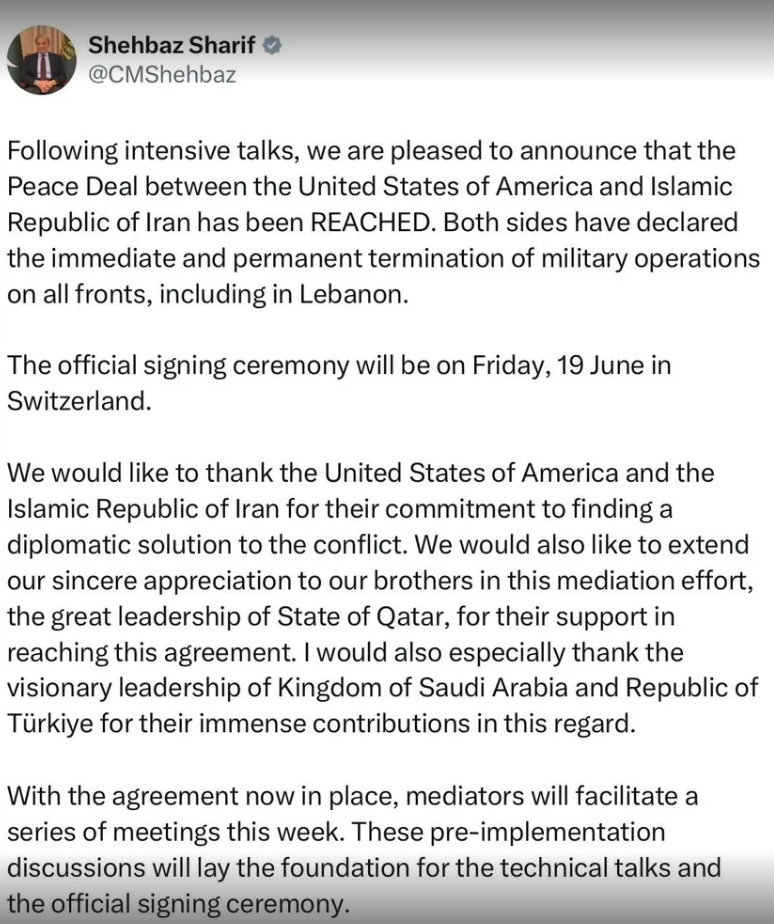
Trump weighed in, too. The Iranian foreign minister had said a day ago that people should not speculate too much about what is in the so-called memorandum of understanding that is at issue. But it leaked out:
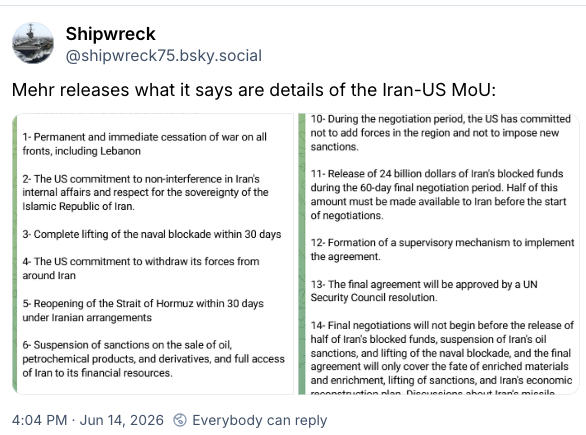
If that truly is what the deal is, and Obama had negotiated it, he would be impeached two minutes after signing it.
Here's a headline and subhead from [mostly paywalled] Haaretz, the center-left Israeli newspaper in continuous publication since its founding in 1918:
'Ayatollah's Total Victory': Netanyahu Rivals, Allies Bash Looming U.S.-Iran Deal
All of Netanyahu's centrist rivals say a possible U.S.-Iran deal 'fails to achieve any of Israel's war goals,' while a far-right minister said 'everything' about the emerging agreement is worrying.
I suspect we'll see some similar talk among the Tom Cottons of Congress. And while the Democrats overall will rightly criticize any deal Trump is likely to sign by comparing it to the 11-year-old nuclear agreement signed by President Barack Obama, the current Senate Minority Leader Chuck Schumer was Majority Leader and one of the four Democrats who voted against the Obama deal in a non-binding Senate resolution in 2015. His criticism of Trump's deal now is neither likely to be resolute or to resonate with many Democrats. If it had been up to him, after all, the Obama deal would never have happened in the first place.
The deal pushes off the nuclear details to negotiations during the next 60 days. So, nothing that signed will come close to even matching the Obama deal because the difficult parts of any nuclear agreement remain undecided. And those negotiations may not go smoothly either.
What the U.S. has done is launch a war in which probably multiple trillions of dollars were expended and infrastructure destroyed, and thousands of lives lost, all to get us back to where we were diplomatically before Trump and Prime Minister Benjamin Netanyahu fulfilled the decades-long fantasy of the prime minister's life. Consequently, environmental, economic, social, and diplomatic wreckage around the globe. Every indicator said don't do this. History, recent history, said don't do this. Reconstructed neoconservatives like Peter Beinart said don't do this. Mostly unreconstructed neocons like Bill Kristol said don't do this. The left, center, center right, and some of MAGA right said don't do this. But we were all ignored.
The toll has yet to really hit home. All this courtesy of two nuclear-armed nations — one of which snickers behind a veil of ambiguity about whether it even has built nuclear bombs that everybody knows it has — attack a non-nuclear nation to stop it from building a nuke that U.S. intelligence agencies say it has not been building.
As Bajoghli and Nasr write at Foreign Affairs, Trump “expected a quick victory through targeted assassinations of Iran’s leadership. But decapitation did not produce regime collapse. Instead, it opened the door for a new generation to take over.” Pity the Iranian people. Murderous assholes in charge at home. Abroad, the leader of the most powerful military ever on the planet talking shit about supporting a democratic uprising against the extremist regime while engaging in the one policy guaranteed to unify Iranians — bombing them and threatening the end of their civilization, just flat-out genocide. Add to this Secretary of War Crimes Pete Hegseth talking about no-quarter, no mercy military operations.
Stock manipulation with these alternate threats and retreats against Iran roiling the market certainly seems more than plausible, and with the Trump organization, the grift is always integral to every move. But Trump now wants Americans to believe that peace is at hand. I want to believe it. Fewer dead people is good.
But in his announcement on Saturday, Trump just had to end what was being presented as good news with a threat if the signing for some reason didn't happen, That would be met with "the ultimate alternative." For a man who has spent months threatening Iran with civilization-wide devastation, the phrase sounded less like a commitment to peace than a reminder that military coercion remains Washington's preferred instrument. As Sina Toossi of the Center for International Policy noted, the remark carried an unmistakable echo of a nuclear threat, another example of the apocalyptic rhetoric that has accompanied a war that never should have happened in the first place.
For decades, many paleo-conservatives and neo-conservatives by definition sought to pulverize the revolutionary theocrats running Iran. The neos thought that was a reasonable possibility after 9/11, but the fiasco of the Iraq intervention put an end to fulfilling that dream of Dick Cheney, Donald Rumsfeld, and the entire neocon cartel.
Iraq broke the back of the neocons, and President Obama's team negotiated a flawed but still valuable, vigorously monitored curtailment and slowdown of Iran's nuclear development, many of whose provisions would remain in place today. If only. So Mr. I've-Ended-Seven-Wars can claim another notch for his Nobel application.
The United States arrived at this moment amid lying boasts of victory and transformation ended with Washington scrambling for a diplomatic exit while many of the president's own allies openly expressed alarm about what he might concede in negotiations. The world's best dealmaker? Surely, the Iranians are overmatched and cowering?
Writing in The Atlantic, Tom Nichols argued that Trump entered the conflict with little understanding of either its objectives or its likely consequences. The advisers Trump was listening to mostly appeared convinced Iran's government would crumble under pressure and long-standing regional problems would disappear along with it. Regime change hovered over the conflict from the beginning, whether or not officials admitted it openly. When the Iranian state failed to collapse, however, the White House found itself searching for a new rationale, eventually narrowing its public focus to Iran's nuclear program and the promise of preventing Tehran from obtaining a bomb. Not once mentioned were Israel's nukes, built in secret with stolen matériel and deception.
You heard the narrowing focus on the reason for the attack in Trump's typical repeat-repeat-repeat methodology "Iran can't have a nuclear bomb," a stance he implied he'd invented when it has been taken by every president since Ronald Reagan. (Who himself had quite the tangled relationship with the revolutionary Iranian leaders). Until Trump, every president avoided anything more than diplomatic isolation, economic sanctions, cyberwarfare, and the occasional assassination of an Iranian nuclear scientist by Mossad hirelings on motorcycles.
But Trump raised the stakes. He repeatedly dismissed the Obama deal — officially the Joint Comprehensive Plan of Action (JCPOA). That had taken 20 months of high-level negotiations during which more than a modicum of actual trust and good will was achieved. Secretary John Kerry deserves some of the credit for that. But so do the underlings who do all the grueling detail work every day. "The worst deal ever," Trump sneered on the campaign trail in 2016. He, the dealmaker of all time, would have negotiated a good one he bragged with salesman guile.
The International Atomic Energy Association (IAEA) was in charge of monitoring the JCPOA. Every quarter it issued a report on whether all the parties were complying. The first report came out in April 2017. And Iran was fulfilling its obligations. So in office Trump waited in hopes that the next reports would show violations and give him an excuse to withdraw. After each of five reports gave Iran a thumbs-up, Trump summarily withdrew without excuse in May 2018, shortly before the sixth report showed full compliance once again.
He denounced the agreement as weak, reckless, and humiliating. He promised something tougher. Better. More effective. Instead, after years of escalating tensions, economic warfare and now open military conflict, the Trump regime appears poised to accept an arrangement that leaves Iran's government not only intact but more extreme while offering fewer restrictions than the deal Trump destroyed.
Some of the loudest criticism of the negotiations that has already come from Trump allies like Senators Lindsey Graham, Roger Wicker, and Ted Cruz might get a lot louder. Former National Security Adviser Michael Flynn earlier warned Trump not to rush toward an agreement. Former Secretary of State Mike Pompeo compared reports of the proposed framework to the kind of diplomacy associated with the Obama administration. The panic among Trump's allies reflects a simple reality: They increasingly fear that the war has produced precisely the outcome they were promised would never happen. If centrists in Israel don't like what they've heard about the agreement, U.S. critics on the right ought to be challenging it directly. But do any of these sycophants have the stomach for it? They shamelessly and incessantly kowtow to Trump.
The Strait of Hormuz has become a vivid reminder — as many predicted — that even the world's most powerful military cannot simply wish away geography, economics, or political complexity. Every tanker delayed, every insurance premium increased, every disruption to global energy flows becomes part of the actual cost of war, costs that rarely appear in presidential speeches but inevitably appear in household budgets and national balance sheets. And we're on the verge of a surge in prices even if the strait does instantly open as we've been told it will.
Despite the acute economic difficulties this war has generated globally, there is a silver lining that a bevy of reports has noted. The war has spurred electrification, a truly good thing. But it's also pushed more nations to reconsider their nuclear weapons stance. If the U.S. were to pull out of South Korea, should Seoul opt for a nuke? Or Taiwan? Or Japan? In those three nations, until recently even talking about the nuclear weapon option was taboo. Or maybe some other nation that would like to protect itself from a nuclear neighbor? There is an obvious message in that non-nuclear Iran got bombed and nuclear-armed North Korea didn't.
Non-proliferation seriously needs rejuvenation unless we're going to be faced with 15 or so nuclear-armed states instead of just the 9 existing ones.
To reiterate, thngs didn't have to be this way. It's all on Trump. Others certainly urged him on, and others have urged the bomb-bomb-bombing of Iran since 1979. But he gave the orders. He and they must pay. If as a nation we are ever to deter similar behavior — whoever is president — it requires us to finally mandate accountability whatever it takes.








Comments
We want Uncharted Blue to be a welcoming and progressive space.
Before commenting, make sure you've read our Community Guidelines.