
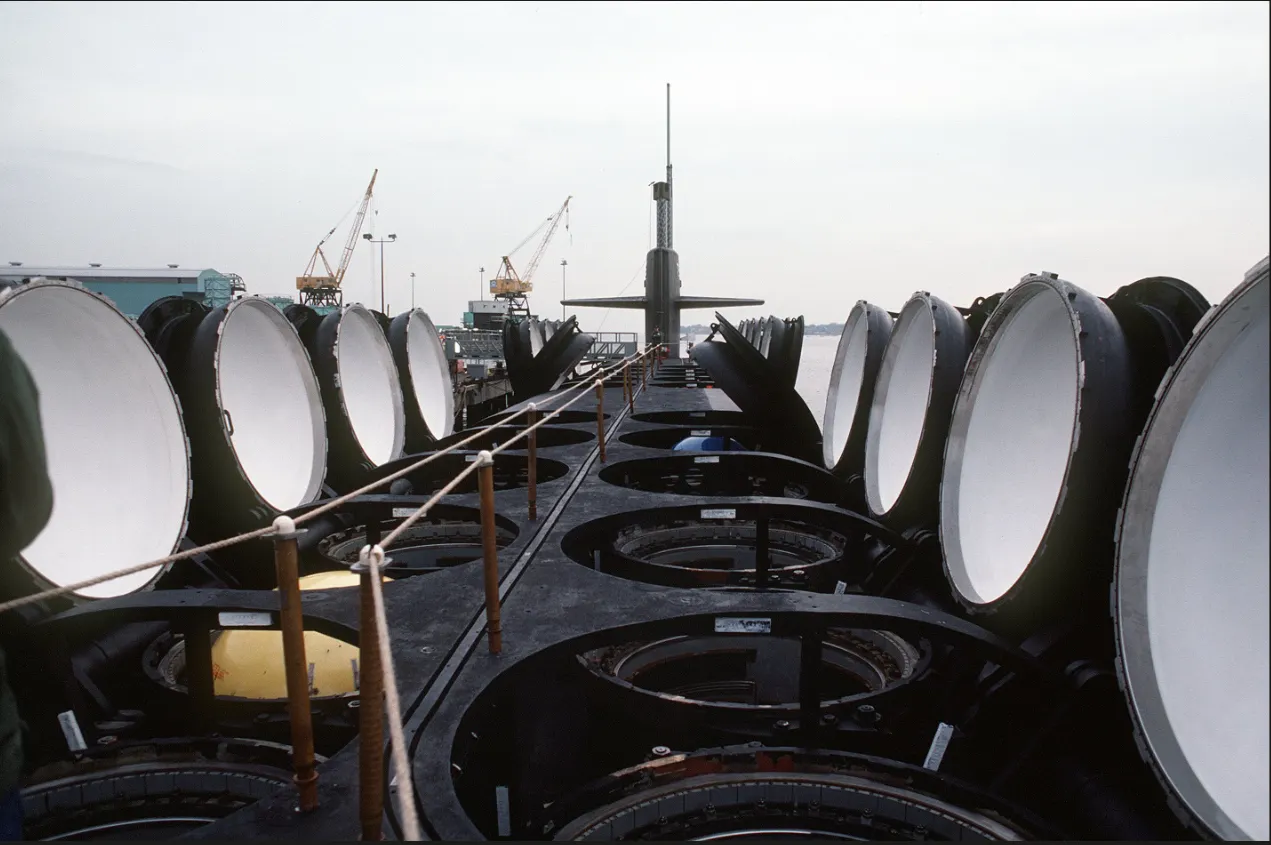
As the world's five major nuclear powers expand and upgrade their civilization-ending arsenals of weapons Tucker Carlson says were created by demons, a barely noticed month-long review conference of the nearly 60-year-old Nuclear Non-Proliferation Treaty collapsed last Friday without adopting a final statement. I made previous note of this likelihood here and here. Which took zero clairvoyance.
After all, the NPT mandates a review be undertaken every five years, and no final statement was adopted for the 2015 or 2022 reviews either. Third time wasn't a charm to nobody's surprise. Read through the statements of the 2026 RevCon — as they're called in the jargon — to see that the frustration is palpable, if diplomatically phrased.
The pitiful lack of major U.S. media coverage was only broken by a misleading 13-paragraph Washington Post piece implying by omission that the RevCon's failure was due to Iranian and U.S. intransigence over a single line in what came to be the unadopted final text.
Because so many people these days just cannot make distinctions, let me note that I carry no brief for the murderous, delusional, and otherwise deeply fucked-up Iranian leadership. May they rot. But the third consecutive failure didn't happen because of Iran. The failure came about because the nuclear-armed states signatory to the NPT — the very governments charged with upholding the treaty’s central bargain — arrived in New York for the review determined to preserve a global order in which nuclear weapons remain instruments of prestige, coercion, and strategic hierarchy for themselves while remaining forbidden to everyone else.
The original agreement, the lure that spurred non-nuclear nations to stay non-nuclear when they signed on in the late '60s and beyond, was that they would gain access to civilian nuclear technology and knowhow in exchange for shucking nuclear weapons of their own. And — a crucial AND — the nuclear-armed nations would move toward collectively eliminating their own nukes.
That lure was developed in 1965, when the possibility of such a treaty was first publicly discussed. It was powerful, practical, and utterly sensible. And it presaged a time when nuclear arsenals not only peaked but soon began a steep decline as arms agreements were signed. But now, at the verge of its seventh decade, in a world where all moves toward nuclear disarmament are in reverse, the treaty is in trouble. Daryl Kimball, executive director of the Washington-based Arms Control Association, told the Post the conference “showed that rhetorical support for the NPT is strong, but the foundations of the NPT are cracking due to inaction, inattention, and intransigence on the part of the major powers.” Ya think? Once again, words on paper or pixels mean nothing without deeds on the ground.
Tariq Rauf takes a rather harsher view than Kimball. A Pakistani-born Canadian with a lengthy and distinguished résumé in the non-proliferation world, he writes of the RevCon:
Even before the final collapse, the trajectory of the draft outcome documents told a damning story. The Conference President’s penultimate draft, circulated in the small hours of Thursday 21 May, had already stripped the text of virtually every meaningful disarmament commitment. A paragraph-by-paragraph comparison circulated by me to diplomats in Vienna of the two final versions of the draft — designated CRP.2/Rev.3 and CRP.4 — makes the steady erosion visible in granular, vertiginous detail.
Urgency was deleted. The affirmation that the indefinite extension of the NPT does not mean the indefinite possession of nuclear weapons was gone. Past commitments from 1995, 2000 and 2010 were no longer reaffirmed — merely “recalled,” like something vaguely remembered from a distant past. The word “urge” directed at nuclear-armed States was softened to “call on.” The requirement for “equal” transparency by nuclear-weapon States was quietly excised. The reference to the “catastrophic humanitarian consequences of the use of nuclear weapons” was narrowed to the consequences of “nuclear war” — as if the distinction matters to those who have already experienced a detonation.
SELECTIVE COMPLIANCE
Let's be clear here. The original nuclear armed nations — the United States, China, Russia, the UK, and France — have worked to keep nuclear weapons out of the hands of most non-nuclear states. Not a bad thing per se. But they've done this while turning a blind eye (or worse) to the behavior of three non-signators and one former signator of the treaty: Israel, India, Pakistan, and North Korea.
As I've written before, the world's non-nuclear states aren't too happy with the implementation of the first part of the NPT bargain. The slow and pinched spread of civilian nuclear tech by the nuclear-armed hierarchy under Article IV. Sixty years is quite the rollout. But unhappy is one thing and those who govern these states are utterly incensed with the failure of the nuclear-armed states to make more progress on getting rid of their nukes as Article VI clearly requires as part of the bargain.
And now the nuclear states are spending trillions of dollars to build more and better such weapons. Including, it should be noted, lower-yield weapons that reduce the threshold for their use. As a consequence of this and the NPT's inconclusive reviews, 99 of the NPT's signators, a big majority, have signed onto the proposed Treaty for the Prohibition of Nuclear War. No nuclear-armed nation has yet signed on or shown up for a TPNW conference.
What's always disturbing about disarmament conferences is how thoroughly discussions of deterrence and strategic balance often float above the human reality of what nuclear weapons actually do. Sure, all the delegates obviously know what they do. Nevertheless, the language of megatons, force posture, counterforce targeting, and escalation ladders creates an antiseptic vocabulary that obscures the fact that these weapons are designed to incinerate cities, collapse health systems, poison ecosystems, and leave generations living amid radiation exposure and relentless trauma.
In 1982, at the New York City anti-nuclear weapons demonstration of a police-estimated million participants, I interviewed several hibakusha, survivors of the Hiroshima and Nagasaki bombings selling origami peace cranes to spread the to No Nukes word. The youngest survivors are now pushing 90. Hibakusha have spent decades warning the world that nuclear weapons are not abstract geopolitical tools but mechanisms of industrialized human extermination. In Hiroshima alone, roughly 140,000 people were dead by the end of 1945 as a result of "Little Boy." Many perished instantly beneath temperatures hotter than the surface of the sun. Others died slowly from burns, radiation sickness, organ failure, and infections in a shattered medical system incapable of treating mass casualties on that scale. Later on, cancer took more lives.
Modern arsenals are exponentially more destructive, with one common American warhead 20 times more powerful than the Hiroshima bomb. But the United States is currently building some "low-yield weapons" with about half the power of the one the hibakusha saw. The very phrase “low-yield nuclear weapon” reveals how thoroughly deterrence doctrine has normalized the previously unthinkable. Hiroshima today sits within the lower range of yields discussed by strategists in antiseptic language about “limited” nuclear options and “escalation control.”
Scientists for years have warned that even a limited regional nuclear exchange — for example between India and Pakistan — could inject enough soot into the upper atmosphere to disrupt global agriculture and trigger mass famine affecting hundreds of millions, potentially billions, of people. Climate researchers including Alan Robock and Brian Toon have repeatedly shown that nuclear war and climate catastrophe are not separate threats but deeply interconnected ones. Firestorms ignited by urban nuclear detonations could darken skies, shorten growing seasons, destabilize food systems, and intensify the very global inequalities already worsened by climate change.
In that sense, the nuclear powers’ failure to move seriously toward disarmament represents not merely a security failure but a civilizational one. Humanity is already struggling to manage ecological breakdown, forced migration, democratic decay, pandemics, and widening inequality. Yet the wealthiest and most militarily powerful states continue investing extraordinary resources into weapons capable of turning those overlapping crises into irreversible planetary trauma.
The nuclear states still posture toward disarmament. They continue speaking the language of eventual abolition. Bu, as noted,t they are budgeting trillions for modernization programs, refining doctrines for deterrence and battlefield use, and treating Article VI of the treaty — the commitment made as part of the bargain to pursue nuclear disarmament — as a kind of ceremonial aspiration rather than a binding obligation.
ATTACK ON IRAN ATTACKS NPT CREDIBILITY
The timing of the review conference made the contradictions impossible to ignore. Only weeks earlier, the United States and Israel had carried out secondary strikes against Iranian nuclear facilities amid the widening regional conflict that now dominates Middle Eastern geopolitics and threatens global energy markets.
Reasonable people can argue about Iran’s uranium enrichment, especially given its history of deception prior to 2003. But the broader message sent by the U.S.-Israel June 2025 attacks on facilities that at the time were safeguarded by the International Energy Agency inside a non-nuclear NPT member-state is devastating to the treaty’s credibility. All the more so since one of the attackers is an outrageously undeclared nuclear state not signatory to the NPT. A state that developed its own nukes with stolen fissile material and deception. Much of the world sees this as a pair of nuclear-armed governments reserving to themselves the right to strike countries that lack nuclear weapons insisting those countries remain permanently non-nuclear while the nuclear-armed states permanently keep theirs.
This perception has become central to the crisis now engulfing the NPT. The treaty was always structurally unequal. When it entered into force in 1970 those five original nuclear-armed countries were effectively recognized as legitimate nuclear powers while the rest of the world agreed not to develop such weapons. The arrangement has survived for decades not because it's fair, but because many non-nuclear states believed the nuclear powers were at least nominally moving toward eventual reductions while providing some degree of strategic stability. And for while they were, with agreements between the two largest nuclear powers — the Soviet Union and the U.S. — reducing combined arsenals from nearly 70,000 warheads to around 10,000.
As noted, however, each of the five original nuclear states is now modernizing or expanding its arsenal in some fashion. The U.S. plans to spend roughly $1.7 trillion over two decades rebuilding every component of its nuclear triad. Russia continues emphasizing nuclear deterrence amid the Ukraine war while repeatedly engaging in reckless nuclear signaling and growing its nuclear weapons. China is constructing new missile silos and increasing warhead production at a pace that alarms Western analysts. Britain has reversed previous commitments to reduce its stockpile ceiling, and France continues treating nuclear weapons as indispensable to its conception of strategic independence.
Outside the treaty framework, India and Pakistan maintain expanding arsenals while Israel preserves its longstanding policy of nuclear opacity. North Korea, having withdrawn from the NPT years ago, now possesses an operational nuclear weapons capability despite decades of sanctions and diplomatic isolation.
Against this backdrop, repeated demands that non-nuclear states simply trust the system increasingly ring hollow. The loss of confidence matters. When the rules are fundamentally selective, treaty compliance begins to look less like responsible international citizenship and more like accepting strategic vulnerability. The examples accumulating over the past two decades reinforce precisely that fear. Ukraine surrendered the Soviet nuclear arsenal left on its territory after the USSR collapsed, only to face invasion by Russia decades later. Libya abandoned its weapons programs and later experienced regime change backed by NATO powers. Iran entered the Joint Comprehensive Plan of Action in 2015 and accepted some of the most intrusive inspection measures ever negotiated, only to watch the United States abandon the agreement in 2018 and later partner with Israel in military strikes against Iranian facilities.
The nuclear powers’ failure to move seriously toward disarmament represents not merely a security failure but a civilizational one. Humanity is already struggling to manage ecological breakdown, forced migration, democratic decay, pandemics, and widening inequality. Yet the wealthiest and most militarily powerful states continue investing extraordinary resources into weapons capable of turning those overlapping crises into irreversible planetary trauma.
The same governments pouring astronomical sums into this are simultaneously failing to adequately confront climate breakdown, food insecurity, refugee displacement, public health crises, and democratic erosion. Nuclear weapons occupy the apex of a broader system in which militarization consistently outranks human survival in budgetary and political priorities.
Increasingly, deterrence doctrine resembles less a coherent long-term strategy than a form of institutionalized superstition masquerading as realism. Political leaders continue insisting nuclear weapons preserve peace because catastrophe has not yet occurred, even as arms-control agreements decay, great-power tensions intensify, cyberwarfare complicates command systems, and regional conflicts increasingly involve nuclear-armed states directly or indirectly.
The Treaty on the Prohibition of Nuclear Weapons emerged largely because non-nuclear states concluded the NPT process had become paralyzed by the self-interest of the major powers. Civil society groups, hibakusha survivors, and many governments in the Global South continue arguing that nuclear weapons should be treated no differently from chemical or biological weapons — as fundamentally illegitimate under any circumstances.
The nuclear powers dismiss those efforts as unrealistic while offering no credible pathway of their own beyond indefinite deterrence and perpetual upgrading and enhancing.
As Rauf notes:
The 2000 Review Conference produced an “unequivocal undertaking” by the N5 to eliminate their arsenals. These are not aspirational statements; they are solemn, negotiated legal commitments. The argument that the NPT also is not a nuclear disarmament treaty is, in practice, empirically false. It encapsulates precisely the interpretation that the overwhelming majority of non-nuclear-weapon States — from the Non-Aligned Movement (NAC) to the New Agenda Coalition (NAC) to individual States like Austria, Brazil, Canada, Indonesia, Ireland, Malaysia, Mexico, New Zealand and South Africa, among others — have spent decades resisting. Canada — a loyal NATO ally and no radical voice — gently but firmly rejected the US framing, calling on nuclear-weapon States simply to “honour their word.”
No outsiders want Iran to have nukes. But for the Big Five and their allies to demand Iran live up to the NPT while themselves behaving directly contrary to one of its key articles is a symptom not a cause of the review conference's failure.
How the Iran War undermines the nuclear nonproliferation regime
United States nuclear weapons, 2026
United Kingdom nuclear weapons, 2024
Pakistani nuclear weapons, 2025











Comments
We want Uncharted Blue to be a welcoming and progressive space.
Before commenting, make sure you've read our Community Guidelines.