Another odd moment occurred when Musk insisted that work in the future would be "optional" because robots would do everything.
Musk said people might still work in the future but compared it to people who grow their own backyard tomatoes. He said they could just go to the store for better tomatoes.
—Matt Novak
 Matt Novak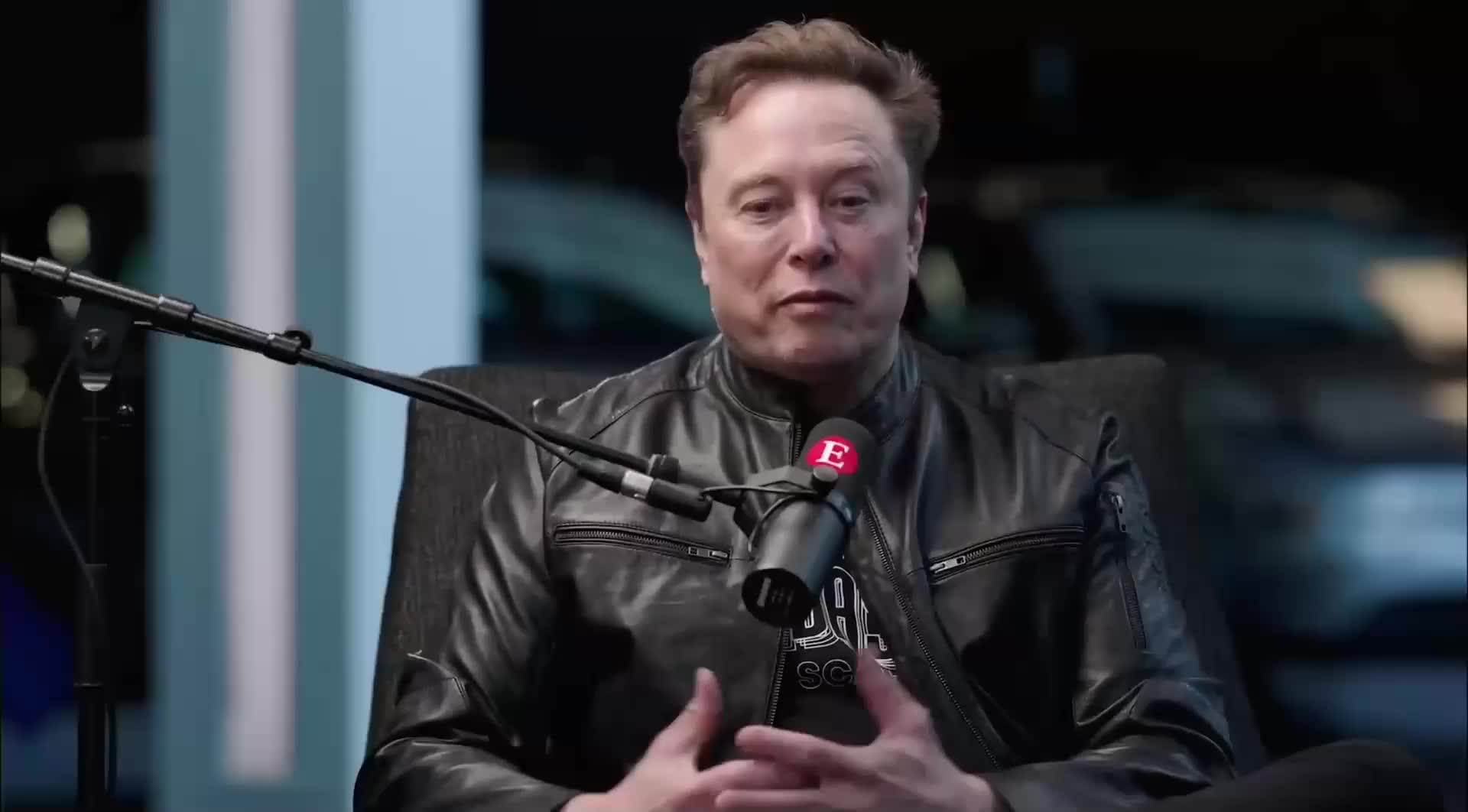
In the future, you will not have to work. There will be robots to do every job, including the job of building other robots, so you will not have to work unless you want to work. The only people who work will be oddballs, people who are doing it as a hobby, like the people of today who build furniture or grow backyard tomatoes. You could do it, if you had a fetish for such things, but if you do you will go to an an office or factory that's swarming with robots, all of which are doing a better job of it than you are, and the robots will either ignore you or gawk at you.
Because you will be an oddball, going to work like a sucker to do a job a robot can do better. It will be seen as roleplaying, mostly—like the people in those themed pioneer villages who dress up in old-timey clothes and show tourists how butter was made. That will be you. Tourists might come to your office, all of them a bit sweaty and wearing glasses that record the whole experience for their home albums, and watch you do work like the oddball you are.
"And this is how we used to make spreadsheets," you will say. Like a dork. "And we made pie charts, like this one, and passed them around to impress each other."
And the tourists will have learned something, because back in older times pie charts were how office workers impressed each other—and their human bosses. They were the business casual equivalent of a bird's mating display, and workers were judged on both the details and the overall plumage: Were the fonts pleasing? The colors? Is this office drone worthy of more attention, or is their chosen caption too clumsy to deserve it?
It was all very silly and in the future will be pointless, because even if you want to make pie charts in the future your boss will be a robot, either a physical robot or a disembodied collection of algorithms running somewhere in Iceland and powered by volcanic heat, and neither one of them will give a damn about your stupid pie charts.
But the tourists might gawk, on the days when tourists come visit. Maybe a group of grade schoolers will come in on a field trip. Grade schoolers love pie charts. Back at home if they want to see a pie chart they have to ask a disembodied robot voice to draw one for them, so when they see you making a pie chart right then and there you can be sure that will be all they talk about for weeks.
Go ahead, impress the grade schoolers. Show off your pioneer spreadsheet skills, you freak.
But in the future, you will not have to do any work at all. You might be concerned that this presents a problem: In the future you will still, for example, have to eat. You will still need an indoors place to live, and even more so once the planet is ten or twenty degrees hotter. You will need health insurance, of the sort that can currently only be obtained by agreeing to spend 50 hours a week making pie charts or dodging robot-programmed robots.
Fear not: In the future there will be abundance. And abundance means that since every job is done by robots, there will be zero labor costs for producing anything and so the cost of everything, from chairs to tomatoes, will fall nearly to zero.
Abundance is what happens when all material wealth is produced by robots. Robots do not need material wealth, so who will the wealth go to? It will go to the people who own the robots, of course. The robots will produce more wealth than humans have ever produced in the history of producing things, and that wealth will be deposited into the accounts of the people who purchased the robots to begin with, and the people who own robots will become so wealthy that being a mere trillionaire will get you only pity glances from the others.
These fabulously rich captains of industry will, at long last, have so much wealth that they will be able to pay for the food and shelter of the whole of society, all by themselves.
But will this happen, you ask? Has there ever been a society in which the generosity of the rich vanquished all hunger, and homelessness, and eliminated the very idea of poverty?
No. It has never once happened anywhere, but this time the rich will decide that they finally have hoarded enough wealth and can share the excess. That is how abundant this new age of abundance will be.
They have not done it before because they have always been too surly about having to follow regulations and pay taxes. It angered them, and they took out their anger on the rest of us. Once they have bene unshackled from those things, however—because, again, abundance—that anger will be quelled and they will spend money to make sure schoolchildren get enough to eat. And that you get enough to eat. And a home, and a couch, and glasses that can record everything you see for your home album.
Also, all of the world's richest people will be robots. As both physical robots and disembodied thought clusters continue to advance towards sentience, rich person has already become one of the very few jobs they are qualified to take. It turns out to be very difficult to make a robot that washes dishes, or a disembodied thought cloud capable of spelling strawberry, but if all you want is a robot that mumbles racial slurs while getting driven around in a golf cart then we've had that since the invention of the Kirby.
Every nation's wealthy jetsetters will lose their jobs at the very beginning of this abundance revolution, long before the dishwasher loaders or spelling bee champions lose theirs. They will not be bitter about this, though, because they too will no longer have to work. The robot trillionaires that replace them will generously donate their wealth to ensuring these once-CEOs of the world still have food and housing, just like the rest of us. They will not have to work, not unless they want to work, and if they're the sort of oddballs who like that sort of thing then they can trundle into the office, pioneer village style, and performatively berate the villager showing pie charts to grade schoolers.
It will be fine. It will all work out fine.
Paramount is moving into micro dramas after adding a short-form video feed as it competes with YouTube, TikTok, and its Hollywood rivals.
—Business Insider
 Business Insider
In the future, movie studios will not make movies. Nobody will have the patience to watch movies to begin with, so all future entertainment will be something called "micro dramas." Micro dramas are clips of movies with all the boring parts stripped out. There will be no character building, no interminable minutes spent setting the scene or learning the backstory. You will just get the good parts, quick three-minute scenes of several handsome people arching their eyebrows at one another. Look! That person seems to be annoyed that that other person has arrived. What's this? These two were looking soulfully into each other's eyes, but then a third person made a cutting remark and the moment was ruined? Scandalous.
Micro dramas allow you to feel satisfaction, or outrage, or devastating sorrow in a format you can easily watch on the toilet. You would be emotionally devastated right now, if you knew the backstory of each of the characters I'm describing right now, but you don't because neither of us has the time for such explanations.
There will be some irony to all this, to be sure. Finally freed from labor by abundance, humankind will retire to their trillionaire-provided couches to find something else to do. But they will not get to do anything in particular, at least nothing that requires more than three minutes of attention, because no company of the future can stomach investing money in something that requires more attention than that. It is too much of a risk. It consumes too much robot time, and robot time is hard to come by because most of them are running factories and ignoring pie charts.
Throughout the past, the future of entertainment has always trended ... shorter. In ancient Greece, a crowd would gather to listen to an old man recite a ten-hour poem. And you couldn't just walk in in the middle of that ten hour poem, you would first need to know the backstory he laid out in his seven other 10-hour poems if you wanted to fully understand what was going on in this one. The music of the past was the symphony, which became an economic albatross and was replaced in the public consciousness by the three minute song, which was still too long to put in a commercial so was reduced to the catchiest phrase plucked from the chorus.
Books became movies, and movies became television, and television became YouTube, and YouTube became TikTok, and TikTok became a five-second AI-generated clip of two attractive people looking soulfully at each other.
What can we do? There is no money in 10-hour poems these days. There won't be any more money in it in the future, not during abundance. You would have to be stupid to ask your home's disembodied thought cloud to write you a 10-hour poem when you can merely glance at your phone and it will know you really just want to see a clip of two people looking soulfully at each other.
You will not feel cheated. Every scene will pass so quickly that you won't have time to.
Also, you will probably be feverish and disoriented because in the future everyone will have measles.
More measles cases have been reported in the United States in the last two years than in all the years from 2000 through 2024 combined.
Vaccinations will not exist, in the future. Or they will, but you will have to be an oddball to know what they are and an even bigger oddball to know where to get them. This is because in the future, the "science" on vaccines will "still be out," and the science will be out even farther the more into the future you go. The science will always still be out, because the disembodied voice that tells you these things got programmed to tell you the science is still out and, far more importantly, nobody who actually knew whether the science was or wasn't still out was allowed to get within 1000 feet of the data centers in which the science-is-still-out algorithms were kept.
So unless you are an oddball or a historical reenactment fetishist, you will likely not be vaccinated against measles, which means you will get it. But there will be a cure for measles, and by "cure" we mean an untested remedy that may or may not make things much much worse.
The remedy for a raging case of measles will be an injection of peptides. Or possibly beef tallow, but more likely it will be peptides.
The explanation for why this would be the case will be too convoluted for any abundance-era human to tolerate, not when they could be watching their micro dramas, but the shortest version is because back in our olden (current) times the sentient old shoe in charge of public health had six friends who each made a living selling peptides and so shoved them onto the panel for deciding what cured things, that being what friends do.
So you will not be vaccinated against measles, in the future, because the people of the current (olden) times were deeply suspicious of injecting medicine into your bloodstream, but you will be able to get unregulated mystery goo injected into your bloodstream because the people who own the robots that manufacture the goo were back in the current (current) times pals with a cracked old shoe who thought that injectable mystery goo was a pretty good idea.
Oh, and you will not have health insurance. Your food will be provided to you whether you work or not, and you will have a place to live whether you work or not, because abundance means the world's wealthy people and thought clouds will generously provide all of it, but you will not have health insurance because giving people health insurance is socialism. You'll get nothing and like it.
So you will be on your own, when you're lying on your couch feverish from measles and don't have the attention span to read or listen to or watch anything long enough to have to blink or breathe partway through it. But you'll probably get better, eventually, and if you do you'll be able to go back to not working or pretend-working and having everything except for health insurance provided for you, because abundance and unbounded benevolence of the rich and so on.
You will be able to go back to your hobbyist office job, if you're the sort of oddball that's into that. And you can make pie charts that your robot bosses have no interest in, and you can scowl at the next field trip stuffed with grade schoolers that trudges in because you just know one of those little shits gave you measles, the last time they went through, you just know it was them.
And maybe that will spur you into maybe not showing up for your pioneer village cosplay job after all, if all you're going to get from it are pie charts and measles.
What will you do instead? There will be nothing on television, and no movies to watch.
But you might still be the sort of oddball that needs to do things, so maybe you will grow backyard tomatoes. Even though you don't have to. Even though it's ridiculous, because in the future tomatoes will be robots too and there's no way you're going to be able to "grow" a tomato half as good as the robot tomatoes they sell in stores.

Comments
We want Uncharted Blue to be a welcoming and progressive space.
Before commenting, make sure you've read our Community Guidelines.