


The 31st annual climate summit's failure in Türkiye to confront the principal cause of global warming was no diplomatic accident. It was the predictable result of allowing fossil-fuel profiteers to dictate the terms of discussion. Despite going into two days of overtime after two weeks of what some critics are labeling the worst COP31 ever — which is saying a lot — the EU, UK, Canada, and several smaller nations couldn't even get a mention of a global fossil-fuel phaseout into the conference's final statement.
Not a surprise given that more than 100 corporations and industry groups sent delegates to undermine climate action and block any focus on a phaseout. They had plenty of help from petrostates Russia and Saudi Arabia. If the Trump regime had been there instead of boycotting the talks, it would no doubt have joined those two dictatorships in the scuttling.
What those interests wanted in the final statement was support for carbon capture and storage, CCS, expensive technologies that have yet to be deployed at anything close to the scale that would be needed to clean up the mess we're still making. And they succeeded in getting this into the proposed final draft.
But the European Union, Britain, Norway, Panama, and numerous vulnerable developing countries refused to endorse it. The summit's Turkish co-presidency ultimately acknowledged that consensus was impossible. Here's The Guardian's account of the collapse.
“It is unconscionable that we would have a climate pact that makes no reference to fossil fuels — and no reference to transition away from fossil fuel either,” said Darragh O’Brien, climate minister in Ireland. “We will not endorse a decision that does not respond to the science and that actually risks deepening the chasm between global commitments and the action required,” he said.
Said Harjeet Singh of the Fill the Fund campaign and Founding Director of the Satat Sampada Climate Foundation:
“Parties were right to reject this text. It failed the people it was meant to protect. Rich countries refused to put money on the table to help communities prepare for and recover from climate disasters, and handed polluters a free pass instead. No deal is better than a deal that locks in failure. But this cannot become an excuse for more delay: the money and the plan must now come.
“This text would have made Antalya the COP that opened the floodgates to carbon capture. It deleted the renewables target, handed the fossil fuel industry a gigatonne-scale lifeline, and would have licensed land grabs from Indigenous Peoples and farmers in the Global South. Its rejection must close those floodgates for good.”
There was another failure, too, providing developing economies with the money they need to change their own energy systems. It's all very well for wealthy nations to urge poorer ones to abandon coal, oil, and natural gas, build renewable generating capacity, modernize electrical grids, install storage systems, and electrify transportation and industry. Those transformations all need doing but cost enormous sums, and the countries that have contributed least to the accumulation of greenhouse gases are being asked to finance much of the transition themselves.
Developed nations have repeatedly promised climate-related assistance, but delivery has lagged far behind the promises. The existing $300 billion annual climate-finance goal agreed at COP29 was maintained in Antayla. But negotiators couldn't agree on a specific annual target for adaptation finance to include in this year's final statement. An earlier COP31 draft proposed $120 billion a year by 2035. That figure disappeared from subsequent versions, leaving only a vague commitment to triple funding without establishing a baseline or a credible path to achieving it.
Nor did the conference produce the predictable, accessible, grant-based financing developing countries need to make their own emissions reductions. The hypocrisy is difficult to miss: wealthy nations and the fossil-fuel companies that have profited from more than a century of carbon pollution want poorer countries to leapfrog fossil fuels, but aren't prepared to provide the resources to make that possible.
On Nov. 18, Panama's environment minister, Juan Carlos Navarro, delivered a message that should have been engraved above the entrance to every negotiating room at COP31. The world, he said, was being “held hostage by the petroleum mafia.” Worse, he added, “We are in love with our kidnappers.” The oil and gas industry, he said, had persuaded governments that its continued destruction of the planet was being done for our own good.
This wasn't simply another disappointing diplomatic compromise. It was a demonstration of how thoroughly the interests of fossil-fuel producers have, over the years, infiltrated and sabotaged the international process established decades ago to confront the climate crisis.
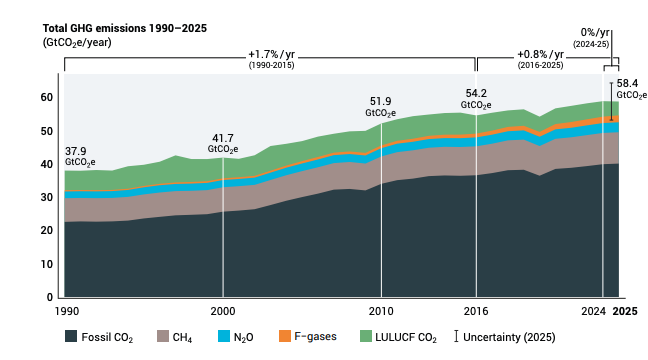
This technical solution isn't complicated. Burning coal, oil, and natural gas is the principal driver of global warming. We've known it for decades. The science is settled unless you're writing for The Wall Street Journal's opinion pages. The response is straightforward: Stop expanding the extracting, transporting, refining, and consuming of those fuels and replace them as rapidly as possible with clean alternatives. Yet the countries most determined to protect the fossil-fuel business managed to make even saying that out loud unacceptable to the conference presidency. Meanwhile, many rich countries have retreated on the climate goals and pledges.
At COP28 in Dubai in 2023, governments agreed to language calling for a transition away from fossil fuels. That was hardly the binding phaseout timetable climate scientists, activists, and vulnerable nations wanted, but it at least represented an acknowledgment of reality. At COP31, even that modest language proved too much for the petroleum interests and their government allies. A conference convened to address the greatest environmental emergency facing humanity couldn't bring itself to name the principal cause of the emergency in its main political statement.
Electrification is not a substitute for eliminating fossil fuels
Defenders of the conference's proposed outcome point to one important achievement: Türkiye's 35-by-35 electrification initiative. The goal, supported by more than 90 countries, is to increase electricity's share of global final energy consumption from roughly 23% today to 35% by 2035. That would be significant progress. Electrifying transportation, buildings, and industrial processes can dramatically reduce energy consumption and emissions.
But there's a catch that the initiative's celebrants would rather not discuss. Where will all that additional electricity come from?
If new demand is met solely with wind, solar, hydro, nuclear, geothermal, and other low-carbon sources, electrification can displace fossil fuels. If it is met partly by new coal and natural gas plants, the climate benefits are substantially diminished. And if renewable generation is simply added to an expanding energy system while fossil- fuel production and consumption continue growing, the world will wind up with more clean energy and more fossil-fuel use simultaneously. And more overheating. Plus, fossil fuels currently kill 7-8 million people yearly from non-greenhouse gas pollution.
This isn't hypothetical. The U.N.'s 2025 energy transition assessment makes clear why simply increasing renewable capacity isn't enough. Between 2015 and 2024, global fossil fuel energy supply grew 12%, the report found. But as renewable energy expanded, during the same period, 736 gigawatts of additional fossil-fuel electricity capacity were also installed.
To be clear, renewable energy is already preventing enormous quantities of fossil-fuel consumption. The International Energy Agency estimates that without renewable expansion since 2010, global fossil-fuel demand in 2025 would have been about 8% higher. That's an enormous achievement. But avoiding additional consumption is not the same as eliminating existing consumption.
The IEA's 2026 Global Energy Review also found that demand for all three major fossil fuels increased in 2025, although the rate of growth slowed. Solar and other low-emissions sources are making substantial inroads, but the fossil-fuel business is still expanding too. What backers of a phaseout have insisted is that electrification be accompanied by an actual, enforceable reduction in fossil-fuel production.
Carbon capture: The fossil fuel industry's escape hatch
From the standpoint of industry and its politiican puppets, the proposition of sucking up carbon dioxide emission and stashing them out of sight sounds attractive: Salvation without requiring fossil-fuel interests to abandon the business models that made them wealthy.
Except that carbon capture is nowhere near capable of delivering what its advocates promise. Here's climate scientist and marine biogeochemist David Ho:
I have many thoughts about CO₂ removal (CDR) and this is one of them.
— David Ho (@davidho.bsky.social) 2026-11-22T09:40:38.297Z
It is a real technology, and it has legitimate applications, particularly in industrial processes where eliminating emissions is exceptionally difficult. But its deployment remains limited, its costs are high, and its effectiveness depends on the particular application, infrastructure, and permanence of storage. Several carbon capture operations have failed outright.
Consider the comparison cited by Climate Analytics in its COP31 briefing last week. Wind and solar avoided about 4.3 billion metric tons of CO2 emissions in 2025. Global carbon capture capacity stood at about 62 million tons. That's an enormous difference between technologies already delivering emissions reductions at scale and one whose advocates promise far more than it currently delivers with technologies that have not proved themselves. The economics are hardly reassuring, either.
None of this means carbon capture has no future. However, presenting it as a justification for continuing to expand fossil fuel production is an extraordinarily dangerous gamble. We are fools if we allow the survival of a livable planet to depend on a technology that has yet to demonstrate anything approaching the required global scale, and may never do so.
Who actually pays for this failure?
More than 130 developing countries at COP31 demanded faster emissions reductions by wealthy nations and substantially greater adaptation financing. They wanted grants, not additional loans that would deepen already crushing debt burdens. They wanted meaningful commitments to help communities cope with rising seas, devastating heat, drought, flooding, and agricultural destruction. They didn't get it. And the petroleum mafia got another reprieve.
As Ghana's environment minister, Zanetor Agyeman-Rawlings, put it during the negotiations: “Africa is not a continent merely seeking assistance. We are asking the developed countries to keep promises that they already made.”
There were achievements at COP31. More than 90 countries backed the electrification initiative. Some nations advanced plans to phase out fossil fuels independently of the U.N. process. Thirty countries, including Panama, joined efforts to develop a fossil-fuel nonproliferation treaty. But we shouldn't confuse individual initiatives with the collective failure.
The fossil-fuel industry didn't need to win an argument about climate science. It needed only to prevent governments from agreeing on what to do about the science. The lesson climate activists, scientists, and rank-and-file citizens should take seriously? We cannot negotiate our way out of the climate crisis by allowing the industries responsible for creating it to determine the limits of our ambition. We cannot keep offering them loopholes, technological fig leaves, and endless extensions while the atmosphere continues accumulating greenhouse gases.
The world doesn't need another global gathering to postpone essential decisions. Navarro is right. We're being held hostage. But the kidnappers aren't invincible. Governments can stop subsidizing them, stop approving new fossil-fuel projects, stop treating their profits as a higher priority than human well-being, and start putting the public interest ahead of the petroleum industry's demands. COP31 failed to do that. And there's zero reason to believe COP32 will be any different.
Dealing with the climate crisis ought to be, must be, a cooperative global undertaking. It's clear these annual summits have become as much of a hindrance as a spur to such cooperation.












Comments
We want Uncharted Blue to be a welcoming and progressive space.
Before commenting, make sure you've read our Community Guidelines.