

The Trump-initiated war on Iran is no closer to a resolution today than it was two weeks ago, and enough time has passed that much of the Gulf oil already in transit has already been delivered—meaning the actual effects of the oil shortage, rather than the merely theoretical effects, are now being felt.
Nonetheless, "the markets" remain bullish on none of this being a problem, not in the slightest, nothing to worry about or see here.
The S&P 500 hit a fresh record high on Wednesday, reflecting investors’ optimism that a peace deal would be reached before the war in Iran could inflict significant damage on corporate America.
The benchmark stock index, which is widely watched across the world as a barometer of the health of the U.S. market, rose about 0.8 percent to close above 7,000 and higher than its previous peak, reached in January. The index had already erased its losses during the war in Iran and now sits 2 percent higher than it was before the fighting began in late February.
For several years now I've been harboring suspicions that Wall Street has become so untethered from real-world events that it ought to be considered more a haven for degenerate gamblers than an engine of commerce—a fancier sort of Polymarket that caters to men who own ties. I've still seen nothing to contradict that theory, and at this point I think most of the world's top financial experts are leaning towards that premise themselves.
The International Monetary Fund said on Tuesday that disruptions to oil markets could slow growth, fuel inflation and raise the possibility of a global recession. Even if the war is short-lived, the damage to the global economy has been done, the I.M.F. warned as it cut its forecasts for economic growth.
“What is a little strange is that there is a tendency by some to assume that it’s business as usual,” Christine Lagarde, the president of the European Central Bank, said on Tuesday when asked about the seeming exuberance of markets at an event held by Bloomberg in Washington.
So we're just now on the cusp of the major real-world economic impacts of the war, and somehow the drunks and reprobates currently making their careers on Wall Street think that this means the world economic outlook is better than it's ever been before. And everybody is nuts, that's the only thing I can deduce from any of this.
I can only fathom that after we someday come out of this era we're going to learn that every semi-rich person in the United States has been flying on cocaine wings or riding on ketamine wheels this whole time. That seems the only explanation for this orgy of misshapen realities spawned somewhere around the time Silicon Valley became a thing and which culminated in people like Tommy Freaking Tuberville being elected to things.
Part of what's going on here is that Donald Trump is an idiot and a liar, and nearly every piece of information traders are using to gauge whether or not the recession experts have been warning of will really happen is whatever the liar has burped out in the last 30 minutes.
Take a look at the live news updates on the war collected by the New York Times, for example, and count how many of them are nothing more than [White House figure] says [likely untrue thing]. Oh, you say Donald Trump once again insisted that the war was "close to over," which is the same thing he's been saying since the war began? Time to buy some stocks!
Freaks. You're all freaks. Write that down, you freaks.
The Blockade
When it comes to the war itself, however, the only consistency we've seen is Trump's unerring ability to choose the most dangerous option in any situation he finds himself in. The man has lived his whole life in a constant state of escalation, a self-assured belief that he can squeak away any consequences for his actions by simply ramping up his belligerence until the other party flees the fight. Trump and Secretary of "War" Pete Hegseth were caught flatfooted when the Iranian government responded to the U.S.—Israeli surprise attack by closing global shipping through the Strait of Hormuz, despite that being the most obvious and feared Iranian response in warplanning that has spanned decades, and after bellowing about it so furiously that the Oval Office needed to be hosed down afterwards the Trump-Hegseth response was to announce that if Iran was going to close the strait, then the United States would close the strait more.
And here we are. But, as with the market non-reactions to the greatest threat to world oil markets since the 1970's, nobody involved seems to have any idea why the decision was made or what will happen next.
In theory, the military blockade of Iranian ports is a plausible tool for exerting financial pressure on the Iranian government. Iran announced the closure of the strait to U.S.-linked shipping in a move to make the U.S. war perilously expensive, both economically and diplomatically, for U.S. allies; this, in turn, is meant to spur those allies into pressuring Trump to end his "excursion" as quickly as possible, even if it means granting Iran more concessions than he personally wants to stomach.
Similarly, the U.S. blockade is meant to create a reciprocal economic crisis inside Iran—but the circumstances there are different. The Trump-Netanyahu campaign began with the mass assassination of many of Iran's top leaders, their families, and their allies, and if you intend to goad your enemy into fighting to the death, murdering their close family members would be one of the top ways to do it. Iran is already a nation under tight sanctions, one that has been in economic peril for some time; they may well have more short-term resolve, when it comes to tit-for-tat economic warfare, than the notoriously impatient and already universally unpopular Trump.
Iran has already threatened to expand the territory closed to shipping beyond the Strait of Hormuz in response to the U.S. blockade.
The semi-official Mehr News Agency quoted Maj. Gen. Ali Abdollahi, a commander with Iran’s Khatam al-Anbiya Central Headquarters, saying that Iran could blockade the Persian Gulf, the Sea of Oman and the Red Sea if the American blockade goes on and "creates insecurity for Iranian commercial ships and oil tankers."
This may be mostly an idle threat, given Iran's likely preference to use their dwindling missile and drone options against nearer, and therefore easier, targets. But as we've seen, mostly isn't enough to convince maritime insurers and shipping companies to take the risk.
International Response
We've also yet to see what the United States means by blockade. So far, ten ships have allegedly been turned back by U.S. forces without using force, but different news outlets appear to be reporting conflicting information about several of those interceptions, so the actual numbers are sketchy.
It also isn't yet clear whether the U.S. truly means to fire on or capture merchant ships that might ignore the blockade.
The US Navy also has the size and scope to pursue any ship getting outside of the Persian Gulf for weeks, anywhere in the world.
“The US blockade on Iranian ports does not have a defined geographic boundary, and the United States can interdict vessels almost anywhere in international waters until they arrive at their final port,” the Institute for the Study of War (ISW) said Tuesday. [...]
“Be careful not to interpret (blockade) too literally as a physical interdiction of the strait itself,” said Bjorn Hojgaard, CEO of ship management company Anglo-Eastern.
No matter where in the world it happened, capturing such ships by force would be a profound escalation—and especially so if a Chinese-tied ship was targeted. How would China respond to such an event? Nobody knows.
The business markets appear to be mostly of the opinion that both China and India, the two nations with the most significant trade ties to Iran, will quietly cower rather than risk escalating "tensions" with the increasingly aggressive and delusional Trump.
The blockade — similar to the “Liberation Day” tariffs — is non-discriminatory and applies to all buyers of sanctioned Iranian crude, rather than singling out China, said Wang. “Beijing will protest at the diplomatic level, but is unlikely to overreact with major retaliation.”
India, meanwhile, is likely to shift energy imports away from Iran once Washington’s waiver expires, turning instead to Russia, the U.S., Australia, and other suppliers, Chaturvedi said.
“Modi is unlikely to cross any red lines drawn by Trump,” he added.
Still, any miscalculation or direct confrontation at sea could tip the diplomatic posturing into rapid deterioration and risk jeopardizing the fragile stability in the detente between Washington and Beijing.
“A U.S. interception of a Chinese vessel would likely become a major incident, [as] China will make a point of standing up to the U.S. in a situation like this,” said David Meale, head of China practice at Eurasia Group, leaving the relationship in a fundamentally different place than where they are now.
Oh, well there we go then. Neither nation is likely to call Donald Trump's bluff on this one, but if the U.S. does use force against a Chinese ship then all bets are off because China has a vested interest in showing it can confront the erratic U.S. regime.
Glad we've cleared that up. Rest easy, Wall Street! Nothing important is going to happen, unless it does, which it might!
Beijing, which had kept its stance on Trump’s blockade largely restrained, appeared to harden its tone on Tuesday. Foreign Ministry spokesperson Guo Jiakun slammed the move as “dangerous and irresponsible,” and it will only “exacerbate tensions.”
There is even a theory circulating, in some circles, that supposes Trump was not being an erratic numpty when announcing that he was going to respond to Iran closing the strait by closing the strait twice as hard. This is all eleventy-dimensional chess by Trump—a move to pressure China into ordering Iran to take whatever peace deal Trump deigns to offer, thus neatly providing Trump a way to extricate himself from this fuckup of his own making.
Or, and this is what Washington is banking on, China can use its leverage as Iran’s sole meaningful customer to pressure Tehran toward a deal. Iran will ignore American threats. Iran will pay attention when its only paying customer calls and says: Take the terms before the ceasefire expires on April 21. [...]
China holds 1.3 billion barrels in strategic reserves, enough for 120 days. Beijing can survive without Iranian crude. The question is whether it wants to while 21 warships sit between its tankers and their cheapest supplier, and the ceasefire clock runs out.
Every warship in the Strait is there to make a single phone line ring: the one between Beijing and Tehran.
That analysis, from a Jerusalem Post op-ed, seems to suffer from the same sickness that has made so much of the rest of Trump-era political analysis a joke: It takes a spur of the moment decision from a known-ignorant and known-impulsive bullshit artist and attempts to backfill it with a supposedly sophisticated, highly strategic wider plan that nobody even three steps removed from Donald Trump has ever shown themselves capable of—or even interested in.
No, I do not think the blockade of Iranian ports was in fact a double-reverse move to pressure China. I do not think the Department of Defense team whose most sophisticated strategic military moves so far have amounted to proclamations like "no beardos" put even half that much thought into this. If anything, the move is another attempt to goad the Iranian people into toppling their government themselves, the same strategic wishcasting that the war was premised on from the beginning.
Nor does it seem that Trump himself is thinking very coherently about the U.S.—China relationship ... or anything else ... at the moment:
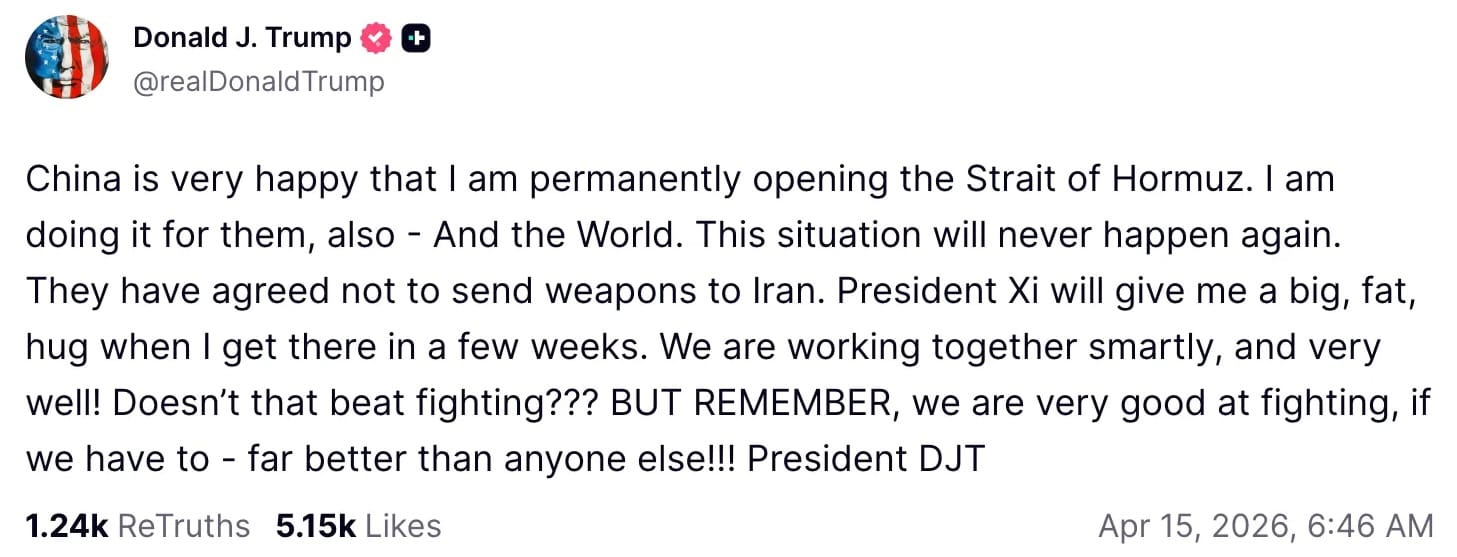
Yep. Yep, those are definitely the ravings of a ... strategic mastermind.
The kind of mastermind that's expecting the president of China to give him a "big, fat, hug" to thank him for his genius moves to ... whatever he's doing.










Comments
We want Uncharted Blue to be a welcoming and progressive space.
Before commenting, make sure you've read our Community Guidelines.