

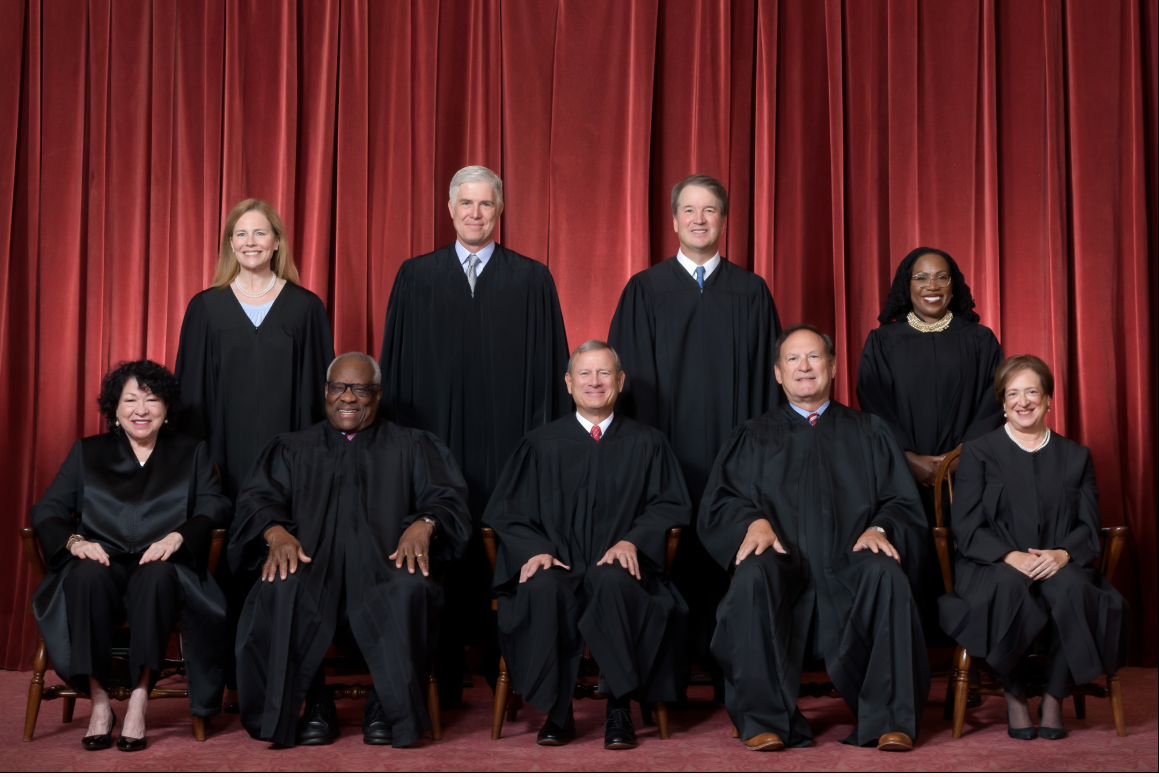
There's not much to be said about the current Roberts Court that hasn't already been said. When you've got law professors, appeals court judges, constitutional scholars and members of every related profession openly admitting that the court has stopped offering up anything resembling a predictable or even implementable set of precedents—at least, none other than a blanket edict that the conservative side should win and the "law" is, for the moment, whatever it needs to be to make that happen—then it hardly matters what the rest of us think.
I mean ... yes. We all know, at this point. A multi-decade, movement-wide conservative plan to rework the judiciary into a movement subsidiary has achieved its longstanding ambition of elevating partisan dullards. It's everything the Federalist Society had hoped for, and none of the people who planned it out wanted any outcome other than this one.
But being a too-elevated mediocrity is not the same thing as being genuinely malevolent, and what the Roberts Court has built for itself is a reputation for promoting injustice. According to the Roberts 6, the law is a weapon. When used against those with power, it must be made dull; when used against the powerless, there must be no shield raised between it and its target.
The Roberts Court is remarkable for its indifference to injustice. No—for its eagerness to work against justice, angry and full-throated.
Handing a win to President Donald Trump, the Supreme Court on Tuesday removed restrictions on the government’s controversial policy of deporting immigrants to countries they are not originally from.
DHS filed an emergency application to block the lower court decision, claiming it created substantial logistical problems with ongoing removal operations, leading to a canceled flight to three separate countries carrying 70 immigrants with criminal convictions.
Oh no, not substantial logistical problems. How can government bear to function, when a court introduces logistical problems?
The six usual members of the Roberts Court decided that lower court rulings temporarily pausing the renditions (it's not "deportation" to send someone to a country they have zero ties to, the technical word for that is "rendition") was too much to bear. They instead overruled those courts to reinstate the rendition program, scheduling both sides to present their case to the Supremes in December. A final decision on the case will likely not come for many months after that, with the renditions continuing at least until that far-off date.
The thing of it is, this is not a case of renditioned persons being merely inconvenienced by being dropped somewhere on the globe with no regard for whether they even speak the language of the place they're sent. This is a case in which the Trump administration, a regime that already boasts of the ease with which it conducts extrajudicial murders, quite specifically dropping prisoners into some of the most dangerous places on Earth with every reason to believe that those prisoners will soon end up dead.
The vast majority of the deportees have been sent to Mexico, but under a series of costly agreements with other countries, the government has deported thousands of others to 35 different countries.
Some migrants have been sent to dangerous places like Libya, El Salvador’s infamous mega-prison or the Central African Republic, a country the Department of State warns U.S. citizens not to travel to because it is too dangerous.
Earlier this month, the Associated Press reported that lawyers for two men deported to Equatorial Guinea said they were beaten and held at gunpoint in a hotel-turned-detention center as part of a $7.5 million deal with the African nation.
The Supreme Court previously allowed the Trump administration to send noncitizens to the war-torn nation of South Sudan.
Renditioning a prisoner to a location deemed so dangerous that the American government issues specific guidance warning its citizens not to go there is, de facto, a depraved indifference to their safety. If a county sheriff dropped a detained individual in a remote location in the desert or plopped them onto a park bench with no cash or clothing in subzero weather, the resulting death would count as manslaughter.
A conspiracy to drop people in a war zone because you'd rather not have them in your country and they'll be tortured in their home country is not something that requires a lot of hems and haws and sussing out. You're trying to kill them. You're dumping them somewhere where they have a good chance of dying—a much bigger chance than the locals themselves do, given language barriers and the strong likelihood of racial targeting—and then pretending that what happens after that is just unfortunate happenstance.
Your honor, I may have tied that man to the trolley track, but if the trolley hits him that sounds like a trolley problem, not a me problem.
So the real question here is not "is the government allowed to rendition undocumented residents to third-party nations paid cash bonuses to take them." It is "the government is currently dropping undocumented residents into nations deemed too dangerous for American citizens to enter, resulting in now-documented violence against them, so should government be forced to endure a brief pause in this program while we sort out whether it amounts to intentional acts of murder?"
And because the Supreme Court is violently opposed to justice, to the point where they are willing to pretend that insurrection itself is not worth weighing in on if the insurrectionist is an ideological mate, they are going to pretend this is a difficult question to ponder.
To be sure, America might be sending off thousands to their deaths for the sake of governmental expediency and intentional malevolence. But the real danger here, according to six shitheels who believe justice has no place in considerations of law, is that the government will not be able to do that for however long it takes the ink and robes set to think it out.
And that is just evil. It's not incompetent. It's not an alternative version of justice. It is prioritizing injustice for the sake of expedience, and that is nothing except evil.
This is yet another case in which the Roberts Court proves itself indifferent to injustice or even welcoming of it. The reason nobody can parse out what system of justice this court is attempting to describe is because it has none. It doesn't consider human rights or basic justice to matter at all in applications of the law.
And I can prove that. It is self-evident. If you are handcuffing prisoners and sending them to nations that the United States Department of State considers uniquely dangerous, you are manifestly indifferent to their safety.
And if you think the greater wound, in that scenario, is that government would be burdened by temporary inconvenience if we halted the practice while we considered its implications, you have no sense of justice. None. Not even a scrap you can pretend at.
This is a disease. It is a social poison, this notion that government should have the rights and its targets need to be put in check. It is the seed of authoritarianism, to be sure, but more to the point it is the dismantling of justice in favor of the gamesmanship of lawyering.
And it is just evil, and these six justices flouncing around pretending that the issues here are a series of pompous technicalities rather than of a human right not to be murdered for government convenience is the product of a darkly oiled soul.
The idea that we should elevate such scabby individuals with words like honor and justice is nauseating. I could never be a Federalist Society stooge-of-the-moment; I could never act with such indifference when someone asked me whether government could conspire to murder as policy. I could never scribble up such an order for the emergency docket, then go back to writing my pompous book about how the rest of you don't understand what the law is for.
I would throw myself in a wood chipper first.







Comments
We want Uncharted Blue to be a welcoming and progressive space.
Before commenting, make sure you've read our Community Guidelines.