
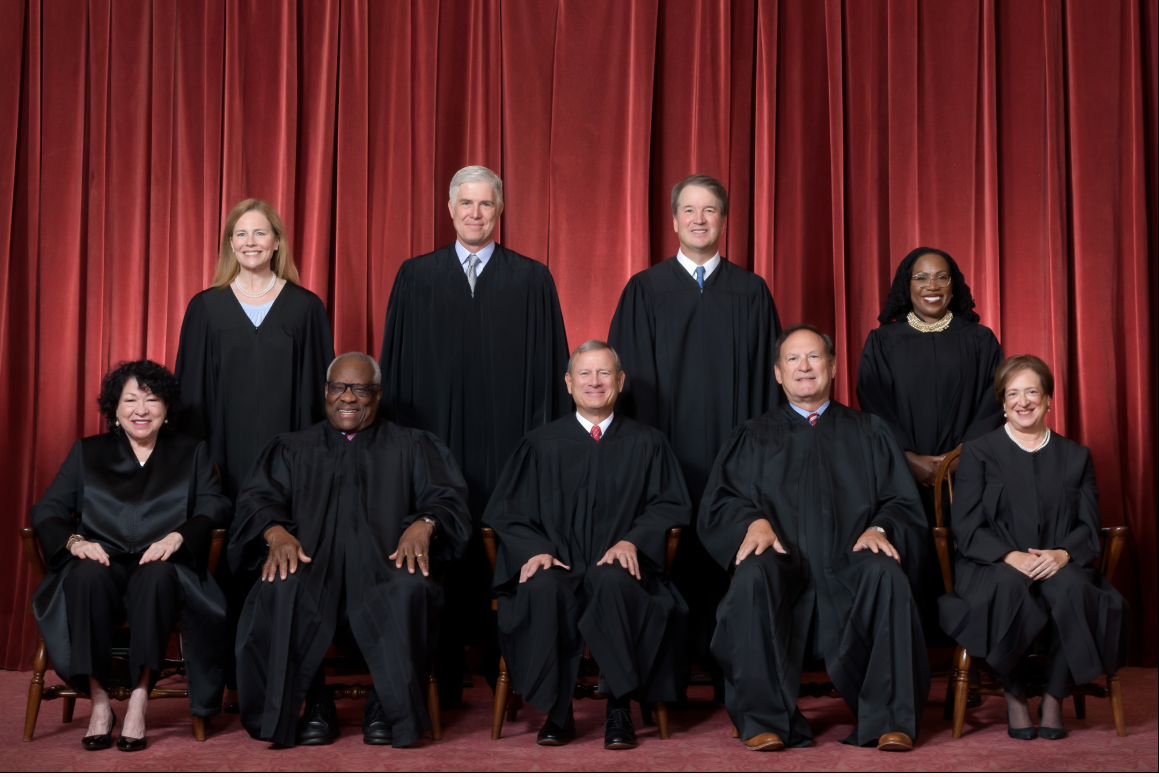
On Monday, the Supreme Court handed down yet another one of its now-rote rulings announcing that another part of the U.S. Constitution somehow doesn't mean what a century, two centuries, or more than two centuries of prior rulings had determined it to mean. As is now commonplace, the new interpretation is based on the legal principle of "The President Can Do What He Wants," and also as now commonplace, both the plain text of the law and every prior Court's rulings on the matter are waved aside in favor of tossing chicken bones around and announcing that they have revealed heretofore hidden Real Answer.
I'm referring of course to Trump v. Slaughter, the court's 6-3 decision asserting that Donald Trump can fire the heads of so-called "independent" federal agencies at his convenience and without cause, and he can keep firing them as many times it takes to get a properly obsequious toady who will manipulate each agency or commission to his advantage. For at least a century that premise was considered to be bad, because of the obvious opportunities for corruption stemming from that thing I just said, but after the Roberts Court's prior declaration in U.S. v Trump granting a president the power to break laws with abandon so long as he says it was for the good of the country, scratching out Humphrey's Executor in favor of YOLO Executive Theory was hardly a great lift.
Once you've decided that a president is allowed to mount a violent attack on parts of the federal government he can't abide, after all, you can't plausibly say the president isn't allowed to merely de-employ them. We would have a situation in which Donald Trump could shoot members of the Federal Trade Commission in the head and get off scot-free, or could stuff them all in sacks and rendition them to Guantanamo Bay on his own say so—but not fire them.
It wouldn't work. If anything, you'd only be encouraging him to do the worse things.
That's the thing about the YOLO executive theory; once you've chained yourself to it, every subsequent attempt to square it with the vast ecosystem of other federal jurisprudence only makes you look stupid. You can't say an autogolpe is fine but forgiving student loan debt goes too far because you'd sound like an idiot. Everyone would begin to suspect, rightly, that you were just pulling new rules out of your netherhole.
So the usual archconservative 6-3 majority made a declaration: Congress can impose no laws that impede a president's right to fire any federal agency head or commissioner he wants, no exceptions. To even suggest otherwise would be madness:
Slaughter’s supposed limiting principle is neither limiting nor much of a principle. On her view, Congress could commandeer the Environmental Protection Agency, the Department of Commerce, the Department of Education, the Department of Health and Human Services, most (if not all) of the Department of Justice, and a number of other agencies besides. Indeed, if Slaughter were correct, then it is not clear why Congress would need to allow the President any say in firings at all.
If Roberts sounds a bit pissy there, grant him some grace. He just had to contemplate the thought of some future out-of-control Congress "commandeering" federal departments that it itself has created, and funded, and which according to the conservative major questions doctrine must do only what Congress has previously ordered them to do by law rather than what any specific president would like them to do. Can you even imagine.
But there we are: The president can toss out whoever he wants to toss, no reason needed, no exceptions. And this is the precedent that held for—one moment, checking—perhaps about 20 minutes or so, or however long it took for the staff to bring a new set of boxes in.
It was Roberts himself who authored the 5-4 opinion announcing that he'd found an exception to the no-exceptions stance previously announced; that next decision, Trump v. Cook, at least temporarily bars Trump from firing Federal Reserve Board of Governors member Lisa Cook without cause. In it, Roberts argues that that not even the most YOLO of presidents can fire a member of the Federal Reserve Board without following congressionally imposed laws because Shut Up, That's Why.
The principle behind the exception is not terribly hidden: Allowing an incompetent demented crackpot of a president to gut the Federal Reserve leadership would lead to economic chaos, and since John Roberts' retirement funds are heavily dependent on the economy not dying in a ditch between now and his eventual stepping down, that turns out to be the one risk America can't stomach.
The written-down argument for that exception did a poor job of squaring it with the still-fresh declaration that no exceptions means no exceptions, though. That rankled conservative Justice Barrett Amy Coney Barrett (who joined Slaughter's no-exception opinion); Barrett suggested that the Court's reasoning was already looking suspiciously netherholish:
[T]he Court’s holding is in serious tension with Trump v. Slaughter, which we also decide today. ___ U. S. ___ (2026). Slaughter announces a categorical rule: Whenever “an agency ‘executes’ a congressional mandate against private parties, it exercises executive power” and must be subject to plenary executive control—“no ifs, ands, or quasis about it.” Id., at ___ (slip op., at 22). Yet here, the Court claims a special exception “‘sanctioned by history’” and based on the Federal Reserve’s role in setting monetary policy. Ante, at 24. How can history support both a categorical rule and a carveout? See Slaughter, ___ U. S., at ___ (SOTOMAYOR, J., dissenting) (slip op., at 46). Do all the Federal Reserve’s existing regulatory powers have the requisite connection to monetary policy? If not, are they grandfathered in? Cf. ante, at 23, n. 6 (opinion of the Court) (“In upholding the constitutionality of the Federal Reserve as currently structured and with its existing enforcement authorities, we do not suggest that Congress could assign the Federal Reserve _additional_ regulatory powers that are attenuated from monetary policy” (emphasis added)). And is the Federal Reserve unique, or might history sanction other exceptions too? The Court does not say.
Well, yes, that does sound bad. But keep in mind that Barrett is arguing for the YOLO side here; she's peeved because she seems to genuinely believe in the President Can Do What He Wants theory, whereas Roberts is a proponent of a trailing "Unless It Consequentially Affects Our Richest Friends" clause.
That divide will likely grow—not because of ideological entrenchments, but because the list of Trump-created disasters that threaten to harm Our Richest Friends is rapidly expanding.
It's somehow difficult to get too worked up about the Slaughter decision, even though overturning the whole premise of "independent," ideology-agnostic federal governance is the stuff of both autocracy and kleptocracy. Part of it may be outrage fatigue; conservatism's attacks on the foundations of American society and power are expanding every day, and every hour. A bit of dullness is necessary to remain sane.
But it would also be far more upsetting if any of us thought for a moment that this really was a new lasting Supreme Court precedent, rather than just another results-oriented decision built to support conservative actors with whatever handwaving is necessary in the moment. We know, with something very close to certainty, that this court will rescind their YOLO executive theory at the exact moment a non-conservative president is sworn in. All of the previous grants of wild new executive powers will suddenly disappear, and the court will begin issuing angry new decisions that declare the new president can fire nobody and do nothing.
There is no "precedent," with this court. That is the charge being leveled against them in law schools, and by historians and legal experts, and increasingly by lower courts themselves; the Roberts Court doesn't make law or precedent because their decisions have no legal theories elucidated clearly enough or consistently enough for lower courts to follow. There's nothing lower courts can do to predict how the Court wants them to decide similar cases except to do what the Roberts majority itself does: Determine which side has the more Republican-coded or wealth-coded theory of government and declare that it wins.
Not always, of course. Not every case. But enough of the time to be predictive.
We can bet, then, that nearly every Supreme Court precedent with the name "Trump" attached to it will turn to vapor when a non-Republican next wins the White House, just as it did during the Biden administration. It will look tawdry and corrupt because it is, and demands to reform the court by expanding it and curtailing it will only intensify. The Court has already proven itself unserious, conspiracy-pilled, and oligarchic.
On Tuesday the Roberts Court will determine whether birthright citizenship in this country still exists or whether the 14th Amendment was nothing but an illusion all along. Court watchers have been broadly predicting that current law will prevail; the arguments against the 14th Amendment's text are so absurdist that only the crankest of cranks are willing to touch them, experts agree.
But the fact that the Court took up the case at all shows a degree of crackpottery that the "experts" still don't seem to have fully absorbed. There will be at least two, and maybe four, and possibly five votes for declaring the Constitution itself unconstitutional. That is the sort of thing the Roberts Court has been repeatedly creeping up against.
In the end I expect current law will stand for the same reason Roberts found an exception to supposedly exceptionless presidential powers: Money. The chaos unleashed by announcing that every American citizen is now no longer a citizen unless they can find old papers that prove, to Stephen Miller's personal satisfaction, that their parents were of proper origin—that is the sort of self-imposed economic disaster that would make Trumpian control of the Federal Reserve look positively quaint in comparison. It would be insane, and John Roberts' 401k plan would turn to shit just like everyone else's.
But we'll see. We already know what the Roberts Court is; each new ramshackle "decision" only speeds or slows the rate of decay. A court that has such broad contempt for even a century's worth of their predecessors cannot, however, plausibly feign outrage when a future administration brushes off the theoretical "precedent" of nine justices and decides that 13 was the correct number all along.








Comments
We want Uncharted Blue to be a welcoming and progressive space.
Before commenting, make sure you've read our Community Guidelines.