

If we cannot solve the problem of hunger in our society, one wonders if we can resolve any of the great social issues before the nation.” Sen. George McGovern, 1971
“SNAP participation is falling because the Trump administration has intentionally kicked people off of the program – leaving Americans hungry and still struggling to afford food.” — Sen. Elizabeth Warren, speaking on Republican funding cuts and strict new rules ousting people from SNAP, the Supplemental Nutrition Assistance Program previously called food stamps. Oct. 22, 2026.
“Prices for everyday basic necessities are increasing faster than incomes, and the result for too many families, is that there is just too much month at the end of their money.” — Linda Nageotte, president and chief operating officer of Feeding America, Oct. 18, 2026.
I know what Nageotte is talking about. Let me repeat a story I've told before. I was 6 years old and sitting next to my grandmother at one of the tables where as many as 14 of our extended family members ate our evening meals. I quickly finished my small plate of rice and beans, and said in Muscogee, “But, grandma, I’m still hungry.” Everyone went silent. My grandma, Simmalikee, smiled at me, took her plate and scraped off the several spoonfuls she had not yet eaten onto mine. No, I thought. Not your food, grandma. Some other food. I sobbed as she coaxed me to eat each bite. No matter how empty my belly felt, I never again said I was still hungry after a meal.
I escaped that grinding poverty long ago, and my grandma has been dead more than 65 years, but I have never forgotten that terrible moment nor what it means to be truly poor. If there was meat or fish on the table then, it was possum, deer, catfish, and the occasional wild hog that one of us killed. In those days, way before food stamps, we received surplus government handouts every month: rice, beans, cornmeal, lard, cheese, and powdered milk. It was never enough, and toward the end of each month, everybody’s portions got smaller.
In the richest nation on the planet, where income inequality today is now worse than it's been in a century, millions of American children know exactly what that shrinking portion means. They know the humiliation of asking for more when there is no more, the anxiety on their parents' and grandparents' faces when the refrigerator is nearly empty, the difference between going to bed satisfied and going to bed with an ache that makes it tough to sleep. They may not understand congressional appropriations, eligibility restrictions or the supposedly glorious virtues of fiscal discipline. But they fully understand the clawing hollowness of too little to eat.
Donald Trump and his lickspittle, lockstep congressional Republican accomplices have decided more kids should feel that hollowness. And as the latest studies have shown, they are feeling it. It's going to get worse as more people are forced into the ranks of the no longer eligible for food assistance because of new rules and slashed funding for the flawed but wildly successful Supplemental Nutrition Assistance Program.
Chopping SNAP has been a Republican dream since it was called the Food Stamp program decades ago. And in July 2025, they triumphantly jammed their obscenely named, vilely framed HR 1, the One Big Beautiful Bill Act (OBBBA) through Congress without a single Democratic vote. Among its many nasty provisions are the deepest-ever cuts to SNAP, nearly $187 billion over a decade, alongside $1 trillion in tax benefits disproportionately favoring wealthy Americans, including, of course, Trump himself and some of his Cabinet members. In the fight against the cuts, Democrats and critics further left warned repeatedly about what would inevitably happen. People would go hungry. Many would be kids.
As was widely reported a few days ago but quickly forgotten in the crowded news cycle, those inevitable happenings are well underway. According to the Center on Budget and Policy Priorities, 5.5 million Americans disappeared from SNAP rolls in the first year following OBBBA's enactment. An estimated 2 million of them are children. (The CBPP regularly updates SNAP analyses and charts if you're looking for a deeper dive.) SNAP participation has plunged to its lowest level in 17 years, CBPP reports, not because hunger has miraculously receded or millions of formerly impoverished Americans have suddenly found prosperity, but because the government has made obtaining assistance much more difficult, for some impossible.
Katie Bergh, a senior food assistance policy analyst at CBPP, noted that “the harm will only grow as the full brunt of HR 1’s SNAP cuts takes effect.”
This comes as food prices continue to climb thanks in great part to the Trump regime's chaotic, counterproductive, and frequently crazy diplomatic and trade policies. In a nation where a Pew Research Center survey found that one in five adults had obtained food from a pantry or food bank during the previous year, and grocery prices are still on the rise, the regime's answer is to make food even harder to obtain.
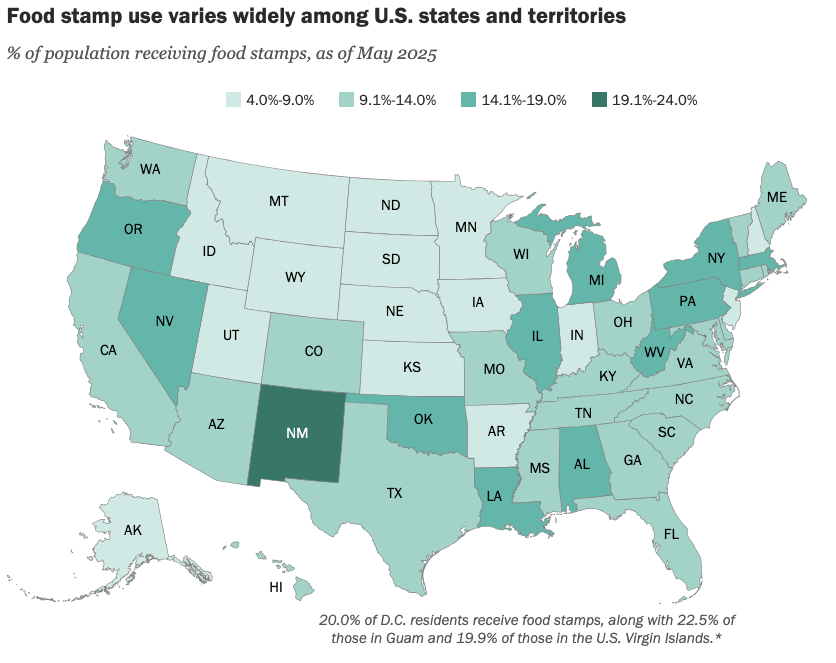
It's worth noting that there's significant state-by-state variation in how much a SNAP beneficiary who didn't get cut from the rolls receives each month. In New York it was an average of $218.44 per person in May 2025, while recipients in Minnesota got $158.45 on average. Helpful to be sure, but it's not as if recipients who manage to stay eligible are living large on government "handouts," as some critics imply.
The consequences of the Republican cuts and new rules don't, of course, stop at the dinner table. Families forced to spend more of their inadequate income on groceries have less for rent, utilities, medicine, and transportation. Inadequately nourished children can suffer consequences that follow them through their school years and into adulthood.
And then there's the impact on national economic well-being. Brookings researchers have warned that the cuts undermine SNAP's crucial ability to expand assistance during recessions, precisely when struggling families most desperately need it. The researchers say: "OBBBA makes structural changes to SNAP that we find will result in the program being substantially and detrimentally less responsive to deteriorating or poor economic conditions. Unless OBBBA’s SNAP cuts are reversed, those cuts will greatly diminish or end SNAP’s critical role as a national automatic stabilizer."
Many kids in families already or soon-will-be knocked off SNAP rolls live in ruby-red congressional districts. That makes them the youngest victims of GOP representatives long eager to ax the highly successful 62-year-old food assistance program that Republicans have fought before it was even born. The damage from their cuts is just gathering steam.
Mixing cruelty and greed, right-wing policies are enriching the already rich and inflicting economic pain on the 50% of the U.S. population that reports it is struggling financially. Not really a surprise when our Outlaw Prez's latest outburst about high gasoline prices included what has been the GOP's true slogan (and should be its epitaph) for a long while: "...don't give a damn. We're making a freaking fortune."
In a statement this past week, Massachusetts Sen. Elizabeth Warren took note of “food misery index” her staff has put together. It shows that soaring grocery costs have added an estimated $17.2 billion in higher prices consumers have paid since July 2025 when OBBBA passed and stripped $5.1 billion from SNAP benefits — $22 billion of abrupt harm to some of the nation's most vulnerable.
The Agriculture Department is in charge of administering SNAP at the federal level. Eric Berger at The Guardian reported Ag Secretary Brooke Rollins' remarks:
“Democrats don’t love” the decrease, Rollins said at a farming festival in August in Minnesota. “But for those of us that love work and celebrate work and want people to work and not be on food stamps, it’s a pretty big win when we move 5 million people off of food stamps.” [...]
“If people were getting paid enough, they would not be on the Snap program,” said Gina Plata-Nino, director of Snap at the Food Research and Action Center, a non-profit that supports anti-hunger programs.
A pretty big win? Exactly where did those 5 million people get moved off to?
The party that claims to be "pro-life" and "pro-child" and wants blond white women to have more children does not give a damn if a few million of those and other children fall by the wayside when it comes to adequate nutrition. They never have. Between 1954 and 1964, several efforts were made to implement a food stamp program. Republicans and Southern Democrats fought against it fang and claw. When it finally passed in 1964 as part of LBJ's Great Society programs, only 13 Republican House members voted for it, with 183 against. Of the Democrats, 216 for, 26 against. All but two of those opponents were white supremacist Southern Democrats soon replaced by white supremacist Southern Republicans.
For decades since then, the right has peddled its poisonous caricature of food-stamp recipients as freeloaders luxuriating at taxpayers' expense. They hate it the way they've hated all the New Deal and later Great Society programs since the 1930s. The reality, of course, is that millions of working people, children, older Americans, and people with disabilities struggle to keep food on the table and depend on SNAP to fill some of the gap their incomes cannot. Not a few people need assistance because, as Plata-Nino says, their employers don't pay them a living wage. Politicians let owners get away with this, so taxpayers must pick up the tab, and food stamp users get pilloried.
And why not? If the public can be persuaded with slander that poverty is a character defect rather than frequently the result of miserable wages (or outright wage theft), illness, unaffordable housing, or simple bad luck, then making food assistance tougher to get isn't an exercise in moral improvement but just one more added punishment dished out for being poor.
We already know who gets punished hardest. The kids. They're hungry at home. Many are also hungry at school, as districts with tight budgets reduce or eliminate free lunch programs because of lowered federal reimbursement. A recent Washington Post story pointed out that when a family loses its SNAP benefits, that reduces the head count that goes into determining if a school district includes enough SNAP recipients to warrant offering free lunches. This perfectly vicious circle masquerading as wise accounting generates longer queues at already over-burdened food banks.
The Republican changes in SNAP expand punitive work requirements to older adults and parents with teenage children, obliterates previous protections from veterans and the homeless, and shuts out many lawfully present immigrants. The defenders of these moves insist that depriving people of groceries will somehow propel them into employment. Never mind that decades of research have found the primary effect of such requirements is to lower participation in assistance programs, not to reduce unemployment.
Of the cuts, Rhona Kamar, founder and executive director of Feed Louisville, a non-profit that aims to reduce hunger, told The Guardian, “There is always going to be a percentage of our communities who we need to help — we have to accept that — and so, once we accept it, it is easy to just move forward and do the right thing, which is to provide resources to people who need them.” Trouble is, as we have seen, a majority of congressional Republicans don't accept that. They truly don't give a damn.
The cruelty of the SNAP changes is compounded by an especially cynical maneuver: shifting enormous costs onto state governments already struggling with their own budgets. They must either find money to cover federal obligations, erect additional bureaucratic obstacles, or contemplate reductions in assistance. And beginning in October 2027, the financial pressure becomes substantially worse. The law will then require states to cover 75% of SNAP administrative costs, up from the current 50%. Republicans have engineered a system in which they can boast about spending less while state officials are forced to deliver the pain and cope with its fallout. In many states, this plays into the hands of people who won't be happy until everybody who wants fire protection will have to subscribe to a private brigade, and the only remaining taxes will be the most regressive possible, say, a sales tax on food.
Private food banks cannot possibly replace a gutted national nutrition program. Yet Republicans seem perfectly content to leave America's continuing hunger problem to churches, charities, and exhausted volunteers while their wealthy patrons enjoy another round of tax relief. Charity can be an expression of extraordinary generosity. Making it the substitute for a government's obligations to its people is a merciless abdication of responsibility by people who know charity isn't nearly substantial enough to fill the gap.
Just like former President Barack Obama said this week in his energetic Atlanta cheerleading speech for gubernatorial candidate Keisha Lance Bottoms and incumbent Sen. Jon Ossoff, I'm tired of being angry all the time because of all the wretched right-wing policies being rammed down our throats. I want to see emphasis on the positive, a retreat from polarization, some true bipartisanship. I want to chill. Trouble is, it's impossible not to be incandescently furious when those running our country yank food from kids' mouths and dare call it a win.








Comments
We want Uncharted Blue to be a welcoming and progressive space.
Before commenting, make sure you've read our Community Guidelines.