


Two recent stories really highlight the ... something ... we're facing in America as voters continue to debate between keeping our nation's status as economically dominant superpower or, instead, becoming a near-illiterate fiefdom of the world's wealthiest and must unhinged sociopaths. Both choices have their upsides, apparently, or the American public wouldn't be having such a difficult time choosing which they like better.
Story One is the preprint release of a study by Yale School of Public Health researchers that estimates moving to a universal, government-run health insurance program like "Medicare for All" would save Americans about one trillion dollars a year—all while providing more care to more people.
To reiterate: Americans would save one trillion dollars every year, or about 20% of their current spending. The trillion dollar tax cuts that Republicans keep falling over each other to deliver to their billionaire donors? Paid for in a year. Trump's latest catastrophic wartime f--k-ups? Boom, paid for. The $40 trillion dollar national debt? With an extra trillion bucks in American pockets every year, and the resulting economic boom, we might even start making a dent in that.
None of this is dark magic, or even terribly difficult. It would mean moving America to the government-run health insurance systems used by nearly every other country with economies worth mentioning, one for which the United States already has built an infrastructure for in the form of current Medicare. And we all get a trillion dollars a year for our trouble, which sounds like a pretty damn good deal.
Another way to put this, though, is that our current national system of health insurance is so broken and corrupt that it's been squeezing a trillion dollars a year out of us to deliver worse care and more deaths.
“Healthcare costs have been rising faster than inflation, and a staggering share of that spending is consumed by administrative middlemen, soaring drug prices, and emergency care for conditions that should have been treated earlier and for less,” said senior author Alison Galvani, the Burnett and Stender Families Professor of Epidemiology at YSPH and the director of the Yale Center for Infectious Disease Modeling and Analysis. “Medicare for All strips out those sources of waste while providing everyone with healthcare, saving over a trillion dollars and 114,000 lives every year.”
The model identified five major sources of savings: lower pharmaceutical prices, Medicare-level payments to providers, reduced administrative overhead, less fraudulent billing, and fewer avoidable emergency department visits and hospitalizations. Even under more conservative assumptions about drug prices and fraud reduction, the researchers projected that the savings would reach at least $663 billion a year. Both figures account for an estimated $304 billion in additional spending to meet unmet medical needs, reimburse care that now goes unpaid, and provide universal dental coverage.
A universal healthcare policy would also save tens of thousands of lives, the researchers project. They estimate that adequate coverage for all could avert about 62,863 deaths annually — and that nearly half, or 29,631, would be among people who already hold insurance. These are the underinsured: the more than 45 million working-age adults whose deductibles and cost-sharing put care beyond financial reach anyway. Reversing coverage rollbacks and other health policies enacted since 2025 would avert a further 51,311 deaths each year, the researchers project, bringing the annual total to 114,174.
You can immediately see the reason why the United States has resisted moving to a civilized version of health insurance: If the current system is skimming a trillion bucks a year from the public, then the billionaires and centimillionaires in charge of the skimming, people who've made enough money to buy their own major newspapers, have a trillion dollars worth of incentive to protect what they've built and more than enough money to buy lawmakers willing to tell Americans to pound sand.
Any American who has ever suffered from the condition called "being alive"—terrible idea, I don't recommend it—has at this point seen the dystopian billing mazes that have resulted from every tier of the system trying to scam every other tier in the system, and all of that dysfunction paid for by raising your rates in order to pay for the legions of administrators required for even the most basic transactions. It's broken. Doesn't work. The sole advantages of the American "system" are that it requires tremendous amounts of office space, entire armies of executives, and works to trap Americans in their jobs by making it functionally impossible to get health insurance for yourself.
But we could fix it anytime we wanted to. Healthcare is not a "market", but a requirement for Being Alive. There's no shopping around involved, no calling 48 hours ahead of your planned heart attack to determine which emergency room has the best Not Dying product.
Healthcare is like clean drinking water. You need it to live, so most governments put it on the basic services list rather than the let's withhold this so that the for-profit markets can work out how best to squeeze all the people who will die without it.
We could do that. We could have universal health care like any of those countries that come up when people are asked which countries they'd most like to live in. It would disrupt the current industry in dramatic, existential ways, but after the disruption settled the American public would be handed a trillion dollars a year rather than seeing their insurance premiums ratcheted up to new supervillainish heights whenever a new one of those envelopes comes in the mail.
That sounds pretty nice. It sounds positively European to be able to get wheeled into an emergency room and have it not destroy your finances Forever. How decadent the rest of the civilized world has it.
On the other hand, and this is why Americans are wrestling so hard with their politics lately: Instead of getting universal healthcare, maybe we should bring back polio?
 Hoodlum 🇺🇸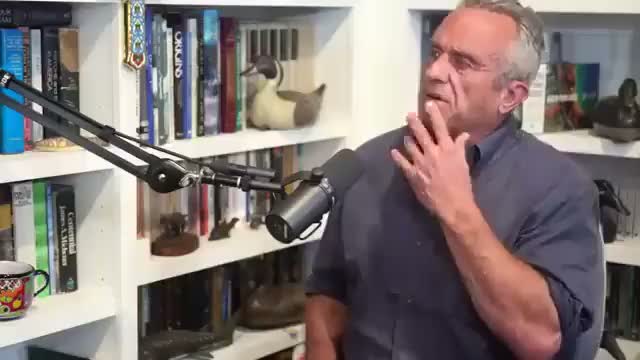
Now, for your sanity I'm going to recommend you not watch that clip, mostly because your health insurance probably doesn't cover whatever it'll do to you. But in it, Trump Health Henchman Robert Kennedy Jr. indeed suggests that the "polio vaccine" has quite possibly killed "many, many, many, many, many more people than polio ever did," which is one of the insane crackpot theories people like me might dream up to satirize people like Robert Kennedy Jr. but which he is willingly is saying out loud, very stupidly and dirtbaggedly, possibly because he was bitten by a radioactive dirtbag in his youth and obtained its superpowers.
Kennedy's theory is not just not true, it's a fine example of why conspiracy theory rhetoric is so dangerous—infinitely more so when it's coming from someone who's doing it from a seat of authority. The Kennedy theory is that because the earliest years of the polio vaccine had a contaminant which we later learned might cause cancer, then well maybe the polio vaccine has been the thing causing most or all of the "soft tissue cancer" that's anyone in his age group has ever been diagnosed with. That's how he gets to the "polio vaccine" being a supposed vector for mass American death, and from there to the supposition that vaccines in general are bad and people should instead be injecting themselves with sketchy "peptide" solutions while licking beef tallow, or whatever he's on about on any given week.
It's not true, though. There were no such mass deaths. There was no cancer cluster found. Polio, however, disappeared.
Kennedy is an example of ... whatever the opposite of science is? Pigheaded fabulism, perhaps. The nugget of truth used to go on this new anti-vaccine rant was that there was a contaminant in some early polio vaccines, but Actual Researchers, as opposed to Roadside Raccoon Penis Enthusiasts, investigated and have been unable to determine whether the affected group faced any increased cancer risk afterwards. Conclusions are confounded in part because the contaminant virus in question, Simian Virus 40, has since proven to be present in human populations worldwide, likely a broader symptom of our species' unconquerable compulsion to Touch Monkeys.
It was still enough for Official Government Nutcase Robert Kennedy to craft a theory of subsequent mass deaths that nobody but him ever noticed—possibly because the rest of us were all having too much fun not having polio—and you'll no doubt recognize that one as the standard-issue Generic Conspiracy Theory Number 2, landing right behind Number 1's "secret people are doing secret things to you on purpose" chart-topper.
Number 2's newest incarnation, however, is far stranger. That would be the Republican conspiracy theory that the Covid-19 vaccine killed "millions" of Americans, far more than Covid itself ever did, and nobody noticed that millions of people were dying because, we don't know, magic fking gamma rays or something. Where did the dead people go? Why does nobody remember them? If millions of Americans died, why haven't housing inventories freed up a bit? Nobody knows, shut up, gamma rays.
To you, I, and the vast majority of actual scientists that study these things and who you and I tend to think of as having some authority on the matter, the reason overall cancer rates are inching higher is our longer lifespans. We're living longer, and cancer is a cell-by-cell game of roulette that keeps going the longer you live, so there we go. (Also, we've surrounded our modern selves with a truly dizzying array of carcinogens, even basing nearly all modes of human transportation around machines that burn carcinogens as fuel. Can't forget that part.)
To people like Kennedy, people getting cancer as they age isn't because they're living long enough for more cancers to appear, or because our whole modern way of life is based on breathing in tailpipe fumes and calling it freedom. It's because a cabal of bastards conspired to make people live longer.
Those absolute bastards, with their vaccines and their studies and their suspicious disinterest in what fermenting raccoon penises might teach us.
So this is basically how we live our lives now. On one hand, we have small clusters of researchers still putting in the diligent work of collecting data sets and calculating p-values, and some of them are again pointing out that if we ditched the obviously dysfunctional and torturously half-assed for-profit health insurance scheme and just went with a variation of what every other Important country has settled on, we'd have an extra trillion dollars to spend even after paying the increased taxes required to set it up.
On the other hand, we've got a movement of morbidly unhealthy rage monsters who instead propose we end vaccinations, bring back hits like measles and polio, and invent new crypto coins to use on new betting sites to place wagers on which patients will die and which will live.
And the public is deeply torn on which approach sounds the craziest. Deeply, deeply torn. On the one hand, nobody wants to die of polio. On the other hand, having an extra trillion dollars to sling around every year sounds like a lot of responsibility, possibly too much responsibility for the current incarnation of America to handle. We'd probably just spend it on something stupid.
What's a little stranger, though, is that among "elite" Americans the dilemma is even more deeply felt. Current polls show that the general public is leaning 2-1 towards Not Polio, which is a massive move away from 2024's Maybe Polio Would Be Fine national zeitgeist. On the news programs, in the newspapers, and among the card-carrying members of the White House Correspondents Association, though, this is a stumper. Both sides make such good points! How can we possibly know who is right and who is a complete f--king imbecile barely able to form complete sentences?
We are flummoxed, we are. Polio or socialism ... polio or socialism ...
Nope, it's too hard a call. It simply wouldn't be fair to tip public opinion in one direction or another; what if universal healthcare ended up saving the life of a child who would later grow up to be Worse Stephen Miller? Nobody wants that, not even Stephen Miller. And what if polio was overblown, and depriving Americans of the right to be permanently paralyzed to own "the libs" will result in "the libs" getting less owned?
America finds itself at a crossroads. A stupid, stupid crossroads. A stupid crossroads where a six-lane highway to a solar powered future crosses a game trail stomped down by a diseased raccoon as it crawled from an abandoned outhouse to a haunted theme park.
Me, I'd take the trillion bucks. But there's no accounting for taste, I suppose.






Comments
We want Uncharted Blue to be a welcoming and progressive space.
Before commenting, make sure you've read our Community Guidelines.