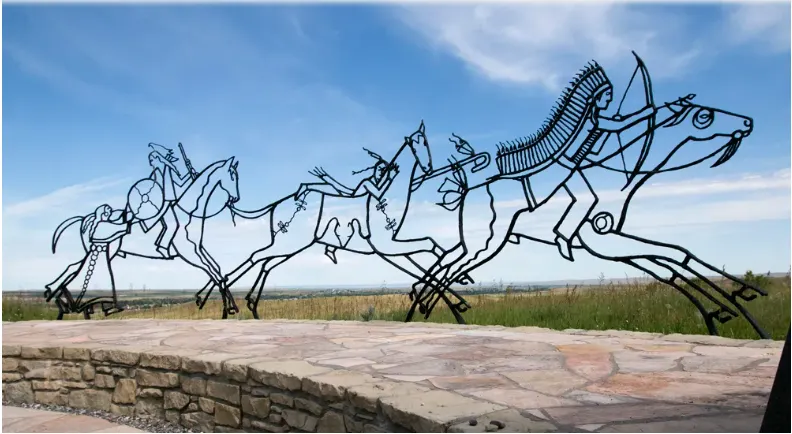
“Makȟá ki éčel tȟeháni yaŋké ló” — Attributed to Oglala Lakota war chief Crazy Horse (Tȟašúŋke Witkó). Translation: “Only the Earth lasts forever.”
"There are not enough Indians in the world to defeat the Seventh Cavalry."
George Armstrong Custer (1876)
The Custer Myth is a living thing, which refuses to die despite the efforts of careful historians to reduce it to uncontroverted facts. Almost everything about it is in some degree disputed."
—The Custer Myth, by William A. Graham (1953)
In 1970, after nearly a century of mostly flattering attention slathered onto George Armstrong Custer in popular books, movies, and the public's mind, Dustin Hoffman as 121-year-old Jack Crabb had this exchange in the film Little Big Man:
Jack Crabb: General, you go down there.
General Custer: You're advising me to go into the Coulee?
Jack Crabb: Yes, sir.
General Custer: There are no Indians there, I suppose.
Jack Crabb: I didn't say that. There are thousands of Indians down there. And when they get done with you, there won't be nothing left but a greasy spot. This ain't the Washita River, General, and them ain't helpless women and children waiting for you. They're Cheyenne brave, and Sioux. You go down there if you've got the nerve.
General Custer: Still trying to outsmart me, aren't you, mule-skinner? You want me to think that you don't want me to go down there, but the subtle truth is you really don't want me to go down there!
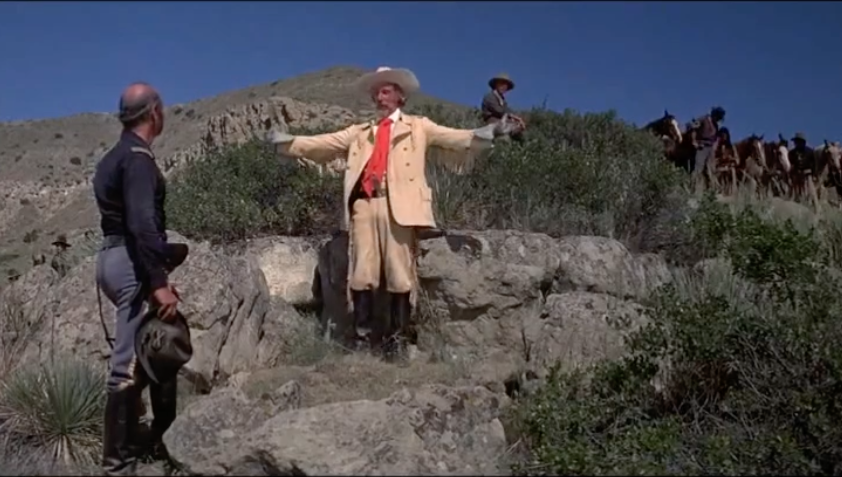
Recent scholarship had by then had pretty much demolished Custer as a brave but reckless opportunist who endangered his own and his men's lives with foolhardy, aggressive tactics during the Civil War, and, of course, at the Little Bighorn River, known to the Lakota, Cheyenne, and Arapaho warriors who fought there as the Greasy Grass. But while scholars looked at the flaws, Custer's reputational comedown among the public at large was yet to come. Little Big Man was part of the shift.
So was Dee Brown's 1970 Bury My Heart at Wounded Knee: An Indian History of the American West. Also Vine Deloria Jr's 1969 Custer Died for Your Sins: An Indian Manifesto. The Native American Rights Fund was initiated that year too, aimed at making the U.S. government stick to its treaty promises. The late 1960s also saw the rise of the Red Power movement, including the militant American Indian Movement (AIM) and Women of All Red Nations (WARN). Both sought to change with political action the negative outsider narrative plaguing the tribes and challenge government policies that had continued to cheat Indians, restrict their voting rights, exploit reservations' natural resources, and provide inadequate services.
But while attitude changes took place, it wasn't as if everyone bought into the views of revisionist historians. For instance, in 1991, 115 years after the battle, hate mail flowed into the National Park Service from people furious that the place where Custer and his command fell was being renamed from the Custer Battlefield National Monument to the Little Bighorn Battlefield National Monument. Not a few of those correspondents called Custer a hero and not a few contained racist slurs, and even death threats. And that was years before a handful of red granite markers was set among the graves of the 7th Cavalry dead at the site.
Imagine the outcry if somebody suggested each of the six states with a Custer County come up with a new name.
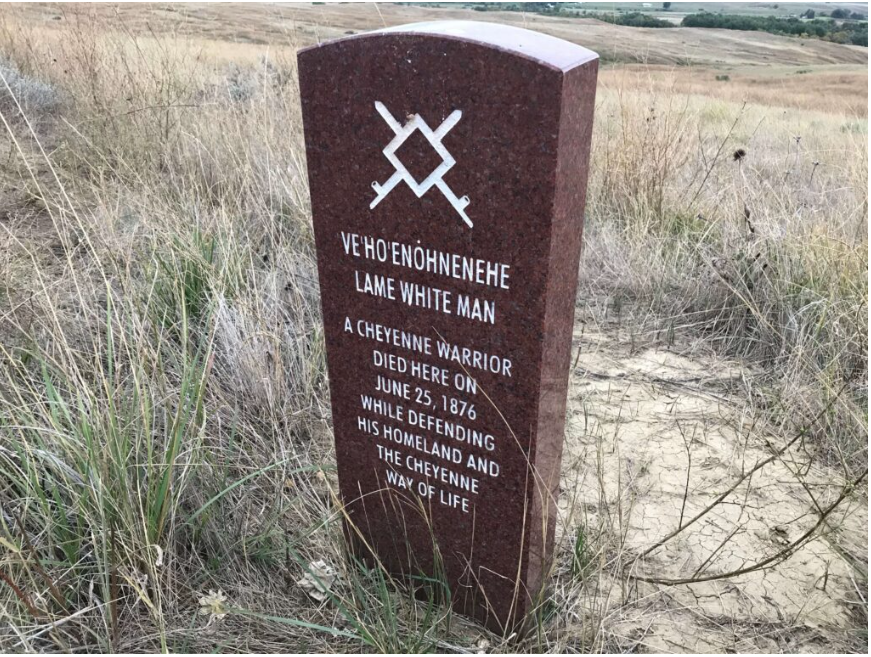
On June 25, 1876, the Custer myth got its start as Sioux (Lakota, Dakota), Cheyenne (Tsitsistas), and Arapaho (Hinono'eino) warriors defended themselves and their families against the U.S. Army's 7th Cavalry in Medicine Tail Coulee and the surrounding area in Montana Territory. When the shooting was over, five companies of Custer's command had been wiped out, with 262 men dead and 68 wounded, half the entire 586-soldier battalion. So startling was the Native victory that when Crow (Apsáalooke) scouts who had been riding with Custer met up with Gen. Alfred Terry the day after the fight and told him what they had seen, he refused to believe them.
So why care about this event from the distant past in which all the participants and the children of every participant are long dead? Because even though the myth has lost the widespread hold it once had, it continues today to have a stereotyping impact, warping how non-indigenous Americans view Indians, not just the Lakota, Cheyenne, and Arapaho, but all Indians.
Since that June day 150 years ago, hundreds of books, many of them bad and some of them brimful of outright lies from beginning to end, and more than 50 movies, most of them dreadful, have kept the myth (or collection of myths) alive. A good deal of this was spun into being by Libby Bacon Custer, Custer's widow who outlived him by 57 years. During that time, she wrote three books glorifying and sanitizing her husband to transform him from a reckless, audacious, ambitious, military politician into a heroic legend. For most Americans historically, and some still today, Custer’s “last stand” represents the most important part of the story passed down over the decades, with the Indian side of what happened as well as contrary white survivors’ versions ignored or denigrated. This effort was assisted by two factors.
One was keeping secret the Official Record of the Court of Inquiry of 1879 until 1951. The inquiry was requested by Major Marcus Reno to clear his name for conduct he had been accused of during the battle. It was not until retired Col. William A. Graham wrote The Custer Myth: A Source Book of Custeriana (1953) that a book for a general audience came close to telling the actual details of that bloody day in Montana.
The second factor was President Theodore Roosevelt's persuading Edward Curtis in 1908 to leave out an account of the three Crow scouts he had interviewed for his photo-rich, 20-volume The North American Indian. The scouts' version conflicted greatly with the image that Libby Custer had created over three decades with her books, lectures, and interviews.

Custer was a favorite hero of Roosevelt — having said of him that he was “a shining light to all the youth of America.” The president informed Curtis that Americans would not take kindly to having their "memory" of the "Last Stand" besmirched by a trio of Indians. They, of course, were untrustworthy just by being Indian even though they had been trustworthy enough to guide U.S. Army troops on numerous occasions. In an 1886 speech, Roosevelt had said, “I don’t go so far as to think that the only good Indians are the dead Indians, but I believe nine out of every ten are. And I shouldn’t like to inquire too closely into the case of the tenth. The most vicious cowboy has more moral principle than the average Indian."
Curtis dutifully followed Roosevelt's advice and left out the Crows' side of the Little Bighorn story. Indeed, despite ample opportunity, the Indian side did not fully emerge into the view of the general public until the 1970s. That came about in part because the murderous policies that led to the battle and hundreds of others throughout American history had begun by then to be examined outside the scholarly circles that had for 40 years challenged Libby Custer’s version.
Three authors of a plethora show how views of Custer changed among those who closely studied the record.
Frederick F. Van de Water put forth the heroic cavalryman myth. His Glory-Hunter in 1934 was among the first major works to challenge the sentimental Victorian image of Custer, but he still treated him as a genuinely gifted soldier. He argued that the real Custer was more complex than Libby had presented him: courageous, ambitious, vain, theatrical. He saw Custer as a flawed warrior rather than a fool.
Evan S. Connell viewed Custer through the lens of tragic American myth in the 1984 Son of the Morning Star. Connell was less interested in deciding whether Custer was hero or villain than in explaining how Americans had turned Little Bighorn into a national legend. Custer, he wrote, became a symbolic figure through whom Americans told stories about, "Manifest Destiny," frontier conquest, military glory, and national innocence. Connell portrayed Custer as charismatic, self-dramatizing, courageous, impulsive, and deeply enmeshed in the culture of celebrity. He suggested the man himself helped create the myth long before his death through newspaper publicity and carefully cultivated fame.
The battle then completed the process. A spectacular defeat became easier for Americans to romanticize than a routine victory. In other words, the myth reveals as much about America as it does about Custer.
Richard G. Hardorff was from a later generation of scholars who have focused intensely on eyewitness testimony, Native accounts, military records, and battlefield archaeology, all of which go far to demythologize man. Included in Hardoff's more than dozen books on the subject is the 1997 Lakota Recollections of the Custer Fight: New Sources of Indian-Military History.
He as well as other modern historians perceived Custer as a capable officer who made a series of serious mistakes in a rapidly changing tactical situation. In this view, Custer is neither saint nor villain but a human commander whose strengths and weaknesses contributed to a disaster.
Yet, even today, in spite of the scholarly delving into the battle, archeological studies on the ground where the fight took place, and the amateur and professional exploration of every scrap of minutiae, every bullet casing, every written or recorded word, elements of what happened at the Little Bighorn remain in dispute. Moreover, some Americans continue to revere Custer as a hero.
As Graham wrote in reply to his publisher's pressure to ditch the word "myth" from his book title:
Just what is a Myth? Ever since I began the study of history, many long years ago, I have been making the acquaintance of myths in one form or another. The exploits of the ancient gods of Greece and Rome come to one's mind instantly when one speaks of myths; but each of them, very probably, was founded in greater or less degree upon the accomplishments of some man, whose identity, once known, was lost in the maze of traditions, fictions and inventions that ascribed to him the attributes of a superman; and as the centuries passed, endowed him with the character of a supernatural person.
We have ourselves created myths in the course of our own short history, which spans less than two hundred years. Washington was in fact a very human person, as contemporary records prove; but the Washington the average American knows is not the real Washington. As "Father of his Country"; the all-wise leader, the military hero, the champion of freedom and foe of tyranny, his human qualities have all but disappeared. He has become a Myth.
So also with Lincoln, martyred savior of his country; about whom and around whom has been built so fantastic a structure of fictitious tales and absurd stores, that the real Lincoln has been obscured from view; and so in our own day with Franklin D. Roosevelt, who to millions of Americans was a selfless, immaculate latter-day Messiah, who gave his life on the altar of self sacrifice. Both these men were human beings—very human; but the Lincoln and the Roosevelt known to the average American are Myths.
And so with Custer, and so with nearly everyone involved in the Custer story. It began in controversy and dispute; but because a devoted wife so skilfully and so forcefully painted her hero as a plumed knight in shining armor—a "chevalier sans peur and sans reproche," that all who stood in the way of her appraisal were made to appear as cowards or scoundrels; and because her hero went out in a blaze of glory that became the setting for propaganda which caught and held, and still holds, the imagination of the American people, what began in controversy and dispute has ended in Myth; a myth built, like other myths, upon actual deeds and events, magnified, distorted and disproportioned by fiction, invention, imagination and speculation. The Custer known to the average American is a Myth; and so is Reno; and so also in Benteen.
The Little Bighorn battle was neither the greatest nor most important fight in the Indian Wars that began in North America in 1540 when Francisco Vasquez de Coronado attacked the Tiwa in what is present-day New Mexico and in 1918 ended in Bear Valley, Arizona, in a clash between the African American 10th Cavalry "Buffalo Soldiers" and a band of Yaqui. But the battle practically every American older than 10 can name has come down to us as the mythical "Custer's Last Stand" and has in a multitude of ways shaped the American psyche regarding the collision between Europeans and Natives. Although the myth has been under attack for decades, both by scholars and Indians alike, it refuses to yield completely.
••••••
• The Custer Myth: A Source Book of Custeriana, W.A. Graham, 1953 and 1981
• Son of the Morning Star: Custer and the Little Big Horn, Evan S. Connell, 1984
• Little Big Horn Remembered: The Untold Indian Story of Custer’s Last Stand, Herman J. Viola, 1999
• A Terrible Glory: Custer and the Little Big Horn—The Last Great Battle of the American West, James Donovan, 2008






Comments
We want Uncharted Blue to be a welcoming and progressive space.
Before commenting, make sure you've read our Community Guidelines.