



Right now, Russia is supposed to be in the middle of a spring offensive. However, that offensive seems to be making only tiny gains while suffering losses of troops and equipment that are among the highest in the war. Meanwhile, Ukraine is continuing to expand the use of the weapon that is making every existing military in the world obsolete—drones.
This far into Russia’s illegal, unprovoked invasion of Ukraine, it’s hard to remember the first days of Vladimir Putin’s war.
In the hours after mechanized forces crossed the border from Belarus in the north, Russia in the east, and occupied Crimea in the south, Putin's brag that he could capture Kyiv within three days seemed all too likely. There was the treachery that allowed Russian forces to cross the bridge into Kherson; the rapid movement south that saw Russian armor fighting in the streets of Kyiv suburbs (and the incomprehensible horror of Bucha), and the incredible close call at Hostomel, where Ukrainian forces acted with reckless speed to stave off a Russian landing at Antonov Airport.
Even when that instant capture failed to materialize, Russian forces continued to fight in the area directly around Kyiv for two months until Ukrainian resistance and their own over-taxed supply lines forced a general withdrawal from the area. And when that was over, there was the long string of Russian advances from the northeast, capturing cities with overwhelming force despite incredible levels of resistance. It still seemed as if Russia would be in Kyiv in months, if not weeks.
Then came the lightning advance of Ukrainian forces through Kharkiv in September of 2022, the recapture of Lyman and other cities in the Donbas, and the grinding strategic advance through Kherson that drove Russia from that capital in November. For a moment, it seemed as if Russian forces would be limping back to Moscow when spring arrived, and the roads were freed of mud.
Only ... that didn't happen. Ukraine's big 2023 spring offensive ran into walls of bad planning, kilometers of Russian defensive barriers, and spy drones that made stealthy movement impossible.
The following three years have been filled with amazing moments of bravery and stubborn persistence by Ukrainian soldiers, and with the steady, dreadful pounding of Russian artillery. Ukrainian forces have repeatedly driven Russians back at places like Bakhmut, Andrivka, and Pokrovsk, only to eventually surrender after these locations had been turned into rubble fields by months of shelling.
But in the last year, even Russia's pattern of blasting the landscape until no shelter remained, then sending men forward in suicidal waves, seems to have stalled out. Russia continues to burn through its resources at an unsustainable rate, but it's no longer seeing much territorial gain for these expenditures.
Putin entered this war backed by a population of 146 million, 1.15 million active-duty military members, 3,300 active main battle tanks, and another 14,000 tanks in reserve. Ukrainian President Volodymyr Zelenskyy was defending a population of around 35 million, with a military of around 220,000 and roughly 1,000 tanks. On paper, this is not even close.
There are three big reasons why this fight is still going on:
- Incredible bravery and persistence by Ukraine's people and leadership
- Russia's difficulty in shifting away from tactics that worked when invading Georgia and Chechnya
- Drones
Right now, April of 2026, was supposed to bring Russia's biggest spring offensive since the first year of the war, and yes, there is intense fighting at over a dozen locations. There's just not much movement. See the Three Big Reasons.
Also see the latest report on Russian losses from the Ukrainian General Staff.
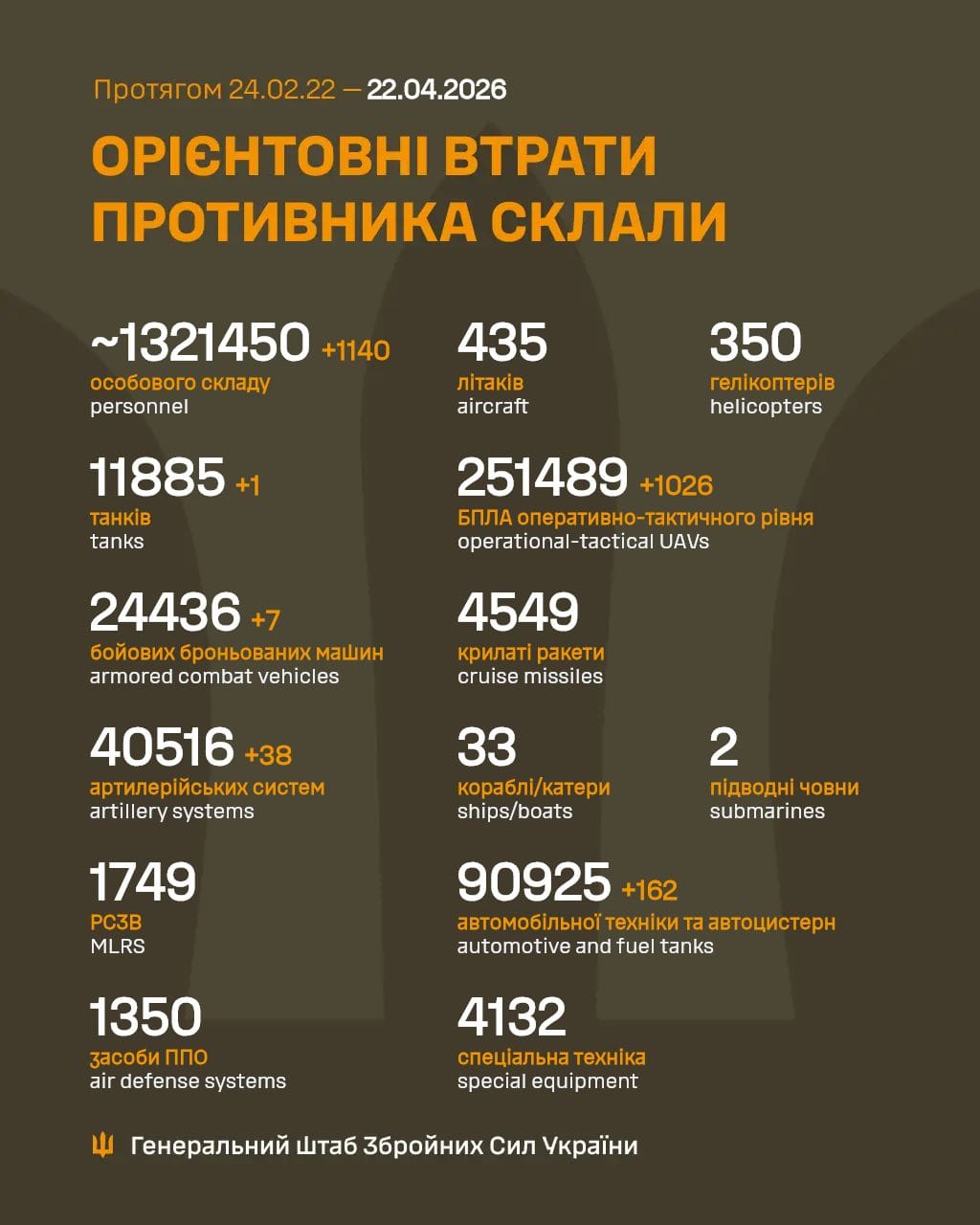
Several numbers stand out in this report. First, Russia's casualty rate continues to be sickeningly high. Putin, it seems, never tires of seeing his own forces get chopped down.
Second, the losses of armor are surprisingly low. To some extent, that's because Russia has run through practically every bit of kit that was functional at the start of the war and is now running on armor that has been resurrected from storage or repaired after being damaged. Instead, movement of troops near the front is taking place with cars or motorcycles, which is why the number of losses in that category remains high.
However, an even bigger reason for the low level of armor losses is the recognition that traditional armored column advances are simply not working on a battlefield buzzing with drones. Long-range artillery may be largely able to stay out of the range of swarming FPV drones, but anything operating within a few kilometers of the front line is likely to be pummeled as soon as a flying eye spots it.
That doesn't mean Russia has given up on the idea of driving tanks across the steppes. At this moment, an armed force is reportedly being assembled as part of a Russian scheme to recapture the city of Lyman that was liberated by Ukrainian forces at the tail end of the 2022 counteroffensive. Maybe this time tanks have learned to dodge drones. Maybe the Russian military has devised a plan to make their heavy metal work in this new battlefield.
But I doubt it.
In that first year of the war, it became obvious that drones were going to play a much larger role in this conflict than any in the past. I went so far as to prepare a "field guide to drones," giving a fairly complete list of every model being used by either Ukraine or Russia.
It was worthless within weeks.
Drone warfare has been evolving in Ukraine far more quickly than most military observers expected. Ukraine has reacted to the intense pressure of this invasion with a constant stream of innovation and a recognition that fast, deadly, inexpensive drones could help match Russia's advantages in men and machines. Single-use First Person Viewpoint (FPV) drones have become singularly important as skilled operators can fly them right into tiny openings in buildings or armored vehicles.
But Ukraine's innovations haven't stopped there. Earlier this month, that led to an incident previously unprecedented in war – human forces surrendering to a completely remote-controlled opponent.
As the European version of Politico reported.
“For the first time in the history of this war, an enemy position was taken exclusively by unmanned platforms — ground systems and drones,” [President Volodymyr] Zelenskyy said on Monday.
“The occupiers surrendered, and the operation was carried out without infantry and without losses on our side,” Zelenskyy added.
"Ground systems" in this case, was a weaponized cart that, like aerial FPV drones, can be operated at a distance by a soldier wearing VR goggles. The carts, known as Droid TW-7.62, carry one or two automatic rifles along with cameras that use AI systems to help operators spot and identify targets. Some models are wheeled for a faster approach along roads or smooth terrain. Others have tracks for making their way over muddy or irregular ground. Small and nimble, these carts can often cross terrain where larger vehicles would quickly be spotted and taken out. They are also relatively inexpensive, so the loss of a unit isn't a catastrophe.
❗️🇺🇦Ukrainian ground drone Droid TW 7.62 helped repel a 🇷🇺Russian assault. During the operation, the ground drone detected and destroyed two Russian FPV drones that were lying in wait for Ukrainian soldiers in an ambush.
— 🪖MilitaryNewsUA🇺🇦 (@militarynewsua.bsky.social) 2026-03-09T19:39:30.529Z
The use of these drones, and their numbers on the battlefield, have been growing rapidly over the last few months. At some locations, these Droids are even being advanced to forward positions expressly so they can shoot down Russian aerial drones. In others, they have routed Russian soldiers from trenches.
Meanwhile, Ukraine is also increasing the frequency of long-range drone attacks on Russian oil infrastructure. Since Donald Trump largely freed Russia from sanctions, Putin has raked in an additional $2 billion to $5 billion, but Ukraine is putting a cap on Russia's oil sales with spectacular damage to some of the largest refineries and storage fields.
⚡️Drone attacks target oil facilities in Russia's Samara, Nizhny Novgorod oblasts. Ukrainian drones reportedly targeted oil and energy infrastructure across multiple regions of Russia and occupied Ukraine overnight on April 23, according to Russian authorities and Telegram media channels.
— The Kyiv Independent (@kyivindependent.com) 2026-04-23T06:23:43.159Z
This is happening as new information indicates that Russia's economy may be far shakier than most believed.
Swedish Military Intelligence and Security Service (MUST) said that while official Russian figures did show falling GDP and weak industrial production, they were presented in a way that made the country "appear more resilient than it really is."
Russia is likely suffering from "higher inflation and a larger budget deficit" than it was communicating, it added.
That report put the real inflation rate in Russia closer to 15%, rather than the 5.9% Putin is claiming. As with all things Russia, it's hard to know the truth, but there are good reasons to think that the Russian dictator doesn't just want this war to end soon; he needs it to end soon.
Over a year ago, The New York Times pointed to the widespread use of drones as one of the big reasons that Ukraine is suffering far fewer casualties than Russia, but it
Working with incomplete information, experts estimate that Ukraine has suffered about half of Russia’s irreplaceable losses — deaths and injuries that take soldiers out of battle indefinitely — in the nearly three-year-old war.
But, as the Times reported back then, 50% fewer casualties isn't enough when your opponent has 400% more people and a leader who seems willing to kill them all rather than admit a mistake. As they put it, Russia was suffering more deaths, but "still winning the war."
It's not clear that was true then. It's even less clear that it's true now.
The latest update from Lost Armor puts total Ukrainian deaths in this war at 90955, with 788 coming in the last week. These are horrible numbers. The real total may far worse, closer to 190,000 lost once those missing in action and civilians lost to Russian missiles or drones are included.
However, according to Ukrainian military sources, Russia is currently hitting an average of over 1,000 casualties a day as it tries to press its offensive. The total number of Russian soldiers killed in Ukraine is thought to be around 350,000. An equal number have suffered injuries that will keep them off the battlefield.
As of April, Ukraine is increasing its use of drones of all kinds. Meanwhile, Russia is ramping up its offensive all along the front, with attacks ranging from north of Sumy (where Russia is trying to capture a buffer against future attacks into its territory) all the way down to the highways south of Zaporizhzhia.
Whether Ukraine can continue to contain Russia's advance isn't clear. Whether Russia's economy is really falling apart isn't clear.
What is clear is that the spring of 2026 may be the most critical time in the last three years.











Comments
We want Uncharted Blue to be a welcoming and progressive space.
Before commenting, make sure you've read our Community Guidelines.