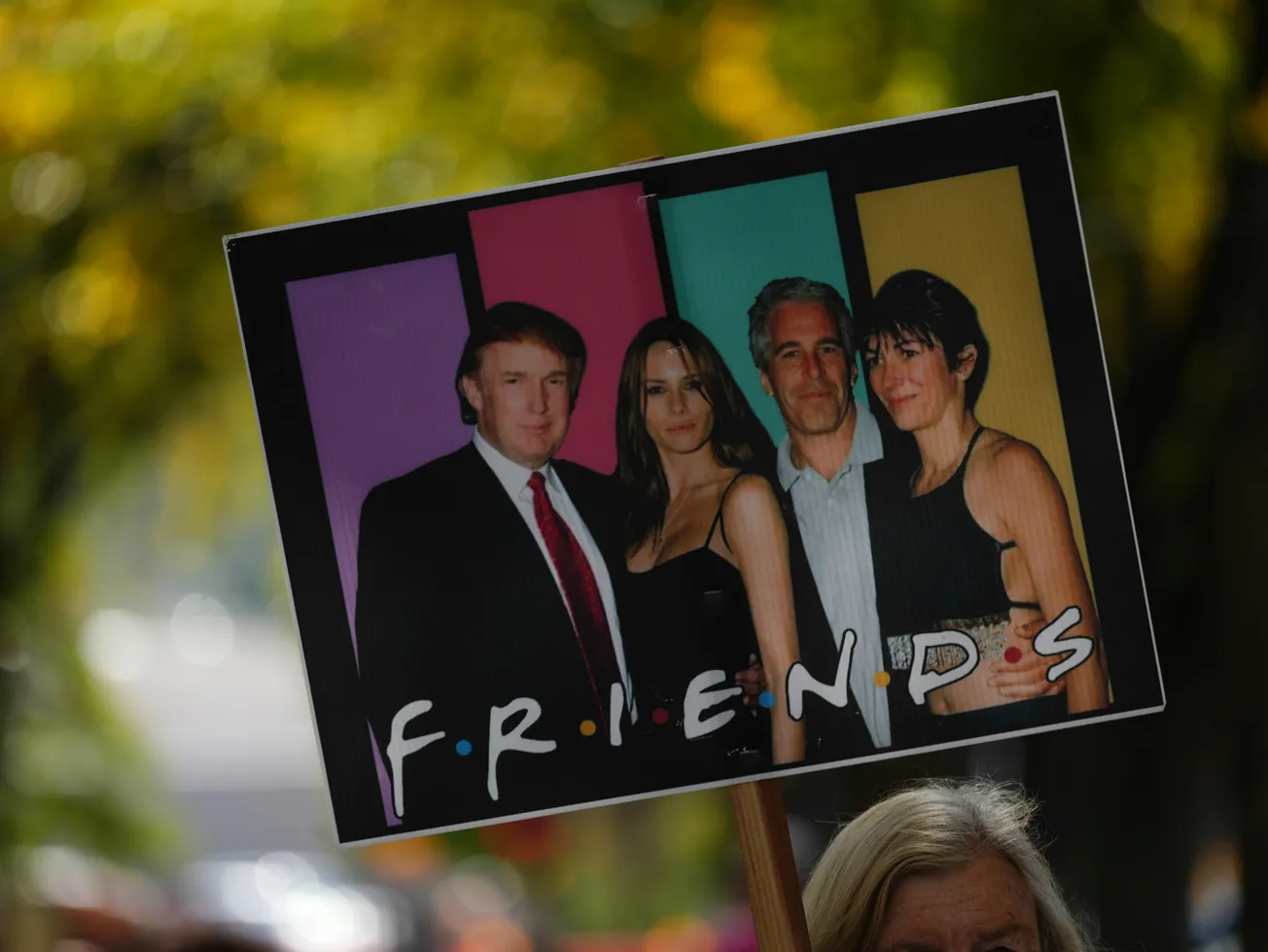
When Jeffrey Epstein turned up dead in his cell, you could almost feel the exhales of relief from a whole batch of rich, powerful people. Entitled people. People who think the rules are made for everybody but them. People whose economic and political clout typically shields them from any serious reckoning. People who had good reason to want to keep secret their sleazy, chummy association with the human trafficking child-raper. With Epstein dead, among the most emphatic whews! surely came from Donald Trump, whose creepy public displays with his own daughter are just one more bit of circumstantial evidence showing who this man truly is.
With just half the purported six million “Epstein files” now released, we’re beginning to see what could turn into that reckoning, with a few prominent people stepping away from public life, including some CEOs and the once royal guy now called Andrew Mountbatten-Windsor who was kicked out of his princely title and fancy digs. A disgrace to be sure, but hardly a proportionate penalty.
And while there now are unsavory new morsels coming to light daily, the release of the latest tranche of Epstein–related documents hasn’t brought catharsis. Instead, it has widened an already gaping moral sinkhole, reinforcing the conclusion many Americans have been circling for years: this was never a story about one predator, or about him and a ring of accomplices, but about an elite culture so insulated, so transactional, and so devoid of consequence that exposure itself no longer mandates accountability.
Before continuing, it’s important to remember the survivors, the women, many of whom were girls when they were violated, then again when Epstein worked out his cushy prison term in 2008, and violated again when the Department of War on Justice included information about them in the document release. Shrugging these victims off the way Deputy Attorney General Todd Blanche has done is all part of the deep-seated misogyny along with the entrenched privilege that animates the Epstein saga.
The Trump minions at DOJ knew what was in those files all along. Knew how devastating they could be. Attorney General Pam Bondi lied about them. Blanche lied about them. They and others have done all they could to delay release of documents that many of them and the whole of the MAGA base had spent years clamoring for. And they’re still at it, holding back millions of files they say they still have, prompting even some of the least skeptical Americans to wonder how bad those three million withheld files must be given what’s in the files we have already seen.
This is why the Epstein scandal has metastasized from a crime story into a recurring civic trauma. Each partial disclosure sharpens public fury while withholding resolution, a drip-feed of outrage that exhausts rather than empowers. The result is corrosive. Trust erodes still further. The question people mutter is no longer who knew, but whether anyone in power did not. When scandal stretches across parties, institutions, and ideologies, anger has too many targets.
In that sense, Donald Trump is, at least initially, a beneficiary of the chaos. The selectively disclosed release mentions Trump, his family, and Mar-a-Lago thousands of times, but it also places him inside a crowd so large and so powerful that individual culpability dissolves into ambient rot. This has always been Trump’s political comfort zone. His core claim is not personal innocence but universal guilt. Everyone is dirty, he insists, I am merely less hypocritical about it. The Epstein files, at first glance, seem to ratify that nihilistic worldview.
But this advantage is unlikely to last. Trump now presides over a DOJ facing sustained and justified pressure to release what remains sealed. The longer the regime resists full disclosure, the more it becomes obvious to people who have withheld judgment that something ain’t right. A president who built his brand partly on railing against cover-ups cannot indefinitely defend one without corroding what remains of his credibility. There is already not much left of that with his approval ratings at 37% and still falling, and with the MAGA wall itself cracking and shedding acolytes,
What makes the Epstein material uniquely damning is not any single revelation — although some of those are jaw-dropping even to the jaded among us — but rather its overwhelming breadth. The network mapped across these documents spans sitting and former presidents, Wall Street financiers, Ivy League academics, Silicon Valley executives, foreign officials, royalty, entertainment celebrities, political donors, movement figures on both the right and the left, top lawyers, and cultural power brokers. This is not a rogues’ gallery lurking at the margins of power. It is a cross-section of the establishment itself. Epstein’s contact list reads like an institutional scan, exposing how money, prestige, and access circulate in America’s upper reaches with almost no ethical friction and even less resistance.
Now, to be sure, many of the people mentioned in these files who exchanged emails with Epstein and are otherwise mentioned, are innocent of engaging in any of the wickedness linked to him. It is, however, no longer plausible to plead ignorance. Epstein’s 2008 conviction for soliciting a minor was public knowledge, widely reported, and impossible to miss for anyone moving through elite social or philanthropic circles. Some prominent people recoiled, and their reactions now serve as moral control samples. Too many, however, chose convenience. The documents instead reveal a sickening parade of accommodation, flattery, and moral outsourcing.
Epstein, astonishingly to casual observers, reestablished himself as a New York power broker after becoming a registered sex offender. Tech leaders, financiers, and moguls treated him as a fixer, a conduit, a man who could smooth problems and unlock doors that were supposedly meritocratic. Elon Musk sought invitations to Epstein’s private island years after the conviction. Others asked for introductions, donations, academic placements, or help securing jobs for their children. The requests were often banal. That is precisely the point. Epstein did not need to advertise his leverage. His correspondents normalized it.
There has always been quiet agreement among the powers-that-be in just about every society that some people are untouchable, some victims are expendable, and transparency is a management tool other than a mandated duty. What these disclosures finally confirm is not merely elite hypocrisy — something we’ve had with us probably since the days of the Akkadian Empire — but institutional decay. The Epstein files expose rot not as an aberration but as an ecosystem in which power circulates horizontally, accountability flows downward, and shame has been priced out of the market.
If accountability is to mean anything, it cannot stop with reputational bruising. There should be consequences for the game played in how these files were released. Officials who violated promises to protect victims’ identities should face professional sanctions, up to and including disbarment and removal from public office. Congressional oversight committees should subpoena decision-makers involved in the selective release and require sworn testimony explaining why political calculation repeatedly trumped victim protection. Transparency that retraumatizes the powerless while shielding the powerful is not transparency at all.
I know, I know. I am a dreamer. Obviously, no accountability will happen as long as the current regime remains in control. And even when and if it’s ousted, no guarantees.
The Epstein reckoning shouldn’t be confined to criminal law. Institutions that accepted Epstein’s money after his conviction — universities, charities, cultural organizations — should WANT to return it and publicly account for how and why it was taken. Corporate boards and nonprofit trustees who waved these relationships through should be forced to explain themselves. At minimum, there should be mandatory disclosure rules governing associations with convicted sex offenders in philanthropic and financial contexts, enforced with real penalties rather than voluntary ethics statements that gather dust.
The Epstein files map a system that rewards moral vacancy. That system will not be corrected by exposure alone because it has already absorbed exposure as a cost of doing business. If this moment ends the way so many before it have — with outrage dissipating and most careers intact — then the files will have served only one real purpose: to reiterate to the powerful, once again, that they can survive anything. So far, the files have not shut the book on Epstein, but they have revealed how carefully edited the earlier chapters were.










Comments
We want Uncharted Blue to be a welcoming and progressive space.
Before commenting, make sure you've read our Community Guidelines.