
Last year, the probe OSIRIS-APEX survived a searing encounter with the Sun and sped toward a critical rendezvous. In June, 2029, the probe will pass within meters of a near-Earth asteroid named "Apophis." Once there, it will do ... nothing.
It was going to do something. It was going to fly along the surface of this quarter-mile rock, which will pass within 20,000 miles of Earth that same year, and provide analysis of its structure and material. That information could be critical if astronomers spot an asteroid whose aim is a little more like the one that did in the dinosaurs.
The asteroid will be there. OSIRIS-APEX will be there. But no data will be collected, because the mission is one of several cancelled in the latest White House budget. Instead, the only probes that will conduct an analysis of Apophis as it swings near Earth will be a cluster of small satellites sent by China.
Whether or not OSIRIS-APEX is among the most important programs being lost is subject to debate. But the cut is certainly emblematic of the destruction of NASA under Donald Trump. As Politico reports, the cuts are effectively the end of the space program that began seven decades ago under President Eisenhower.
At least 2,145 senior-ranking NASA employees are set to leave under a push to shed staff, according to documents obtained by POLITICO — potentially spelling trouble for White House space policy and depriving the agency of decades of experience.
That's just the start. The proposed 2026 budget actually calls for a reduction of 5,000. Forget recapturing the glory days of Apollo. Under Trump, there will be fewer people working at NASA than during Project Mercury.
The letter that the White House sent to Congress spells it out: NASA has done great things, but now it's done. Because science is the enemy.
“While NASA’s science missions have greatly expanded humanity’s understanding of the Earth, solar system, and universe, the current expenditure of over $7 billion per year on over 100 missions is unsustainable."
Strangely, though there doesn't seem to be enough money for NASA to continue operating a wildly successful observation satellite already in orbit around Mars, or launch a new generation of already constructed satellites that could help refine predictions of our ever more chaotic weather, there's plenty of money for someone else to muck around in space.
The Space Force budget is being more than doubled, with $25 billion—more than three times what NASA was spending on science—devoted to Trump's plan for the "Golden Dome" missile defense. It's as if Trump is extending his wall from Texas to orbit ... and it's even more pointless than the original.
Just to rub it in, Space Force is getting a gift of another $14 billion for unspecified research and development. It seems there is plenty of money to dream up weapons in orbit, and no concern about handing Space Force a wad of cash that dwarfs what NASA had requested.
Human spaceflight, including the return to the Moon scheduled for 2027 (but unlikely to meet that date as Elon Musk keeps blowing up the proposed landing system), remains in Trump's budget. But that's only because Trump views getting another American flag on the Moon as critical to American nationalism. Presumably, the astronauts will be forbidden from looking too closely to avoid learning anything.
Maybe they'll replace "one small step" with an ad for Trump's crypto coin.
But it's not over yet. Congress can still reject the cuts called for by the White House. It won't bring back the scientists who have already fled, but it might convince others to stay and see through programs that have been decades in the planning.
On Monday, every living former administrator of NASA across both Democratic and Republican administrations signed a letter to Congress warning of the dangers in Trump's cuts.
The economics of these proposed cuts ignore a fundamental truth: investments in NASA science have been and are a powerful driver of the U.S. economy and technological leadership. … These activities inevitably result in novel technologies, algorithms, and advanced materials, while advancing the experience and knowledge of NASA engineers. Collectively these have direct, positive, and measurable benefits to our economy and our national security. The proposed cuts to NASA space science will starve the nation of that unique engine of innovation.
NASA has regularly generated far larger returns than any other investment the government makes. And while private space companies like to paint programs like NASA's Artemis rocket as too expensive, that expense includes investments spread across all 50 states. NASA programs not only fund the current generation of scientists and engineers, they also help create the next generation and ensure that every region of the country benefits from their training and research.
The agency also provides critical data for preparing for our changing climate. Or at least it did. Trump's budget wipes out future climate missions entirely and cuts off existing research far earlier than previous plans.
Throwing NASA away isn't just a massive blow to our future; it's a massive expense and a loss that will be felt in communities across the nation. It's also insanely dangerous.
Instead, as The Washington Post points out, Trump appears to be handing the future to China on a silver platter. Even as the Trump administration destroys an agency that has been a gift to the nation and the envy of the world, China is carefully building up its space agency, including a heavy investment in science.
Maybe Musk will finally get his big rocket to fly. Maybe Artemis will manage to get a few astronauts to the Moon by the end of this decade. Maybe we'll all come together for a moment to cheer their bravery. But even if that happens, it will be a sad coda to a program that launched generations of engineers and decades of advancements if Trump's cuts are allowed to stand.
Decades ago, Carl Sagan noted that human beings had dipped a toe into the cosmic ocean and seemed ready to strike out from the shore. That future has never faced a bigger threat.
From the microprocessors in your phone and the smoke detector on your ceiling, from Cochlear implants that restore hearing and improved mammograms that have saved millions, and from water purification systems that prevent disease all over the world to the foam that makes your shoes more comfortable, the value of NASA research is incalculable. Don't let it end with Trump.
Make your voice heard by calling your Representative. Tell them what the former administrators said: "Given the scale of the proposed cuts, their long-term consequences, and the potential loss of human knowledge and inspiration, we unanimously urge Congress to reject the proposed cuts to NASA’s budget. We therefore request that the Congress preserve U.S. leadership in space science by maintaining funding for NASA’s Science Mission Directorate at the FY 2025 enacted level."
Or make it simple. Tell them, "Trump's cuts to space science will hurt our state and our district. Reject the cuts and keep NASA's programs intact."
Or call them up, cuss them out, and let them know what you think of this whole assault on science and research. That's good too.
But call them. Because the only time to save the future is the present.
As if Trump hasn't tortured NASA enough, there is now this:
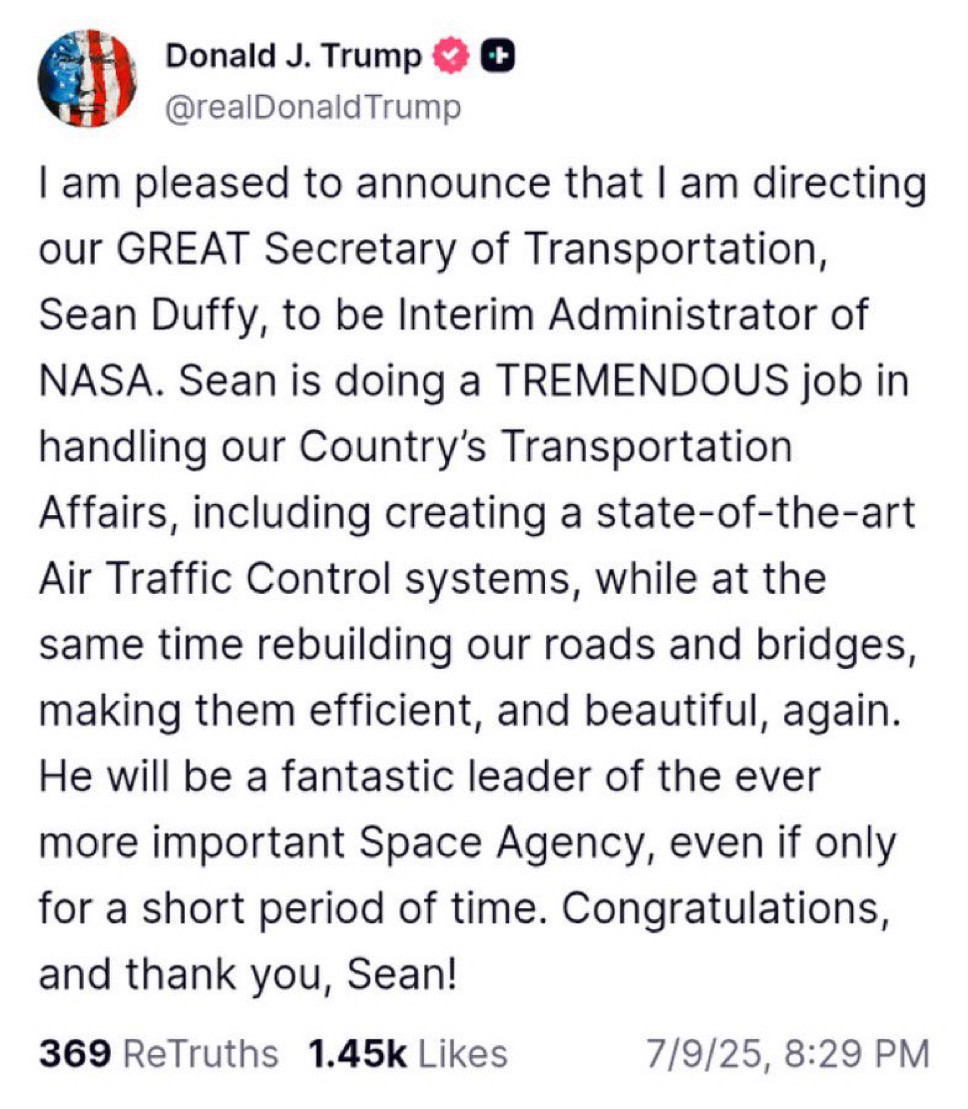
Sean Duffy has never taken even the slightest interest in science. He didn't study science, didn't introduce any legislation related to science during his time in Congress, and has absolutely nothing in his background that suggests he could run NASA—except for the dismal job he's done at Transportation. If running the space agency into the ground is the goal, he's the man for the job.
Duffy's appointment only reflects Trump's disdain for NASA as anything other than a show pony and his hatred for both science and scientists.








Comments
We want Uncharted Blue to be a welcoming and progressive space.
Before commenting, make sure you've read our Community Guidelines.