
Filipinos were stunned back in March 2025 when former President Rodrigo Duterte was arrested on a warrant issued by the International Criminal Court and flown to the Netherlands where he remains in custody awaiting trial.
It's unlikely that Donald Trump will ever be arrested and flown to The Hague to stand trial before the ICC. But as Duterte's case shows, Trump could be charged with crimes against humanity for ordering the deadly strikes on boats in the Caribbean and eastern Pacific that the U.S. government claims are carrying drugs.
The ICC, in a March news release, said Duterte, who was mayor of the southern city of Davao before winning the 2016 presidential election, was "allegedly responsible for the crimes against humanity of murder and attempted murder, allegedly committed on the territory of the Republic of the Philippines between 1 November 2011 and 16 March 2019 in the context of the ‘war on drugs’ campaign."
The Associated Press reported:
Estimates of the death toll during Duterte’s presidential term vary. National police put the figure at more than 6,000, while human rights groups claim up to 30,000.
The arrest warrant itself read:
Duterte was "instructing and supporting the city and nation-wide extrajudicial killings of alleged criminals; his public statements accepting responsibility for the killings committed pursuant to the State policy; supplying necessary equipment to implement the attacks; assuming responsibility for the attacks; and promising the police officers and hitmen immunity from prosecution."
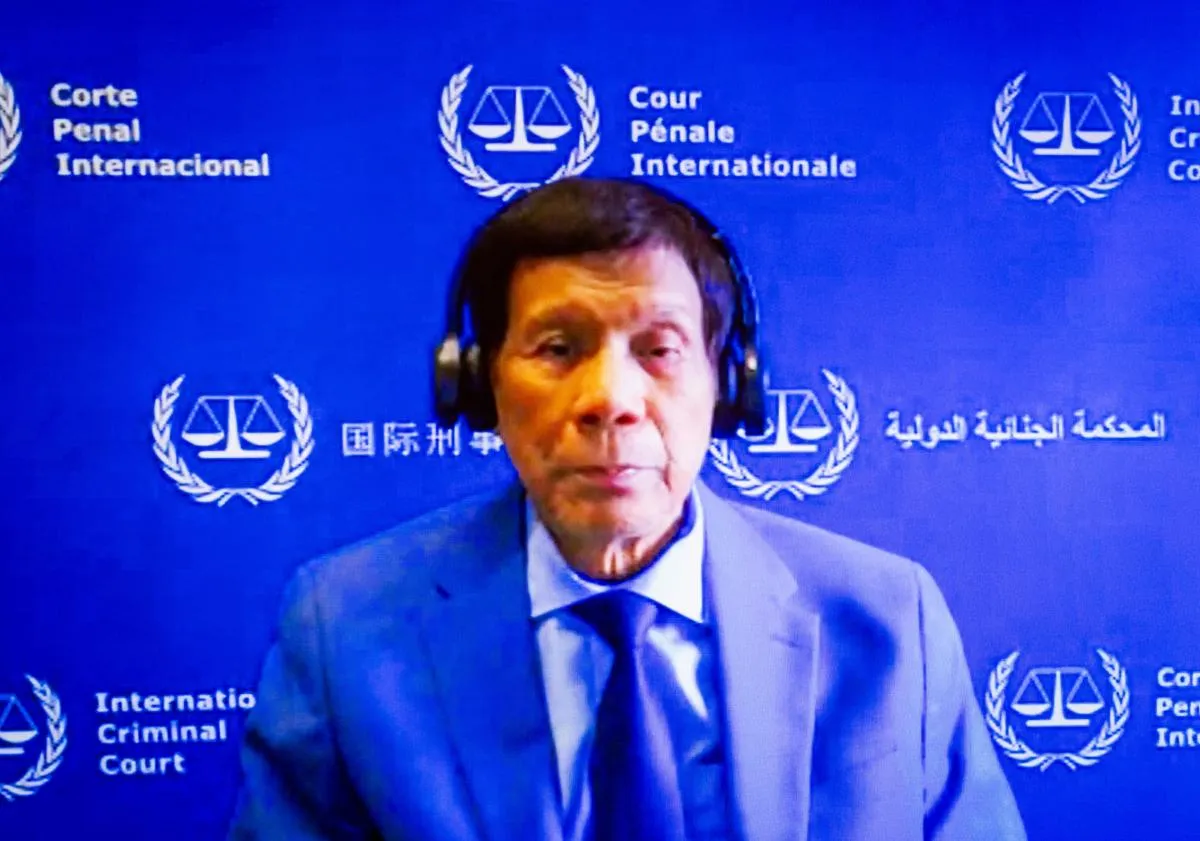
Here is a link to Duterte's first appearance before the ICC on March 14.
Duterte was arrested by Philippine authorities only after he had a falling out with his former ally and successor, President Ferdinand Marcos Jr.
But nevertheless Amnesty International issued a statement that read:
Rodrigo Duterte's arrest is a long-awaited and monumental step for justice for the thousands of victims and survivors of his administration’s ‘war on drugs’, which turned much of the Philippines into a nation of mourning. The man who said, ‘my job is to kill’ oversaw the shootings to death of victims – including children – as part of a deliberate, widespread and well-organized campaign of state-sanctioned killings.
Duterte’s arrest on an ICC warrant is a hopeful sign for victims in the Philippines and beyond. It shows that suspected perpetrators of the worst crimes, including government leaders, can and will face justice, wherever they are in the world. At a time when too many governments renege on their ICC obligations while others attack or sanction international courts, Duterte’s arrest is a huge moment for the power of international law.
Duterte was arrested even though he withdrew Philippine membership in the ICC in 2018 shortly after it began a preliminary examination of potential crimes against humanity committed during his deadly war on drugs.
The U.S., along with such countries as Russia, China and Israel, are not members of the ICC. But the ICC issued arrest warrants for Russian President Vladimir Putin as well as Israeli Prime Minister Benjamin Netanyahu and former Defense Minister Yoav Gallant for alleged war crimes in Ukraine and Gaza, respectively.
Trump has been openly hostile to the ICC, issuing an executive order imposing sanctions on the court, accusing the organization of engaging in “illegitimate and baseless actions” targeting the U.S. and its ally, Israel.
Back in March, a Filipino journalist noted the similarities between Trump and Duterte. Joel Ruiz Butuyan, a columnist for the Philippine Daily Inquirer, compared Duterte's so-called war against illegal drugs with Trump's "waging a war against illegal immigrants." He wrote:
Their similarities are uncanny. They speak with the same bombast, they make unreal promises, they turn friends into enemies and enemies into friends, they’re allergic to criticism, and they have no qualms about abusing laws and violating their country’s constitution. ...
Their style of leadership, demeanor, language, and beliefs are alike. It’s as if Trump and Duterte came out of the same womb. An increasing number of countries are giving birth to leaders of their kind. Dark clouds are gathering on the horizon for the whole world.
And this comparison was made months before Trump and Defense Secretary Pete Hegseth ordered the controversial military strikes against boats they claim are carrying drugs from Colombia and Venezuela. The first attack on Sept. 2 was the double-tap strike in which two survivors clinging to flotsam from their damaged boat were killed – which is considered a war crime. So far more than 85 people have died in these boat strikes that are extrajudicial killings.
The similarity with Trump is even more obvious when you listen to this 2017 video of Duterte's blunt, violent language put together by The New York Times.
Consider his holiday greetings:
Merry Christmas to all the criminals, thieves, corrupt criminals, and those making Filipinos' lives miserable. If you do not want to stop, and violnece continues, it will be your last Merry Christmas.
Sound familiar?
After President Barack Obama's White House raised concerns about Duterte's extrajudicial killings, Duterte said in October 2016: "Mr. Obama, you can go to hell." He also called Obama "the son of a whore."
Duterte had kinder words for then President-elect Trump when he congratulated him in a December 2016 phone conversation.
"Here comes Trump, so we had a talk and he said: "President Duterte, you're doing great."
And where is Duterte today? He is currently detained at the United Nations Detention Unit (UNDU) within the Scheveningen prison complex near The Hague, Netherlands.
But unlike Trump, Duterte's approval rating remained high throughout his presidency and even after his arrest despite the human rights abuses. In May, he was elected mayor of Davao while in ICC custody, and his son is now serving as acting mayor.
On Nov. 28, the ICC ruled that the 80-year-old Duterte will remain in detention after appeals judges rejected a defense request for his interim release to the custody of a member state. The defense team claimed that Duterte is "infirm and debilitated" and that it is cruel to keep him in custody while awaiting trial. The ICC judges ruled that he was likely to refuse to return for trial and could use his freedom to intimidate witnesses, The Associated Press reported.
Duterte's lawyers said they plan to reintroduce their request to release him based on the results of a new medical examination issued this month. The AP wrote: "According to defense filings, Duterte’s cognitive faculties have declined to a level that he cannot assist his lawyers."
Gina Apostol, a Philippine novelist, in a Dec. 4 op-ed piece for The New York Times, wrote about Duterte's arrest: "This watershed moment in international justice comes from the yearslong work of ordinary Filipinos who braved the state’s violent machine to challenge a popular, albeit killer, ruler."
She described how churches protected widows; lawyers died taking cases to court, journalists documented package-taped corpses dumped on streets, and photographers kept vigil.
And she compared what happened in her country to what is going on in the U.S. today.
Paramilitary-like dragnets, called “death squads” in the I.C.C. filing, have eerie resemblances to current ICE raids in the United States. Duterte’s bounty hunters targeted vulnerable neighborhoods, mostly the working poor stigmatized as “gang members” or “criminals,” and even wore masks. One sees not only how the embrace of one man’s law-and-order propaganda, stigmatizing the victim as “other,” became a portal for authoritarian rule, but also how the state’s production of fear manufactured consent to intolerable abuse. Duterte’s command was to kill. That ICE only structurally mirrors Philippine fascist policing — state-sponsored arrests targeting the vulnerable with impunity, often without warrants or probable cause — gives no great comfort as I read today’s American news. Too much is familiar to me.
Apostol lived through fascism twice in her life – during the regimes of President Ferdinand Marcos (who received U.S. backing) and Duterte.
She concluded by writing:
But the mirror Duterte’s arrest holds up to Americans is that resistance matters. I never felt helpless when I was on the streets of Manila in the ’80s, despite the tear gas, water cannons and rifles aimed at us. I experienced and believe in people power. If we demand our rights, call out the president’s lies, value professional integrity, protect each other, act for our neighbors — if we resist, as Filipinos have, then and now — we can bend a dark arc toward justice.
I’m not surprised that fascism can happen in the United States, but I also believe that people, even if they voted for it, never deserve it. No one deserves the cruelty of fascist rule, and my experience tells me everyone must fight it.






Comments
We want Uncharted Blue to be a welcoming and progressive space.
Before commenting, make sure you've read our Community Guidelines.