



At a press conference on Friday morning, NASA Administrator Jared Isaacman announced major changes to the human spaceflight program. Artemis III is no longer going to the Moon. Instead, that mission, still targeted for 2027, will go only to low Earth orbit, where it will test docking with one or more lunar landers. It won't be until 2028, and Artemis IV or V, that American astronauts will aim to set foot on the lunar surface. This was just one of several sweeping changes.
“NASA must standardize its approach, increase flight rate safely, and execute on the President’s national space policy,” Isaacman said in a press release. “With credible competition from our greatest geopolitical adversary increasing by the day, we need to move faster, eliminate delays, and achieve our objectives.”
This conference comes after Artemis II was rolled back from the pad for repairs on a helium leak on the space launch system upper stage. Acting associate administrator Lori Glaze explained that the rollback was necessary because NASA's mobile launch platform doesn't allow full access to the upper stage.
The changes also follow closely on a report from the Aerospace Safety Advisory Panel (ASAP), which "cast doubt on the current Artemis III timeline and the feasibility of the Artemis III mission goals."
Faster launch cadence
Isaacman pointed at the similarity of the problems on Artemis I and Artemis II as a symptom of the three-year gap between launches. That long span, said Isaacman, means NASA personnel cannot reliably get vehicles onto the pad, and may be fixing symptoms rather than root causes. He announced that NASA would seek to return to a launch cadence closer to that of the Gemini and Apollo era, when only weeks or months separated launches. All six Apollo landing missions took place in a smaller time frame than the period that has already elapsed between Artemis I and Artemis II.
Simplied design for Space Launch System
In addition to reducing the interval between launches, Isaacman also announced that NASA would be "standardizing" the Space Launch System (SLS) so that each launch vehicle was not "a work of art." This is another massive change, as NASA was well down the development path for varied SLS vehicles, with contractors already building out components.
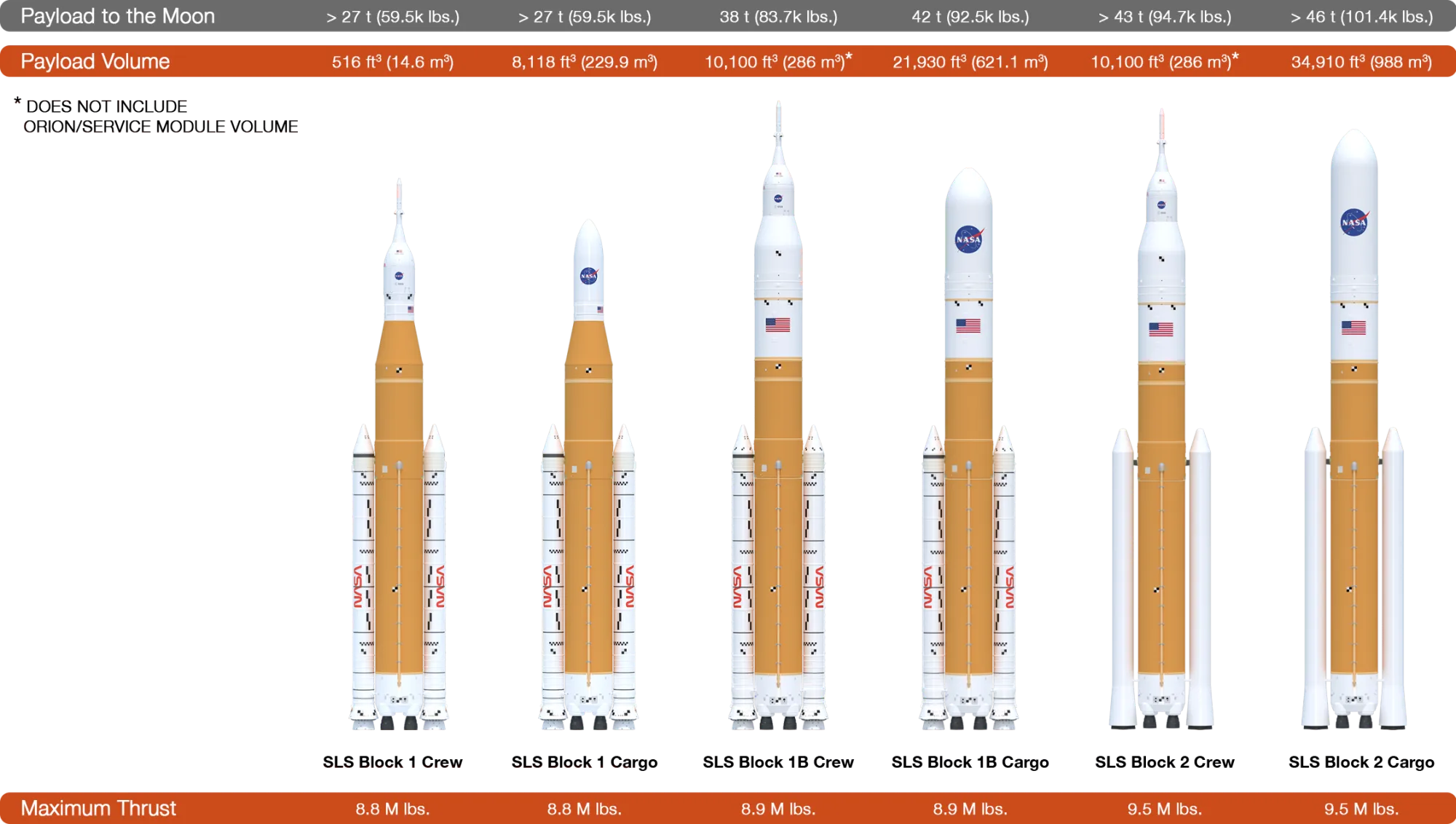
The revised plan would see this parade of launchers greatly reduced, perhaps to just a single design. The stated reason was that the difference between vehicles at each launch was making it more difficult to test vehicles between launches and deal with issues as they appeared. This was also one of the issues brought up by ASAP.
It was not explicitly stated, but it seemed clear that this means the end for the Block IB design that was supposed to fly the Artemis IV mission and the Exploration Upper Stage that would have been on all missions following Artemis III.
The closest anyone on the stage would come to saying what the more standard version of SLS would look like was saying that Artemis IV and V would use a "near Block 1” design featuring a "new upper stage." However, Isaacman said that he expected the design to "evolve" and that Artemis X would likely look nothing like Artemis V, so it's unclear just how standard this "standardized" SLS might be.
More NASA employees… but only for Artemis
The third key change that Isaacman announced was additional staffing. He stated that NASA lacked enough employees to manage a successful lunar program and the increased cadence that requires. This comes less than a year after over 2,000 NASA senior employees were let go, many of them related to programs in basic scientific research, climate monitoring, and general Earth science.
Asked about his, Isaacman did not address specific programs. However, he said he didn't believe NASA could successfully manage both Artemis and "other billion-dollar programs," making it clear that the return to the Moon has priority.
The New Artemis
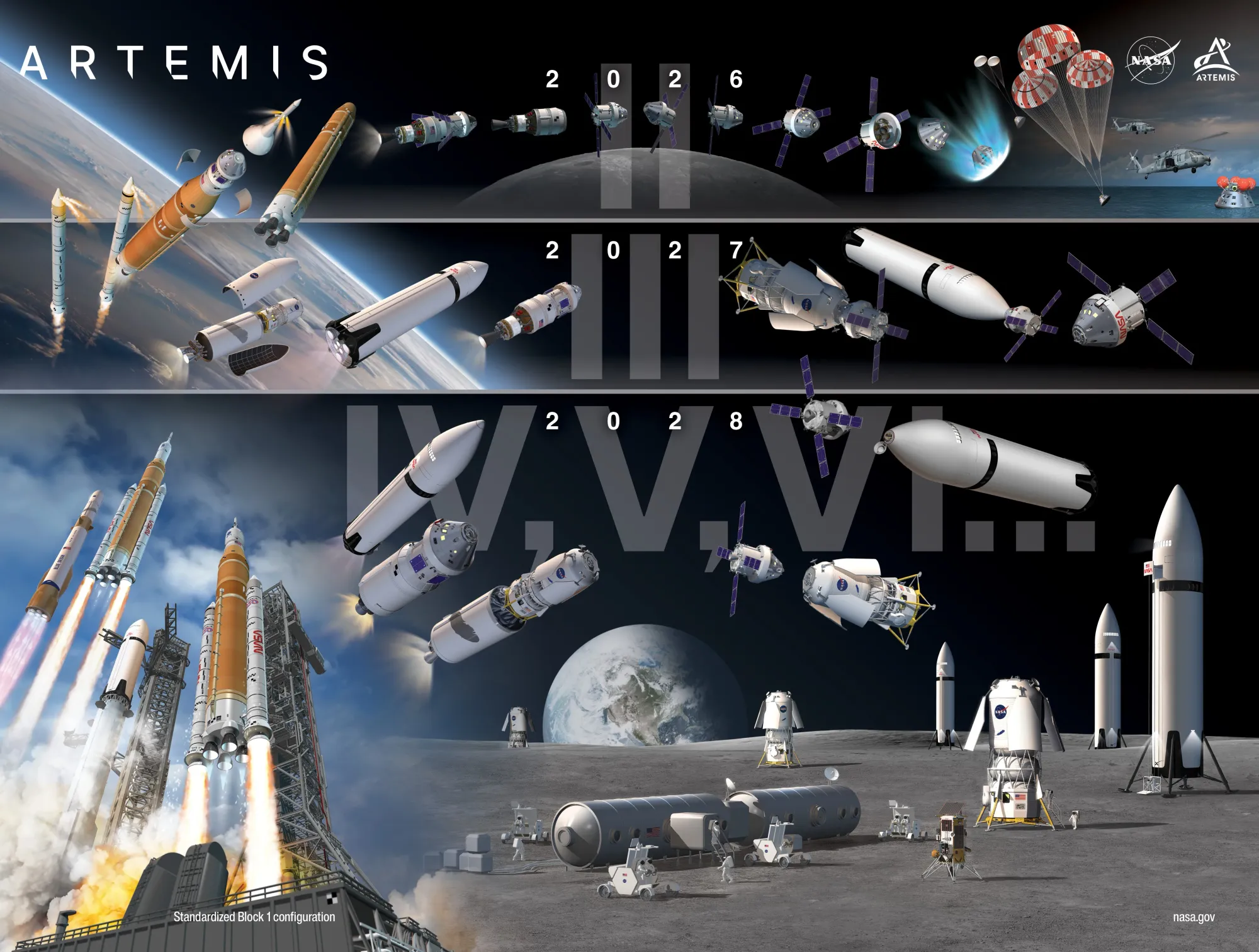
NASA provided an infographic showing the state of the redesigned program.
- Artemis II continues the planned loop around the Moon as soon as the issues can be addressed and the vehicle rolls back to the pad.
- Artemis III is scheduled for 2027, but would travel only to Earth orbit for a docking with either or both of the contracted lunar landers.
- Artemis IV and V would both target 2028 and would represent landing missions, possibly using different landing vehicles.
- The infographic also shows Artemis VI in 2028, but during the conference, Isaacman did not mention this mission.
What upper stage?
Isaacman and other NASA officials at the press conference hedged their bets on some specific questions by saying that the intention of this event was not to go into "architecture." While there was to be a "new upper stage," the capabilities and contractor for this stage were not discussed.
One of the biggest factors in the design of current Artemis missions is that the current upper stage, and even the now-cancelled Exploration Upper Stage, lack the power to bring the Orion capsule to the kind of low-lunar orbit that was used in Apollo missions. Instead, it achieves a near-rectilinear halo orbit (NRHO), which is easier to reach from Earth. However, this orbit requires more power to reach when leaving the Moon.
Docking with Orion in NRHO, traveling to the lunar surface, then returning to dock with Orion means that an Artemis lunar lander has to be more capable than the ones used in Apollo — and that lander has to get to the Moon on its own, because the Artemis upper stage doesn't have the power to carry it.
Whether any of this changes with the new upper stage design was left unclear.
What about the Lunar Gateway Station?
Much of the future of the Artemis program was supposed to be based around the Lunar Gateway (or just "Gateway") space station that was slated to be launched into lunar orbit early in 2027. Starting with Artemis IV, crews were expected to go to Gateway first, then catch a ride on a waiting lander to make their way to the Moon.
The hardware for this station is largely complete, but it was supposed to launch on the now-cancelled Block 1B SLS, so it has no ride to the Moon. Isaacman and other officials pointedly dodged questions about Gateway during Friday's conference.
Unless they find some other way to deploy the station, Gateway seems to be as dead as the SLS IB and Exploration Upper Stage. Which would represent a pretty painful waste.
What kind of lander?
A series of failed flights on the SpaceX Starship program made it clear that the Human Landing System (HLS) designed to use Starship was unlikely to be ready in time for the original Artemis III mission. That spurred previous NASA officials into seeking a lander that would be ready sooner.
Both SpaceX and Blue Origin (whose lander was scheduled to be used for Artemis V) have been designing smaller versions of their landers to meet NASA's schedule, but none of them are ready to go. This makes even the revised Artemis III plan seem ambitious.
Isaacman would not say what landers Orion would meet during Artemis III.
Suits?
Isaacman also seemed to place a lot of value on getting a chance to test out the Moon mission suits during Artemis III, but it’s unclear how much value testing these suits in orbit will be. They are designed for movement in lunar gravity, and they can be tested in a vacuum without being launched.
What next?
The revised plan would achieve a goal given to NASA by Congress—to use up the already built and partially built SLS hardware. But there was no suggestion about plans for how astronauts continue to get to the Moon once the supply of SLS hardware is exhausted.
It's even unclear why NASA would exhaust a full SLS stack just to put Orion in low Earth orbit for Artemis III.
NASA's current crop of contractors seem to be on board with the changes, suggesting that future contracts may be in the works. But right now, the details of what happens after Artemis III are not ... standardized.









Comments
We want Uncharted Blue to be a welcoming and progressive space.
Before commenting, make sure you've read our Community Guidelines.