


On November 20, number theorist Levent Alpöge at Anthropic announced that, working with a version of that company's Claude AI, he had solved the Riemann Hypothesis. The actual proof runs to about 17 million lines—250,o00 pages when printed out*. Some mathematicians have verified portions of that proof, which is written is a specialized mathematical programming language. Other mathematicians have warned that it will be years before they are able to carefully parse the complete solution. But so far, it seems to hold up. (Another Riemann proof, this one a 940-page AI-free manuscript by mathematician Alessandro Masullo appeared just hours after the Alpöge-Claude collab, but Masullo’s proof appears to be unfinished.)
Alpöge had nothing but rapturous praise for his silicon partner.
Claude and I have had a great time together with such breadth in recent months, but this time Claude far outpaced me near the finish line. No, Claude flew, and danced, and sparkled near that finish line.
If you really want to know the details, and you're not frightened by a substantial chunk of Very Serious Math, then this will fill you in on what makes this a big deal.
If you skipped the deep explanation above, the Riemann Hypothesis describes the sequence of zeroes in a function that’s critical to number theory. More practically, the resulting values can be used to determine the distribution of prime numbers within any sequence of numbers. In theory, that's a power that could help unravel forms of cryptography and speed up some genuinely tedious calculations. It would ... except for the fact that we've been acting as if the Riemann Hypothesis is true essentially since it was first stated.
What made the Riemann Hypothesis such a Golden Fleece of mathematics wasn't so much the consequences of proving it, but the simple fact that proving it was clearly very, very, very hard. So hard, that's there are whole heaps of math that just assumed it was true and moved on. So finding that it wasn't true would have resulted in a lot of hair-pulling, but finding that it is true doesn't immediately change a lot.
Except for the fact that many mathematicians always assumed that solving the Riemann Hypothesis would require some wholly new mathematical approaches; the math equivalent of the Large Hadron Collider kicking up some new particle. Do either of these proofs have that kind of "wow, we discovered the Riematron!" energy embedded in their lines? That's not clear.
Alpöge believes that the solution cooked up by Claude also solves the generalized and extended versions of the hypothesis, which has something to say about the placement of certain types of primes in some pretty exotic situations.
Just like finding that new particle, this may turn out to have revolutionary implications that require New Science. But at first glance ... it doesn't look that way.
What does seem to be happening here is that there's been a break between being able to prove something in mathematics and having a human being who understands that proof and can explain it to others. We may need to call on Claude and other LLMs to hold our hands and explain this proof to us. It shouldn't be surprising that this makes some people queasy.
Assuming this solution pans out (and honestly, even if it doesn’t), this announcement contributes heavily to the ongoing crisis in mathematics. Solving famous conjectures by applying enough AI tokens to fund lifetime employment for the world’s contingent of professional mathematicians has become a popular means of showing the power of the latest LLMs. Most mathematicians are considerably less thrilled by this than Alpöge.
For many of them it seems that their profession has become not just the favorite hobby horse of billionaires out to prove the worth of their trillion dollar machines, but has placed them on the bleeding edge of the next great human experience: being eternally unemployable.
Which is, of course, what generative-AI is all about. Mark Zuckerberg or Dario Amodei can talk all they want about enhancing the human experience, but the purpose of their companies, and their LLMs, is removing humans from the workforce. Artist or accountants, editors or sales agents, they are all in the AI gunsights. Put together the projected plans of SpaceX and Anthropic alone, and it requires replacing every white collar job on the planet from the mail room to the C-suite. It also assumes that companies, now neatly devoid of dim-witted humans, will instead direct their former salaries to SpaceX and Anthropic, which is … “genuinely stupid” seems like the appropriate term.
Replacing you, and I do mean all of you, is their business plan. It’s the only thing that can sustain their dreams of building more and larger data centers to build ever larger and more capable models.
If you are protesting that you don’t have a, sniff, white-collar job, because you actually work for a living, let me introduce you to the millions of robots being built by Elon Musk and others, all of them neatly human-sized and human-shaped so they can fit into your coveralls without an issue.
Will they succeed at idling humanity? It seems highly unlikely. Will they succeed at f*cking up the labor market, disrupting lives, and devaluing workers with critical skills? They’re there already.
Microsoft is offering voluntary buyouts to about 60,000 employees, or roughly one-quarter of its global workforce, as the technology giant invests more in artificial intelligence. … Microsoft expects to spend $175 billion on AI infrastructure, including through investments in data centers, in 2026 alone, Chief Financial Officer Amy Hood said in a July earnings call with Wall Street analysts.
Notice that these employees were not offered to take up new and lucrative careers made possible through the human-boosting power of AI. They were instead offered the chance to take their sweaty meat brains elsewhere. Those former Microsoft employees will join an estimated 136,000 U.S. workers who have already lost their positions directly to AI replacement. And that's just the ones where they're being open about it.
Meanwhile, computer science departments at universities are swiftly emptying out. What once seemed like the last remaining ticket to a living wage has turned into an invitation to start over. With more debt.
The techbro-buddies of the AI billionaire club are fully aware that their capitalization plans involve shredding the lives of billions. But when asked about it, they are quick to wave away concerns. Previous technologies, from cars to computers, only created more jobs. AI will surely do the same. Just go out and learn how to write a good prompt and things will be cool.
Except those previous technologies didn’t gain their value only from replacing human workers. AI does.
But we shouldn’t worry. Elon’s got this.
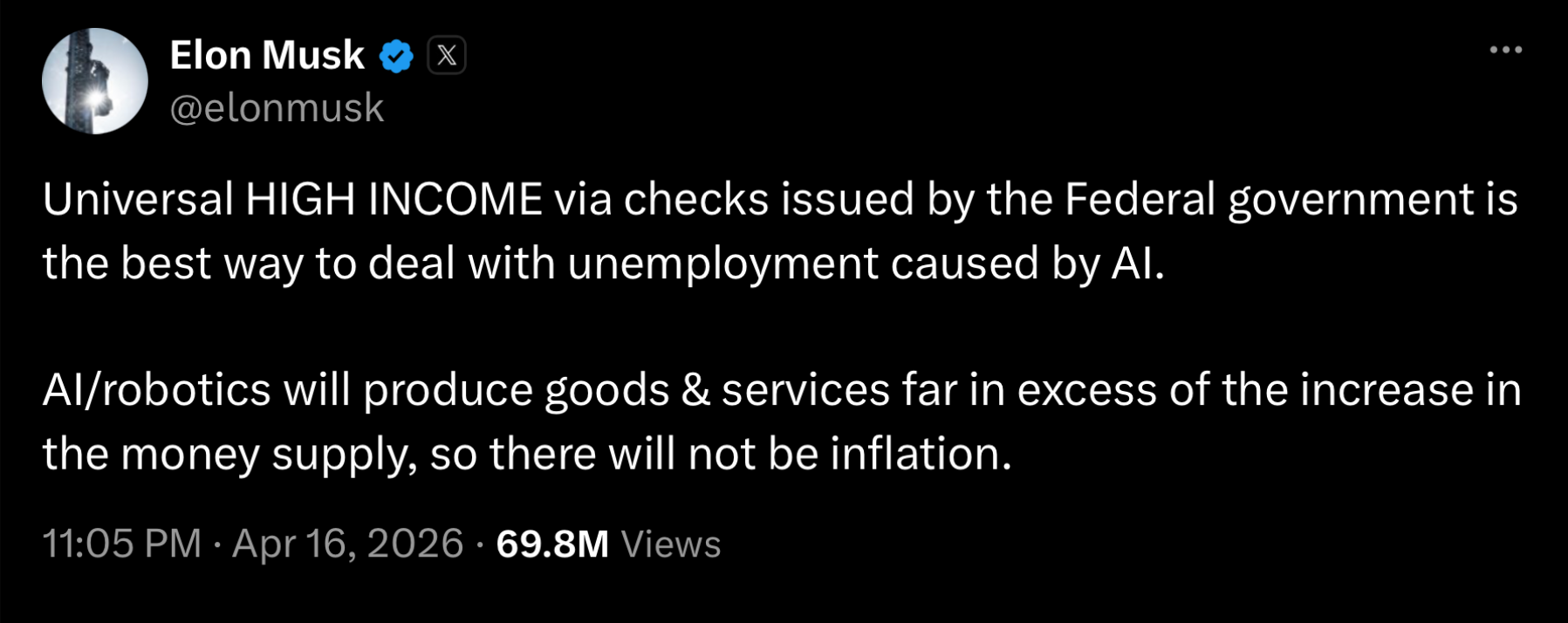
Assuming that “universal high income” includes a salary of $100,000, the government only has to come up with an amount roughly equal to the national GDP each year to cut those checks. Which is going to be tough if they’re counting on Musk’s companies to provide the funds.
Elon Musk’s companies—most notably Tesla—reported paying little to no U.S. federal income tax on 2025 profits, with Tesla’s filings and independent analyses showing “precisely zero” current federal income tax on roughly $5.7 billion of U.S. pretax income in 2025. Public reporting shows Tesla paid about $28 million to the U.S. in cash taxes (likely for prior years) and approximately $1.2 billion in cash taxes worldwide, most of which went to China and other foreign governments, while SpaceX has also been reported to have paid little to no federal income taxes in recent years.
Is that government check coming from China? Musk certainly doesn’t seem to be putting anything into American coffers.
Anthropic appears to have done slightly more planning than Musk, at least when it comes to defining the problem. They have an economics team that recognizes that AI could have a huge impact in just the next four years. Their projection sees AI performing “almost half” of the “cognitive work” by 2030 with labor’s share of income dropping by 30%, and 20% of white-collar workers permanently unemployed.
What do we get from handing over this chunk of the economy to AI?
One surprising finding of our model is that the growth speedup from AI in innovation is relatively minor, even in the extreme change scenario. …Automating research increases the amount of research inputs that go into the production of new knowledge, but research remains bottle-necked by physical tasks. Labor productivity rises through this channel by well under one percent in all three scenarios, and measured TFP by less.
The very hungry machine gets ever hungrier, but if you feed it one in five workers and surrender a third of your income, you get 1% more goodies. That's cool.
But a 1% growth in productivity sure doesn't sound like the kind of thing that's going to create so much revenue that the government can start cutting us all "universal high income" checks. It's not even going to come close to compensating the people directly displaced to gain this trivial advantage.
Right now, with Donald Trump running interference for both AI companies and tech CEOs, there are essentially no federal restrictions on either AI or the data centers that LLMs need to gobble up what remains of the economy. Several bills have been proposed, including one sponsored by Sen. Bernie Sanders that would prohibit building or upgrading AI data centers without community approval until controls are established to ensure AIs can be built safely and meet environmental guidelines. Another bill passed the House overwhelmingly in September which is supposed to keep residents from facing utility increases when data centers move in nearby. However, the reason Republicans were quick to sign onto this bill is because it is completely toothless.
Beyond ensuring that data centers aren't going to pollute our water and air, drive up electricity prices, and create an infernal racket that makes living within miles of them intolerable, there's an entire other set of guarantees that should be required by any federal legislation.
In short, what are they planning to do about all the people they displace? If AI is going to permanently replace workers in the way that makes their education and expecience worthless and positions them for lifelong unemployment, then AI companies don't just need to pay taxes, they need to pay for those displaced workers.
The government can't pay those workers out of the nonexistent taxes provided by tech companies. AI companies need to pay a levy directly based on the income of the workers they displace. If their technology is better than humans, they should still turn a profit. If their technology is just an excuse to take the money going to workers and put in the hands of a wealthy few, that will become clear.
Right now, every AI company is telling you their plan: We take all the money, humans lose all their jobs, and then ... magic ... government cuts a check.
Why not require AI companies to devote at least as much energy to solving this problem as they did to cracking the Riemann Hypothesis? When Claude can get back to us on how AI is going to provide for every person it displaces, and real economists check out that plan to be sure it's workable, then they get to build a new data center. And not one picosecond sooner.
*Alpöge now says the 250,000 pages “was a joke,” but 17 million lines of Lean is definitely going to run to some paper. As of Thursday, there is now a 76,000 line version that claims to prove the general solution.








Comments
We want Uncharted Blue to be a welcoming and progressive space.
Before commenting, make sure you've read our Community Guidelines.