

A few days ago we took a look at "Deciding To Win," the latest centrist-generated report arguing that Democrats need to talk about things voters like, not talk about things voters don't like as much, and that despite the fact that every Democratic campaign since you were born already follows this advice if we do it just a little bit more then surely the voters will come flocking back and not vote for idiot game show hosts trailing a string of Nazi wannabes behind them.
It was something like that, anyway. I wrote about it as a case study in "How Not To Interpret Data," because the whole thing was an egregious example of how companies, governments, and other groups of often savvy, knowledgeable people "data-poison" themselves into believing bizarre things by measuring the wrong things or measuring them badly.
Proper experts know that "data" is something you should interrogate at gunpoint, and that the more you think it proves your prior assumptions the more you should presume you've screwed something up.
In "Deciding to Win," the authors made two catastrophic errors. The first is that they premised their whole paper and argument on purportedly measuring which issues voters believe the Democratic Party is prioritizing too much or not enough, asserting that Democrats should shift what they talk about to better match voter preferences. But they then proceeded to measure social and mass media depictions of Democratic priorities, which isn't even close to the same thing.
It's understandable, because the number of actual real-world voters who pay close enough attention to accurately bubble-sort Democratic Party "priorities" is, considering that Democratic lawmakers themselves can't easily do it, effectively zero. But it means that the data they've collected is useful mostly for measuring which Republican-promoted media attacks are most prevalent at the current time, and sure enough, the alleged "top" misplaced priorities of the Democratic Party turn out to be a collection of Republican talking points.
The authors' mistake is the unwillingness to acknowledge that if the supposed gap between real and imagined Democratic priorities turns out to be a product of whatever a mostly-hostile media market claims it to be, then there's no reason to believe altering Democratic talking points will make a damn bit of difference. The Sean Hannities and Jesse Waters are not going to say "oh, I see Democrats are no longer talking about raising taxes to spend on social programs" even if every Democrat in the country stopped talking about that tomorrow.
Right now one of the top misplaced Democratic Priorities is, allegedly, "promoting" DEI. Very few of the poll respondents answering this question could tell you what a "DEI" program was, before a singularly malicious propagandist began peddling it as the far-rights new quasiracial slur. Now it's allegedly a major Democratic Party priority because Some Complete Knob said so?
If you want to measure the reach of partisan propaganda, then measure that. But you can't measure the reach of propaganda and pretend you're measuring deep-seated voter preferences. It don't work that way.
That brings us to the second catastrophic error in the report: That the argument that Democrats must focus on better matching their issue priorities to voters' own self-specified issue priorities. This would be an unassailable argument—if we had evidence that voters vote for candidates based on those priorities.
But we don't. On the contrary, we have mountains of evidence that voters do not vote for candidates based on specific issue priorities, but instead justify their votes with an array of weird and mostly vibe-centered arguments. Instances abound of the same groups of voters both choosing in overwhelming numbers to, for example, protect abortion rights while on the very same ballot voting to elect candidates openly hostile to that positions.
If voters don't actually keep meticulous policy priority lists in their heads, and don't actually compare those lists to the announced policy positions of each candidates, then this whole "analysis" of their agenda has been a horrible waste of time and the money ought to have gone to, I don't know, delivering sidewalk chalk to hungry orphans or something.
Now, via CNN's Ariel Edwards-Levy, we have more evidence to throw at the theory that No, Actually, voters are not souring on the Democratic Party because Democrats don't sort out their issues in the right order. A just-released Pew Research Center study asked Democratic and Dem-leaning voters what their biggest frustrations with the party are, and the answers are what we've been hearing for a while now.
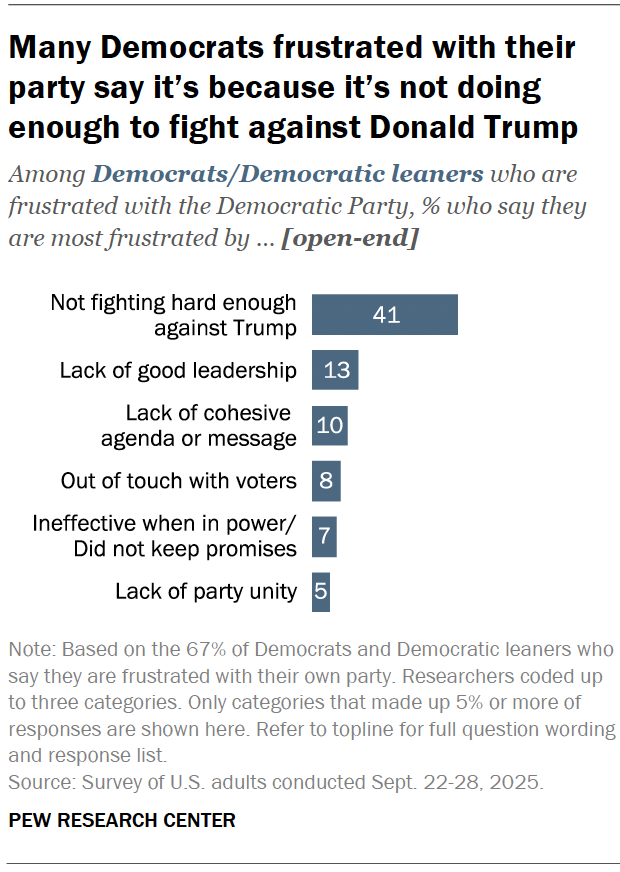
Surprise! What frustrates Democratic-aligned voters the most is the perception that the party isn't pushing back on Donald Trump's continued antics enough. Each of the next most popular responses can be seen as tightly related to that perceived inaction; voters are peeved that Democrats aren't engaging in leadership, aren't pushing back with a message of their own, or are perceived to be, sigh, either in disarray or disarray-adjacent.
Not present in those responses: Complaints about specific issues or specific issue prioritization. You have to go waaaaay to the bottom, dipping into the white-noise end of the responses, to find those.
Here's the full list -- both "specific policy" and "prioritizing the wrong issues" are pretty far down. (This is an open-ended question, so these categories are researchers' coding of individual responses. www.pewresearch.org/wp-content/u...
— Ariel Edwards-Levy (@aedwardslevy.bsky.social) 2025-10-30T17:44:53.479Z
Well, crap. For three decades now centrism-seeking Democratic strategists have told the party that voters wanted to see the party focus on specific issues and talk much much less about other specific issues and it turns out that in an N=271 statistical poking, only ten or so voters gave a flying damn about that.
So once again, we've got the James Carville wing of the party insisting that if Democrats don't properly prioritize which issues they fight for, focusing on "the economy" while dropping talk of "climate change," "democracy," and "rights," we'll be in dire danger of losing maybe as many as ten of those people.
But nobody, among the centripundits, thinks it's a problem if 41% of Dem-frustrated voters become disillusioned by a perceived party unwillingness to confront the crookedest, most abusive, most vindictive, most economy-gutting administration in U.S. history. Just keep making jokes about the price of eggs, senators—those videos of government-funded violent thugs zip-tying crying children aren't what undecided voters want to talk about. That's too spicy for your average moderate.
The possibility that even solidly Democratic voters might become less solid in their support, less willing to drag themselves to voting booths because they don't think the party will "fight hard enough" for them whether they're in the majority or out of it, is always, always, always discounted. Either it won't happen, say the pundits, or the gains we make among those 3% of voters will surely offset the vote decay we face among the 41%. Because reasons.
There is much dispute over why voters are the way they are, and it will not be resolved anytime soon. Voters are flighty creatures, to be sure, but for the most part it's difficult for any human with a job and a life to be more than glancingly aware of what is happening in government. There just isn't time. That is why we choose representatives to begin with, under the assumption that if we choose representatives who we trust and tell them it's their job to learn and pay attention to these things, those people will do the detail work and get back to us if something big happens.
As to why 41% of Dem-leaning voters are prioritizing as abstract a concept as "fight harder against Trump" while only 3% are ticked off about more specific issues, though, that's easier to explain.
Voters have a lot better handle on what they don't like than on what they do, and voters are much more swayed by what is happening in the present than by theoretical plans for the future. Right now, millions upon millions of Americans see what Republicans are doing and hate it, hate it with a burning passion: They do not care what the future might bring so long as it is Not This.
Those voters want a message or agenda that consists of "Not This," and they want to see leaders willing to oppose Trump in ways that will make Not This happen as quickly as possible. Voters don't like details. Voters don't reward details. Voters do not, in general, have time.
It feels icky, I know, to acknowledge that voters don't care nearly as much about policy as they do about the abstract vibe of leadership, but it has been consistent since before "voting" was invented. Once again: It is the whole premise of representative government. We find people who can act as our "leaders," we task them with coming up with solutions to problems we ourselves may be only vaguely aware of, and then all the rest of us can get on with churning the butter or mucking out the stalls or mining the cryptocurrencies.
We see, time and time again, that voters vote for "leadership" over policy. Donald Trump is an odious, lying barnacle clinging to America's hull—and was voted into the White House twice because while voters had no damn idea what he stood for, they knew he stood for it good and hard. Barack Obama was elected on a less vitriolic but similar notion; he represented "hope," which is not an agenda but a generic promise to make things better whether you're paying attention or not.
Ronald Reagan and Bill Clinton rose to the presidency based on similar abstract notions of change. Those who were seen as more technocratic, from George H. W. Bush to Kamala Harris, have had a rougher go of things.
That still leaves us with the question of how to move forward, since "go do some leadership" is easier said than done and our more aged Democratic electeds have been trained to be cautious to the point of near-subservience. It likely requires, in many races, new Democrats. But top party donors are always on the lookout for those who promise the most hope but the least change; money in politics is blisteringly hostile to economic reformers but always willing to pony up for regulatory retreat.
And that, right there, is how we got there. It is difficult to create a "cohesive agenda or message" while sabotaging all substantive thoughts of reform; it elevates ineffectiveness into a "best that can be hoped for" second place. It is difficult to show inspiring leadership while promising to fix nothing much, and it is impossible to both show leadership and have an office policy of running from every fight.
For three decades now, Democratic wealth has pushed Democratic politicians into prioritizing stasis over reform, condescendence over leadership, and for every campaign to be a fight for a narrow band of moderates, minimizing or even demonizing those who would seek more reform than that. It is intentional. And it is so weak and vapid an argument that even thuggish fascism is seen as a plausible alternative.
If almost half of Democratic-leaning voters have, as their top frustration, a seeming inability of Democratic leaders to mount a cohesive opposition to Trump's incompetent and crooked authoritarianism, then one would think even the centrist wing of the party would sit up and take notice. Frustrated voters are not voters who show up to vote. So aren't we done here? Look! The voters have announced their top-priority issue. It beats out every other top-priority issue by, literally, an order of magnitude.
So maybe we should get on that.









Comments
We want Uncharted Blue to be a welcoming and progressive space.
Before commenting, make sure you've read our Community Guidelines.