


The United States and Israel enjoy total air supremacy over Iran. That's been true almost from the moment Donald Trump and Benjamin Netanyahu let loose their first salvo. As of late March, U.S. Central Command reports that missiles, drones, and bombs have been used on over 10,000 targets inside Iran. That's just the U.S. total. Israel has also reportedly struck at least 1,000 locations.
But what does that mean in 2026?
It means that a month into the war, the Iranian regime is still in place, less than 1% of normal traffic is passing through the Strait of Hormuz, the world economy is plummeting toward recession, the stock market has surrendered all the gains made in the first three months of the year, and every U.S. military base in the Middle East is "uninhabitable."
"The damage to US bases in the region has been underreported," said Mark Cancian, a [Center for Strategic & International Studies] senior adviser.
Iranian drones have done at least $800 million in damage at 13 bases, including destroying a $485 million radar installation at an air base in Jordan. All this is on top of the roughly $2 billion a day the U.S. military is spending to keep forces in the region and drop all those bombs. Estimates suggest that, even if the Pentagon gets the massive $200 billion supplement it requested, it will burn through its resources by mid-August.
Many U.S. troops are now reported to be working remotely from hotels and other locations. Iran is aware of this and has struck multiple hotels in the region while warning that housing U.S. forces makes them a legitimate target. This doesn't tend to give American soldiers preferred guest status.
However, not all U.S. forces have relocated from military bases. We know this because on Friday, an Iranian missile, and one or more Iranian drones, hit Prince Sultan air base in Saudi Arabia, leaving 10 U.S. service members seriously wounded. The attack also damaged multiple refueling aircraft, similar to the KC-135 that crashed earlier in the war.
At this point, it might be surprising to learn that Iran is still lobbing missiles into targets across the region every single day. Especially since the White House made this announcement almost two weeks ago.
“Iran’s ballistic missile capacity is functionally destroyed. Their navy assessed combat ineffective. Complete and total aerial dominance over Iran,” the White House said on Saturday. “Operation Epic Fury is yielding massive results."
Massive. However, despite all the big booms in Trump's daily two-minute briefing, NPR reports that the U.S. can only confirm that it has taken out about one-third of Iran's missile capacity. That's probably not what most people would take from the words "functionally destroyed."
Iran manufactures a variety of short and medium-range missiles from the aging Quds cruise missile to the new Kheibar Shekan "Castle Buster." The locations where these missiles are made have been a declared target of the U.S. attack from the outset.
Speaking to reporters about the administration's war aims Friday, Secretary of State Marco Rubio said: "We are going to basically destroy their ability to make missiles and drones in their factories."
It's likely that most of the factories—which are large, immobile targets—have been destroyed in attacks launched in the first month of the war. However, many of the missiles are small, mobile, and have little or no infrastructure requirements for launch. Genuinely destroying Iran's capacity to continue launching missiles would require practically a house-to-house search across a nation over twice the size of Texas. How many of each type of missile Iran had stockpiled at the beginning of the war isn't clear. How many are left now is pure speculation.
Drones are worse.
The drones that have accounted for most of the damage done across the region by Iranian attacks are based on designs by Shahed Aviation Industries. These drones have wingspans just over 7 feet. Multiples of these drones can be stored in the average garage. When selling these drones overseas, Iran charges from $20,000 to $50,000, but the actual cost of building them is considerably less.
Estimates suggest that, just before the attack, Iran was cranking these drones out at a rate of about 400 a day. They had a stockpile estimated to be around 80,000. The number used so far in this war is thought to be around 2,000.
If the United States located and destroyed half of Iran's drone cache, they could still be sending out flights of Shaheds at the current rate in the fall of 2027, and that's if they don't manage to build any more over that time. Which they will, because drones, unlike missiles, don't require high-tech factories. Home-built works just as well.
Somehow, none of that sounds like a war that we've "already won."
What may be worse is that all the damage that the United States and surrounding nations have taken has largely been due to drone warfare as it existed in 2023. The evolution of drone warfare has been happening at a rate close to that of new COVID-19 strains. To see what things are like now, you need to shift the camera 3,000 miles to the northwest, where drones have become the defining feature of Russia's illegal, unprovoked invasion of Ukraine.
The big Shahed drones, including Russian clone versions, are still a major feature of the war in Ukraine, but mostly in the sense that Vladimir Putin loves to throw them at civilian targets. On the battlefront, other drones have become the stars.
The scale of drone warfare in Ukraine is something that few outside that war seem to appreciate. As the Royal United Services Institute reports:
Few military developments in recent history have matched the scale and speed of Ukraine’s drone transformation. In just three years, Ukrainian production surged from an estimated 3,000-5,000 drones in 2022 to over 2.2 million by 2024, with projections reaching 4.5 million in 2025.
Most of these drones are small FPV kamikaze drones guided to a target by a pilot wearing VR goggles. They can take down a tank, blow apart a gathering of soldiers, or kill everyone inside a house. It's these drones, not tanks or other traditional weaponry, that now set the pace of combat on the Ukrainian front.
However, as the rate of drone production has increased, Ukraine has run into two problems.
First, Russia has turned its attention to more and more electronic warfare weaponry, mostly in the form of jammers. These jammers block the GPS signals the drones need to find their way, interfere with the signal the operator-pilot uses in guiding the drone to a target, or both.
Second, even though most of these drones are single-use, the number of drones in use at any time has stretched Ukraine's ability to find and train drone pilots. Machines are outrunning men.
The solution to both of these issues is the same: Take the human beings out of the loop. Ukraine is now using footage recorded by its drone fleet to train AI models. The same thing is happening on the other side of the line.
… drone makers in both Russia and Ukraine have been experimenting with A.I. systems that can autonomously recognize targets such as cars, tanks or humans and eliminate the need for a radio link with a pilot.
For many, taking humans out of the kill decision is a critical line. That line is going to be crossed this year, millions of times. It's unlikely to be drawn again.
If U.S. ground forces move to take possession of parts of Iran, they should definitely expect to meet clouds of drones. Will their technology be as advanced and their operators as skillful as those now buzzing around Ukraine? No. But so far, U.S. planning has shown no sign that it recognizes that an entire era of warfare has been given a funeral in the cratered fields of Kharkiv and Donetsk.
We are not ready for this new age of drone warfare. We can be sure of this because no one is. Russia went into Ukraine with the second-largest army in the world and an incredible advantage in just about every category of men and machines. Here's what that army looks like now.
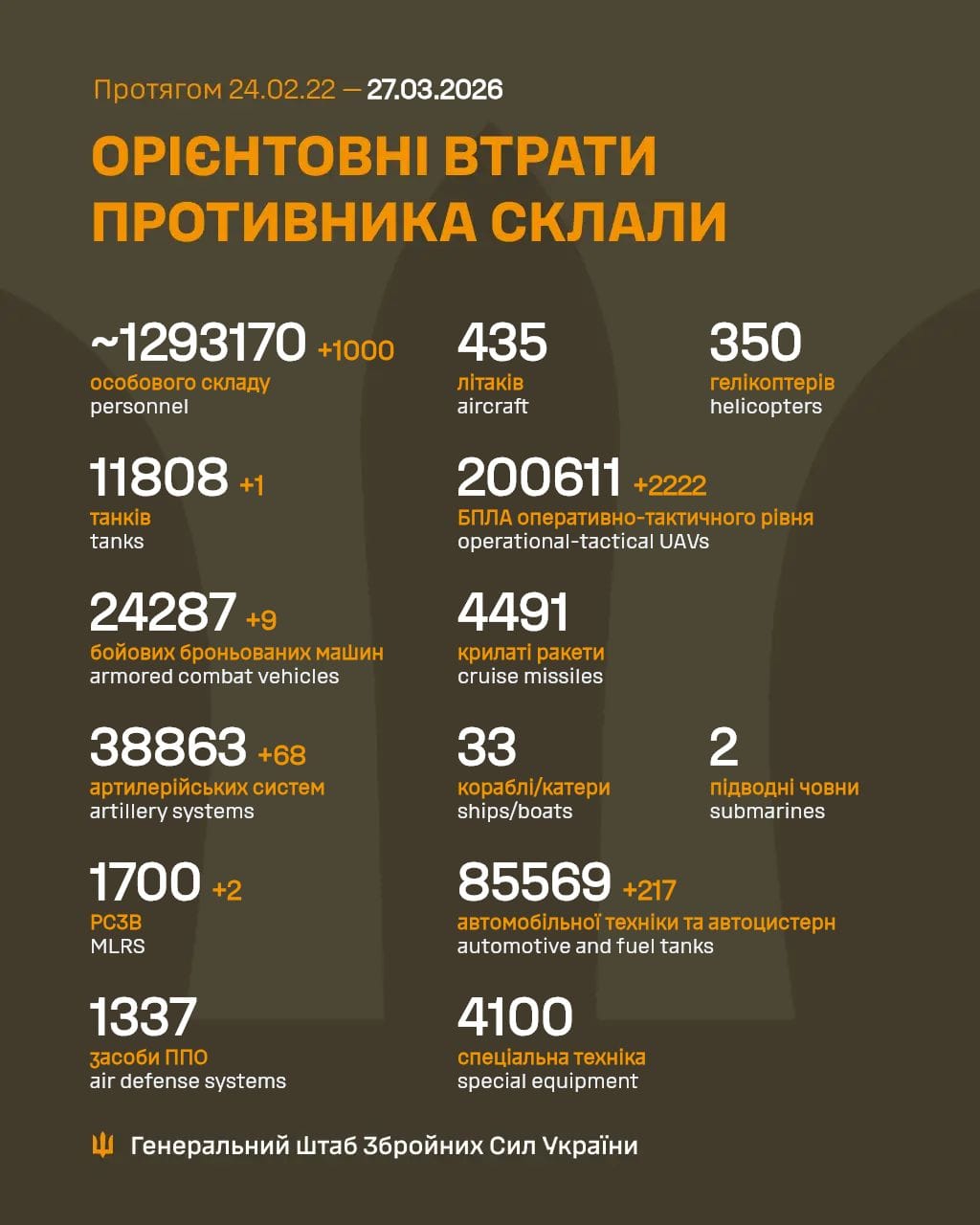
You would have to be an absolute idiot to believe that plans drawn up using standard forms of assault are still functional today. Iran is larger than Ukraine, far wealthier than Ukraine, and the sanctions against it have more holes than a colander. It almost certainly has hundreds of thousands of small drones waiting for the first wet footstep on the sand. Drones mean that all the usual rules about what it takes to occupy and hold territory are extinct.
Of course, there's still a good chance the United States will not splash up on the shores of Khargh Island or try to roll Abrams tanks through the streets of Tehran. If there's anything Trump cares about, it's poll numbers and stock prices, and both of those are sending him big Get Out Now signals.
How that will happen is about as clear as anything in this clusterf**k. Rubio says we should expect the war to be over in "the next couple of weeks." Netanyahu wants to keep fighting for months. Trump says the war is "over," but Iran doesn't seem to agree.
The 15-point plan to end the war that the US has presented to Iran, which includes Iran turning over its stockpile of highly enriched uranium and accepting limits on its missile program, is probably a non-starter for the Iranian government. Iran has rejected the plan and presented a five-point proposal of its own, including the payment of war reparations.
If Trump walks away now, not only will he leave the region in utter disarray; he'll leave behind an Iranian regime that is more entrenched, an Iranian populace with renewed hatred for America, and a new source of wealth for Iran.
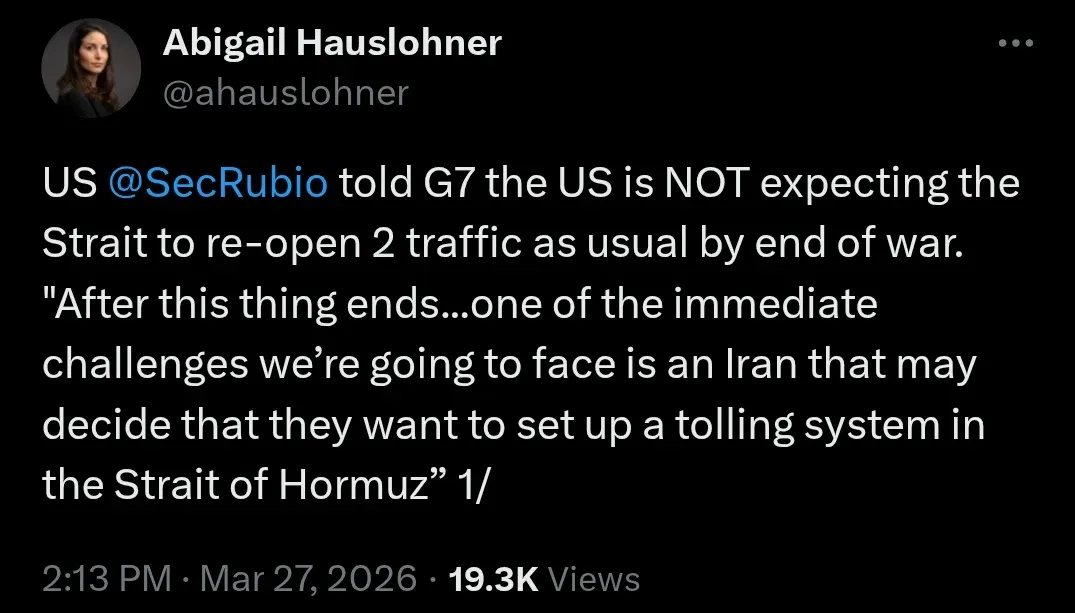
Iran’s IRGC has imposed a de facto ‘toll booth’ regime in the Strait of Hormuz, requiring vessels to submit full documentation, obtain clearance codes and accept IRGC-escorted passage through a single controlled corridor
Rubio is making it clear that the U.S. is willing to allow Iran to keep up this naval piracy if that's the price for getting out of Trump's Folly.
Trump has repeatedly turned TACO despite multiple claims that the biggest, meanest, worstest attack ever was right around the corner. He'd obviously like to drop this hot potato and hide behind his ballroom plans.
But no matter what comes next in Iran, he's going to have a hard time convincing even his biggest fans that it smells like victory. He's also going to have fun explaining to Americans what they bought for $200 billion.
Iran War to be paid for out of cuts to state and local programs for Americans.
— Ron Filipkowski (@ronfilipkowski.bsky.social) 2026-03-26T13:41:28.250Z









Comments
We want Uncharted Blue to be a welcoming and progressive space.
Before commenting, make sure you've read our Community Guidelines.