With his threats to take over Greenland, Donald Trump is actually undermining national security because any actual attempt to seize the Arctic island risks destroying the NATO alliance.
U.S. troops have been based in Greenland, a semi-autonomous territory of the Kingdom of Denmark, since 1941. Denmark, an original NATO member, has always accommodated U.S. national security concerns, even tacitly allowing the deployment of nuclear weapons at the peak of the Cold War.
A 1951 mutual defense agreement between the United States and Denmark gave the U.S. military wide latitude to operate bases in Greenland.
Luke Coffey, a senior fellow at the Hudson Institute, noted in a post on X that there is no need for the U.S. to seize Greenland because the 1951 agreement could be used to address any legitimate U.S. security concerns.
Coffey wrote:
Every homeland defense/national security issue America has in Greenland can be addressed through existing agreements we have with Nuuk & Copenhagen. Denmark & Greenland are longstanding allies. If Denmark can’t handle the security situation like President Trump is suggesting then we should help them—not annex them!
In an article for The Atlantic Council ,Anna Wieslander, head of the council's Northern Europe Office in Stockholm, wrote:
The Trump administration's stance risks dissolving the transatlantic community and putting an end to the most successful military alliance in history.
Trump might be using national security concerns as a smokescreen to cover up the interest in Greenland by tech oligarchs with close connections to his administration.
Due to climate change, Greenland's untapped oil, gas and mineral riches, including raw earth elements essential to making smart phones, electric vehicles and high-tech military hardware, are becoming more accessible, although extraction costs remain very high.
Wislander wrote:
As reported by Reuters and The Guardian, a circle of US tech entrepreneurs and venture capital figures is promoting Greenland as a potential site for so-called “freedom cities” and large-scale extraction and infrastructure projects. These ideas are framed through libertarian concepts of minimal corporate regulation and ambitions spanning artificial intelligence, space launches, and micronuclear energy. Several of these actors are among Trump’s largest campaign donors and investors, including investors linked to mining operations in Greenland, fossil fuels, and cryptocurrency ventures.
Trump nominated Ken Howery as Ambassador to Denmark with the mission of securing U.S. "ownership and control of Greenland." Howery co-founded PayPal with Peter Thiel and Elon Musk, and partnered with Thiel to launch the venture capital Founders Fund, whose portfolio includes SpaceX and Palantir.
It's not as if Danish and Greenlandic officials are blocking U.S. billionaires from investing in mining projects. In 2022, Jeff Bezos, Michael Bloomberg and Bill Gates were among the financial backers of Kobold Metals, a mineral exploration company, CNN reported. Kobold is looking on the west coast of Greenland for a large deposit of nickel and cobalt,
So there's really no rationale for the megalomaniac Trump to be obsessed with having the U.S. take control of Greenland.
And once again the White House stenographer corps is failing to ask Trump the most obvious question: Why do we need to take over Greenland for national security needs when the U.S. already has a base there and could build more if it asked?
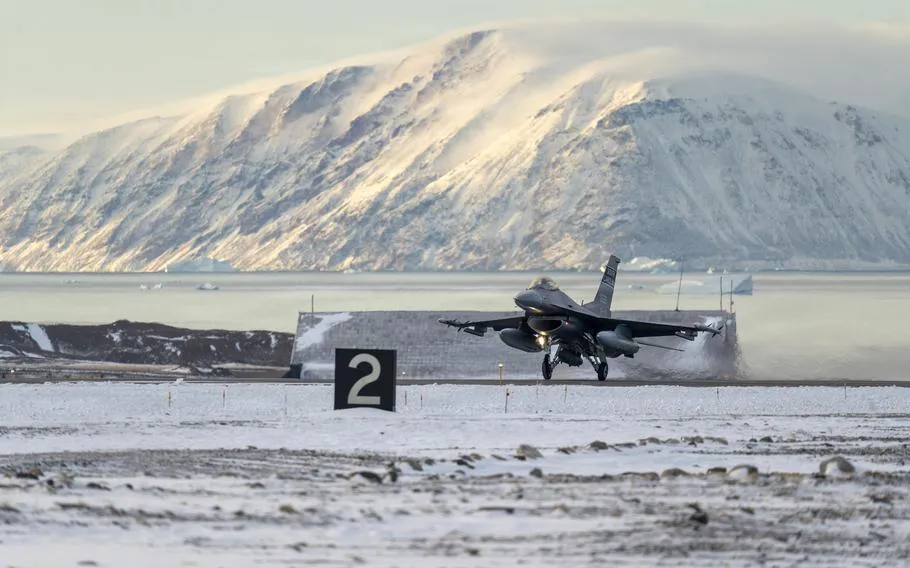
Given that so many news stories lack background these days, I wonder how many Americans are aware of the key role in ensuring national security played by the Pituffik Space Base, formerly known as Thule Air Base, located 700 miles above the Arctic Circle on the northwest coast of Greenland.
Pituffik, where 150 Space Force and Air Force personnel are deployed year-round, operates a solid-state phased-array radar system to detect and track ICBMs and also conducts space surveillance missions to track objects orbiting the earth. Pituffik has an airfield operating year-round and the world's northernmost deep-water seaport.
“It is quite literally the outermost eye of American defense,” Peter Ernstved Rasmussen, a Danish defense analyst, told The New York Times. “Pituffik is where the U.S. can detect a launch, calculate the trajectory and activate its missile defense systems. It’s irreplaceable.”
Here's a video introduction to Pituffik, the northernmost U.S. military base.
After the U.S. military kidnapped Venezuelan President Nicolas Maduro and his wife, Trump savored a premature Mission Accomplished moment as he spoke Sunday to a gaggle of reporters on Air Force One.
Trump laughed after a reporter asked if he had any plans to take action on Greenland.
Right now Greenland is covered with Russian and Chinese ships all over the place. We need Greenland from the standpoint of national security, and Denmark is not going to be able to do it, I can tell you.
Mikkel Runge Olesen, a senior researcher at the Danish Institute for International Studies, said Trump's claim that the waters around Greenland are swarming with Russian and Chinese ships is incorrect.
And then Trump mocked Denmark.
"You know what Denmark did recently to boost up security on Greenland? They added one more dog sled. It’s true. They thought that was a great move.”
Trump's insulting comment wasn't true. Denmark did add a dogsled patrol. But last fall, the Nordic country announced $4.2B in extra defense spending in the Arctic and North Atlantic regions, including Greenland, the BBC reported. It also said it will spend $4.5B to buy 16 more F-35 fighter jets from the U.S.
Denmark said the extra defense spending would be used to buy two new Arctic ships, maritime patrol planes, drones and early warning radar and set up a new Arctic command headquarters in the Greenlandic capital, Nuuk.
The odious Trump adviser Stephen Miller, in an interview on Monday with CNN's Jake Tapper, declined to rule out using military force to take over Greenland.
Miller said:
"The United States should have Greenland as part of the United States. Obviously, Greenland should be part of the U.S. There's no need to even think or talk about this in the context that you're asking of a military operation. Nobody is going to fight the United States militarily over the future of Greenland."
TAPPER: Can you rule out that the US is going to take Greenland by force?
— Aaron Rupar (@atrupar) January 5, 2026
STEPHEN MILLER: Greenland should be part of the US. By what right does Denmark assert control over Greenland? The US is the power of NATO.
TAPPER: So you can't take military force off the table?
MILLER:… pic.twitter.com/9ikEPvlBVA
Tapper asked about Greenland after an X post by Miller's wife, Katie, depicted a map of Greenland with the Stars and Stripes overlaid and the caption "SOON."
At a private briefing for lawmakers on Monday, Secretary of State Marco Rubio took a less aggressive tone, saying that Trump plans to buy Greenland rather than invade it, The New York Times reported. The prime ministers of Greenland and Denmark have both said the island is not for sale.
Rubio has announced that he will meet next week with officials from Denmark and Greenland.
On Thursday, Reuters reported that Trump administration official have discussed providing Greenlanders with lump sum payments ranging from $10,000 to $100.000 per person to convince them to secede from Denmark and potentially join the United States, according to unnamed sources.
If anyone is actually threatening U.S. national security it's Trump. On Monday, Danish Prime Minister Mette Frederiksen warned that an American takeover of Greenland would amount to the end of the NATO military alliance.
“If the United States chooses to attack another NATO country militarily, then everything stops,” Frederiksen told Danish broadcaster TV2. “That is, including our NATO and thus the security that has been provided since the end of the Second World War.”
On Tuesday, the leaders of Canada, France, Germany, Italy, Poland, Spain and the United Kingdom joined Denmark's Frederiksen in issuing a statement defending Greenland's sovereignty.
The leaders said:
"Greenland belongs to its people. It is for Denmark and Greenland, and them only, to decide on matters concerning Denmark and Greenland."
The foreign ministers of the Nordic countries – Norway, Sweden, Finland, Iceland and Denmark, in a separate statement, said:
The Kingdom of Denmark, including Greenland, is a founding member of NATO, and has historically worked closely with the United States on Arctic Security, including through The Defence Agreement between the US and Denmark from 1951, which offers opportunities for increased security cooperation.
We collectively reiterate that matters concerning Denmark and Greenland are for Denmark and Greenland to decide alone.
But the Trump administration ignored these statements from European leaders. Just hours later, the White House said that acquiring Greenland was a "national security priority," the BBC reported.
The White House said:
"The president and his team are discussing a range of options to pursue this important foreign policy goal, and of course, utilizing the US military is always an option at the Commander-in-Chief's disposal."
It's worth taking a closer look at Greenland's historical role in ensuring U.S. national security.
In 1916, the U.S. purchased the Danish West Indies (now the U.S. Virgin Islands) from Denmark for $25 million in gold to prevent the islands from coming under German control during World War I. The contract had an appendix in which the U.S. declared it would recognize Denmark's sovereignty over the entire island of Greenland.
Oddly enough, in 2017, Trump floated the dumb idea of swapping Puerto Rico for Greenland, acting like it was a real estate swap, according to former DHS official Miles Taylor, who quit the Trump administration in protest over the president's erratic behavior.
After Germany invaded Denmark in April 1940, the U.S. government feared that the Nazis might try to occupy Greenland. The U.S. government signed an agreement on April 9, 1941, with the Danish ambassador in Washington, Henrik Kauffmann, which made Greenland an American protectorate for the duration of the war. The U.S. was neutral at the time, but the Roosevelt administration said it was upholding the Monroe doctrine.
After the U.S. entered the war, the military set up radio and weather stations, patrol bases and airfields around the island. It was a trans-Atlantic pit stop for the U.S. military. Meteorologists based in Greenland, a breeding ground for western Europe's storms, provided key information to the allied war effort, including the right day, time and forecast for the June 6, 1944, D-Day landings.
In 1946, the Truman administration, recognizing the island's importance to U.S. security, privately offered 100 million in gold to purchase Greenland, but Denmark refused, The Associated Press reported in a 1991 story.
The U.S. took another path to obtain the bases it needed after the 1949 formation of the North Atlantic Treaty Organization. After drawn out negotiations, the U.S. and Denmark signed a mutual defense agreement in 1951 that confirmed Denmark's sovereignty over Greenland and allowed the U.S. military to start constructing bases there.
The military affairs magazine Coffee or Die wrote that Greenland became "the cornerstone of America's nuclear defenses" as Cold War tensions deepened.
Coffee or Die wrote:
The US began quietly constructing Thule Air Base in 1951. ... The new base would serve as one of America’s most important military installations during the Cold War. Thule sat squarely between the United States and Russia, which made it the perfect spot for nuclear bombers to refuel should they ever fly for Moscow. Turn the tables and the base made an ideal launch point for American fighters to intercept incoming Soviet aircraft. Furthermore, Thule was the northernmost US port where big ships could reliably resupply. For these reasons, the base housed roughly 10,000 troops at the height of the Cold War.
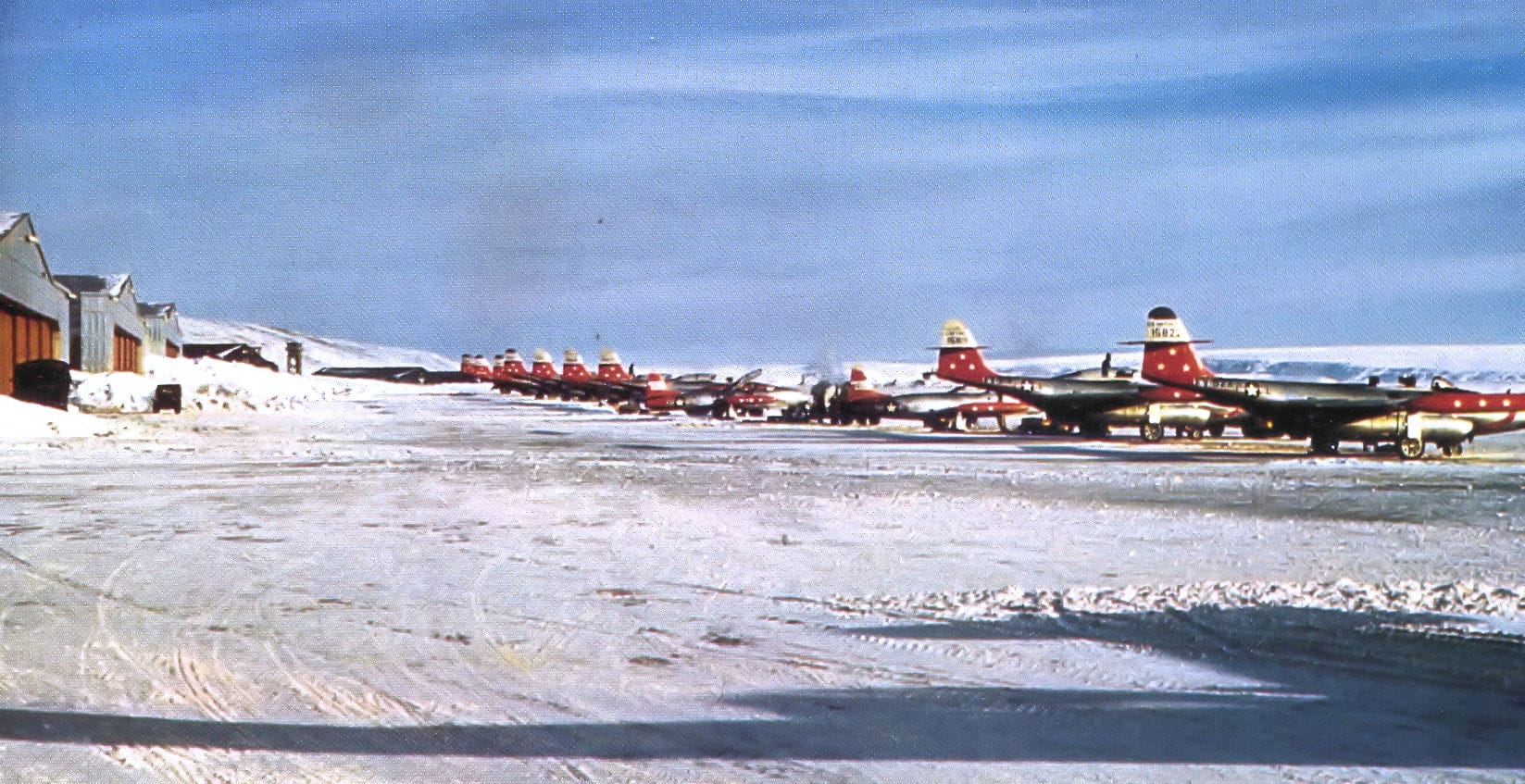
74th Fighter-Interceptor Squadron F-89s, Thule Air Base, Greenland, 1955 (Photo by David W. Menard/ U.S. Air Force)
The U.S. military also constructed four radar sites across Greenland's ice sheet that extended the Distant Early Warning (DEW) line, set up to warn of an incoming nuclear attack by way of the Arctic, to 3,600 miles stretching from Alaska through Canada to Greenland.
Starting in 1961, the Strategic Air Command approved a plan for two nuclear-armed B-52 sorties a day to fly over Thule. The flights ended in 1968 after a B-52 crashed, spreading plutonium contaminated debris across the ice.
As the Cold War subsided, the U.S. began closing bases in Greenland. After the collapse of the Soviet Union, the U.S. shut down Sondrestrom Air Base, leaving Thule as the sole U.S. military base on the island.
Thule is the name of the most northerly location mentioned in ancient Greek and Roman literature. In April 2023, the Biden administration renamed it the Pituffik Space Base to honor the Greenlandic cultural heritage.
At the renaming ceremony, U.S. Ambassador to Denmark Alan Leventhal, said:
Pituffik is not a new name. It is the name this land has had for many generations. It is a place where people have lived, hunted, and tied up their dog teams for thousands of years. ...
I hope today’s ceremony and the new name – Pituffik Space Base will become a symbol of our cooperation, in science – climate and space research, the common defense of our countries, and the stability of this amazing part of the world that is so vital for all our survival – the Arctic.
Contrast that with the boorish behavior of Vice President J.D. Vance when he visited Pituffik last March.
Speaking to U.S. troops, Vance said:
Our message to Denmark is very simple: You have not done a good job by the people of Greenland. You have underinvested in the people of Greenland, and you have underinvested in the security architecture of this incredible, beautiful landmass filled with incredible people. That has to change, and because it hasn't changed, this is why President Trump's policy in Greenland is what it is.
During his first term, in August 2019, Trump confirmed rumors that he was considering an attempt to buy Greenland which The Guardian wrote "was greeted internationally with widespread hilarity but with indignation in Greenland and Denmark.
But the notion seems less farcical once Trump returned to the Oval Office and intensified his efforts to take over the Danish territory as outlined in a timeline put out by The New Republic.
As Miles Taylor, the former DHS senior official turned never Trumper, noted on his Defiance.News substack, Trump is now "surrounded by people prepared to end the West as we know it, as long as it pleases the boss" whose "dictatorial fantasies are hardening into real policy."
Taylor described the catastrophic consequences if Trump applies force, economic pressure or "negotiated" extortion to take over Greenland.
He wrote:
If NATO fractures at the top, the dominoes will fall quickly. European allies will begin cutting bilateral security deals, no longer trusting Washington. Russia will exploit the vacuum in the Arctic, Eastern Europe, and the Baltic. China will surely accelerate its own territorial ambitions, citing U.S. precedent. Intelligence-sharing with our closest friends will dry up, while joint military planning collapses. And U.S. bases and outposts abroad will become politically radioactive overnight.
If you need to be reminded, history tells us that isolation is exactly how great powers fall.
And what about the 56,000 mostly Inuit people who live in Greenland. Aaja Chemnitz, one of two Greenlandic representatives in the Danish parliament, told The Associated Press that many Greenlanders feel that U.S. leaders "are disrespectful."
Chemnitz said:
We have a firm saying in Greenland, ‘Nothing about Greenland, without Greenland.’
She said most Greenlanders “wish for more self-determination, including independence” but also want to “strengthen cooperation with our partners” in security and business development as long as it is based on “mutual respect and recognition of our right to self-determination.”
And opinion polls show that Greenlanders overwhelmingly do not want their island to become part of the United States.
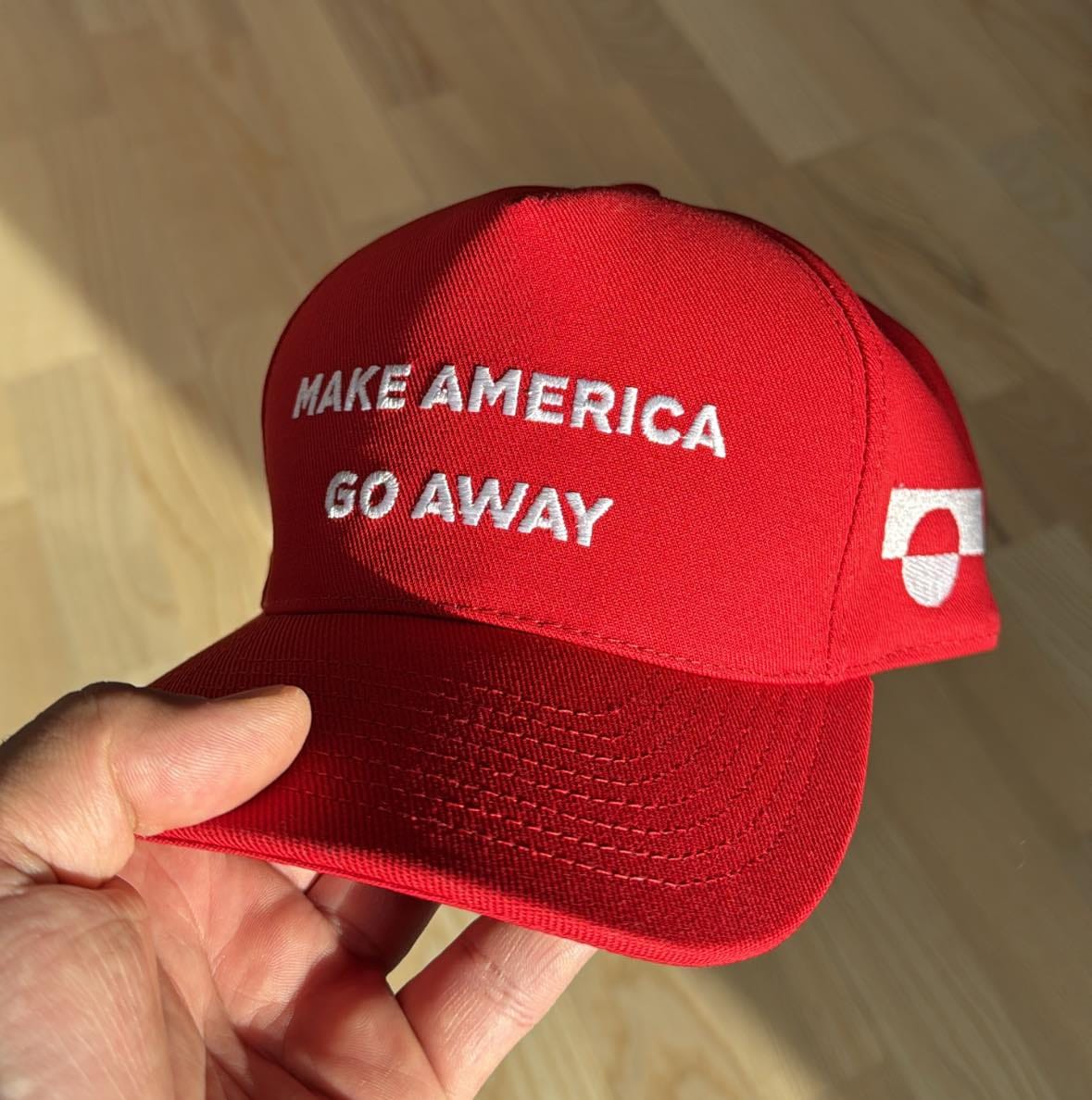
Before Vance's visit, Greenlandic digital creator Aannguaq Reimer-Johansen posted on his Facebook page an anti-MAGA hat he had designed with the slogan "Make America Go Away" with Greenland's red-and-white flag on the sides. It went viral not only in Greenland, but internationally.






Comments
We want Uncharted Blue to be a welcoming and progressive space.
Before commenting, make sure you've read our Community Guidelines.