
This week in Shenzhen, a city of 20 million people in southern China, Beijing is hosting the 33rd meeting of the 21-member-economy Asia-Pacific Economic Cooperation forum on regional trade and economic cooperation. On the sidelines, the three presidents of the world's most heavily nuclear-armed nations — Vladimir Putin, Xi Jinping, and Donald Trump — are expected to meet for a trilateral summit on Nov. 19. Trump says he wants to focus on denuclearization.
Xi reportedly is displeased by this. For many years, the Chinese government has resisted participating in direct talks on nuclear arms, arguing that the United States and Russia should have bilateral talks since they maintain by far the world's largest quivers of nukes. China has a point. The last remaining nuclear arms-control treaty — New START signed in 2010 by Russia and the U.S. — expired in February 2026, although both nations say they are sticking to its limits for now. But since each has also ditched the verification regime the treaty established, it's unknown whether restrictions on the number of nuclear warheads, missiles, and launchers each country was allowed to deploy under the pact are still actually being followed.
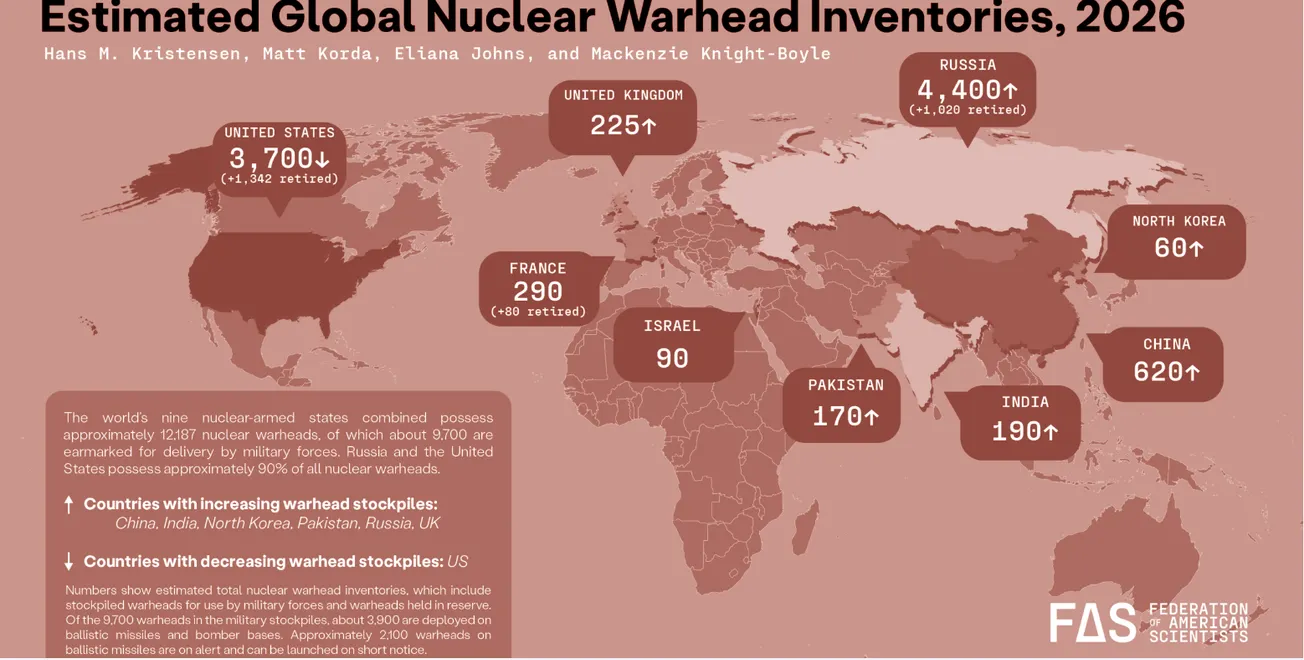
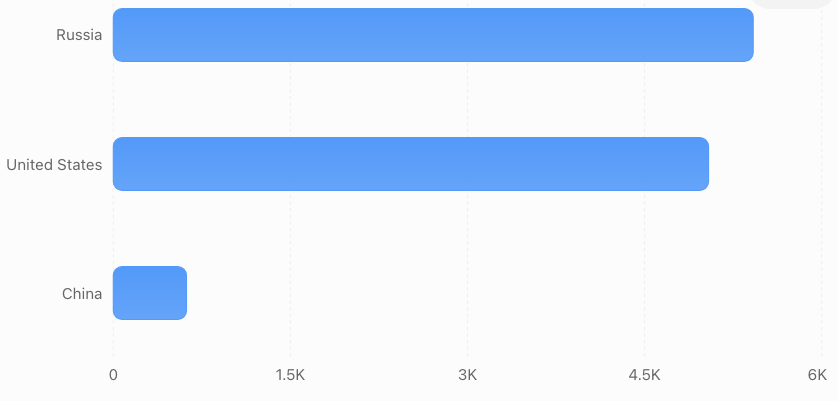
The treaty limit on deployed nuclear warheads was 1,550 each, with subcategory restrictions. But both Russia and the U.S. have thousands more nukes in storage awaiting dismantling yet still potentially usable. Currently, China has about 620 warheads, a doubling of its nuclear arsenal since 2020, and a key concern of U.S. strategic planners, Japan, and some other Asian nations.
Nuclear arms-control talks shouldn't remain a mere sideline. The world's five original nuclear powers — the U.S., Russia, France, the U.K., and China — are in the midst of trillions of dollars in upgrades and expansions of their nuclear arsenals. Officials in South Korea, Saudi Arabia, Poland, Japan, and Turkey have over the past few years seriously discussed the possibility of acquiring their own nuclear weapons. There's been plentiful homegrown resistance to the idea. But probably there's no longer a should-we or shouldn't-we debate in Iran. The hardliners in the Islamic Revolutionary Guard Corps have gained the upper hand after the U.S. and Israel killed much of Iran's top leadership in early 2026. Those attacks followed the June 2025 bombing of Iran's nuclear facilities, which Trump claimed had all been obliterated, but weren't.
He also claimed and continues to assert that “If I didn't do that attack, Iran would have had a nuclear weapon and they would have used it almost immediately.” Mark Sumner wrote some truths about that last month.
The big boys assert that having nukes deters a major enemy attack. In Cold War parlance, that's Mutually Assured Destruction, with the bullseye acronym MAD. Attack us with nukes and we'll turn your cities to glass and your people to shadows. Deterrence thus depends on weapons whose use would mean they have failed their primary job but decisively performed their secondary job by wiping out civilization. So nuclear deterrence is a fundamental good? Then when the nuclear-armed nations of Russia, the United States, and Israel attack the non-nuclear states of Ukraine and Iran, why wouldn't those nations choose nuclear deterrents of their own? Why wouldn't any nation? China, India, and Pakistan made that choice decades ago. They had each other to deter. More recently, so did North Korea, with an eye to deterring the United States.
Despite some serious accidents and close calls via radar misinterpretations or bad communications, plus that Cuban missile thing a while ago, no nuke has been exploded in anger since the pair that obliterated two Japanese cities 81 years ago. No nuclear exchange has been initiated despite a handful of immensely bloody proxy wars. No nuclear-armed country has nuked a non-nuclear country, although Trump is said to have considered hitting Iran's deeply buried nuclear facilities with one, and Putin has rattled the atomic saber more than once over Ukraine. A bluff so far.
But the odds of a future deterrence failure will inevitably grow in a world where geopolitical tensions are rising, nuclear arsenals are expanding, a handful of nations are thinking about making their own nukes, tactical use of smaller nukes is alluring, and the presence of "AI makes mistakes" in combat is growing.
Article VI of the 1968 Nuclear Non-Proliferation Treaty mandates that the original five nuclear-armed nations must ultimately get rid of all their nukes, now totaling 9,235 warheads, excluding those in storage. The U.S. and Russia once made big strides in reducing their warhead count. They and the three other original NPT-recognized nuclear-weapon states made an unequivocal commitment to the total elimination of their nuclear arsenals at the 2000 NPT Review Conference. But no further progress has been accomplished in a long time. And now, they and the other three are violating Article VI.
The five nations that have been pondering a move to develop their own nukes also signed the NPT, which requires that nations without nukes at the time of signing not acquire them. Three nuclear nations — India, Pakistan, and Israel — never signed the treaty, and North Korea withdrew from it before beginning its weapons tests. Together these four have 510 nuclear warheads, according to the Federation of American Scientists. It's estimated that altogether, the nine nuclear-armed nations have 12,187 nuclear warheads as of 2026.
The NPT came into force in 1970. Yet 16 years later, the nuclear arsenals of the Soviet Union and the U.S. peaked at 70,300 warheads. If just 5% of those had been detonated, hundreds of millions of people would have been killed. They weren't. And those tens of thousands of nukes were cut by more than 80%, mostly in the 1990s. But we're now a decade and a half since any further progress in reductions have been made. Today's decline in the total inventory continues largely because the U.S. and Russia are dismantling retired weapons in storage. Meanwhile, the number of warheads in military stockpiles is increasing again.
Hypersonic and hyper-precise missiles have been developed and there's still no effective defense against an all-out assault from silo- and sub-launched missiles. There are far fewer warheads now than 40 years ago, but the potential damage and slaughter from even a regional exchange of those weapons remains unimaginably massive. The increase of the nuclear club from nine members to 14 or more for deterrence's sake wouldn't make the world safer. More hands on the button, more chances of an irreversible mistake, more potential for rogues or psychopaths emerging somewhere to get the radioactive shitshow underway.
Given China's stance against trilateral nuclear talks until Russia and the U.S. have bilateral ones, getting Beijing on board in Shenzhen to reduce the count of the world's deadliest warheads is as likely as Kim Kardashian winning an Oscar. But — stay with me here — if he actually pulled it off, Trump might actually get that Nobel Peace Prize he so avidly covets. Cough, cough.
What Xi more likely will do is say he'll think about thinking about it, a polite "No." In fact, expectations are already in retreat. A senior official of the Trump regime told Reuters, "We do not expect to get to any kind of agreement [at Shenzhen]. This is a difficult topic for China to address, but we do think it's time for China to sort of step up, you know, to the adults' table, if you will, and have adult conversations about adult things."
Cough, cough. Infantilizing China when most of the Trump regime has very un-adult views about everything from vaccines to the climate crisis is an astonishing display of condescension, the pot calling the kettle immature.
As much as this might seem a Trump move to improve his legacy — cough, cough — the proposed talks with Xi and Putin on nukes weren't cooked up as some kind of redemption in the wake of the devastating midterm elections that put the Loser tag on Trump. Back in 1984, when he was a 38-year-old New York real estate developer, he proclaimed his ambition to become President Ronald Reagan's chief negotiator in nuclear arms talks with the Soviet Union. No, I am not kidding. Trump was convinced he had the necessary skills, telling The Washington Post that it would take him just an hour and a half to learn everything he needed to know about nuclear missiles. U.S. negotiator Linton Brooks recalls Trump's recommended approach was essentially walking out of negotiations until the Soviets conceded. Ah! The art of the deal.
Trump also wanted to get trilateral nuclear talks with Russia and China going during his first term, but never pulled it off. At the beginning of his second term, in February 2025, he said, “There's no reason for us to be building brand new nuclear weapons. We already have so many. You could destroy the world 50 times over, 100 times over. [...] And here we are building new nuclear weapons, and they're building nuclear weapons, and China's building nuclear weapons. Hopefully, there'll never be a time when we need those weapons. That's going to be a very sad day, that's going to be probably oblivion.”
Last month. Lauren Sukin, Luis Rodriguez, and Stephen Herzog wrote "The nuclear paradox: Why the world wants both deterrence and disarmament":
Our research challenges decades of assumptions about nuclear politics. Contrary to conventional wisdom that views possessing and abolishing nuclear weapons as irreconcilable, our data reveal something far more complex: Many people around the world embrace both views simultaneously. They support maintaining nuclear arsenals for deterrence, but they also desire their complete elimination. They endorse the taboo against using nuclear weapons, but they also approve of nuclear strikes under certain circumstances.
These apparent inconsistencies are not reflective of some small, confused minority. Instead, the majority of [27,000] individuals we surveyed have at least some views on nuclear weapons that seem contradictory. Understanding what drives this paradox and how it plays out is essential for formulating policy to navigate an increasingly complex and dangerous nuclear landscape.
As long as leaders as well as rank-and-file citizens hold to the view that the way to deter an enemy with nukes is with nukes even as they also want nuclear disarmament, implementing the complete ban on nukes called for in the NPT's Article VI isn't going to happen. But talks to further reduce the world's nuclear arsenals can take us closer to that ultimate goal.
But how can that be achieved when China has resisted further nuclear arms negotiations, arguing that the enormous disparity between its arsenal and those of the U.S. and Russia makes the transparency required for meaningful arms control a potential threat to its security. Beijing's position has long been that Washington and Moscow must substantially reduce their arsenals before China joins any negotiations. That stance has remained unchanged even as China accelerates its own nuclear buildup, developing new ballistic missiles, submarines, and bombers, and adding hundreds of warheads to its stockpile.
The buildup has spurred congressional China hawks such as Senate Intelligence Committee Chairman Tom Cotton and Senate Armed Services Committee Chairman Roger Wicker to push more confrontational approaches to China's threat to Taiwan and its activities in the South China Sea. The Pentagon's big strategic concern is the possibility that a joint attack sometime in the future by Russia and China using their combined nuclear arsenals could overwhelm U.S. nukes.
Here's Steven Pifer at Stanford's Center for International Security and Cooperation:
While China is building its nuclear arsenal, it still has a long way to go to match the US and Russian nuclear levels and become a true peer competitor. In late 2024, the Defense Department estimated that China would grow its current arsenal from 600 nuclear warheads to 1,000 in 2030. (The Pentagon has not repeated its 2023 projection that the number would rise to 1,500 by 2035.) That compares to a total US nuclear arsenal of 3,700 nuclear warheads and a Russian total of 4,300, not counting the two countries’ warheads that have been retired but not yet dismantled.
In the 1960s as well as long after he had left office in 1986, Defense Secretary Robert McNamara posited that an arsenal of 400-500 nuclear warheads was enough to deter the Soviet Union from initiating an attack. In 2013, the Obama Pentagon looked at three options for reducing the nuclear arsenal to as few as 300–400 deployed warheads in its Report of Nuclear Weapons Employment Strategy. Ultimately, a less ambitious target of 1,000–1,100 warheads was proposed, contingent on reciprocal Russian reductions.
Whatever else can be said about China's ever-more assertive foreign policy, Beijing is right that there should first be bilateral nuclear talks between Moscow and Washington, each of which has more ready and in reserve warheads than all the other nuclear-armed nations together. If Trump is serious, he'd push Putin on bilateral nuclear talks, and cut that 1,550 limit in half, or down to the 300 option. This might be as hard a negotiation in the Senate as in the Kremlin. If and when such a pact were signed, efforts could get rolling to persuade President Xi to set China's nuke count equivalent to the new U.S.-Russia limit.
Could an agreement with Moscow be had before Trump leaves office? Maybe. The Iran nuclear negotiations under Obama took 20 months. While a U.S.-Russia signing almost certainly wouldn't come in time for him to name such an agreement after himself, progress could still be made for a future White House administration to complete. Assuming, of course, that he didn't shiv any progress by mouthing off on Truth™ Social.
Rose Gottemoeller was the chief U.S. negotiator for the New START treaty and later served as NATO's deputy secretary-general. She wrote in the April 15, 2025, issue of Foreign Affairs:
In the meantime, Washington should engage with Beijing to understand its objectives, create predictability about future force structure and modernization plans, and lower the risk of misunderstandings that could lead to a nuclear crisis. Rather than focusing on the size of China’s arsenal, the United States should be trying to build mutual understanding with China and exercise mutual restraint in order to avoid a nuclear arms race—in other words, arms control.
It's a rare day when Trump says gets something right and actually makes sense. Maybe there's a grift I'm missing somewhere in here. But if he were to stick to the subject he's chosen in Shenzhen and not veer off on some I'm-the-greatest-president-Dumocrats-stink tangent, some modest advance might actually be made for future leaders to build on.
Juan Manuel Santos, former president of Colombia and the 2016 Nobel Prize Laureate, recently wrote:
On October 11, 1986, US President Ronald Reagan and Soviet Leader Mikhail Gorbachev met in Reykjavik, where they confronted the threat of nuclear weapons and found common ground despite the Cold War. This historic meeting reduced the danger of nuclear war and led to major reductions in global nuclear weapons stockpiles.
The foundation of Reagan and Gorbachev’s commitment to removing the nuclear Sword of Damocles hanging over humanity was their shared understanding that “a nuclear war cannot be won and must never be fought.” This declaration, which came a year before the two leaders first met in Geneva, helped overcome their mutual distrust and underpinned subsequent efforts to pursue disarmament. [...]
Immediate steps to stabilize strategic relations and reduce nuclear risks should not be a substitute for more expansive ambition. Reagan and Gorbachev’s progress on nuclear reductions was driven by the goal of eliminating the nuclear threat for good—not just reducing the risks. As the history of Reykjavik and other peace processes shows, once negotiating parties establish a productive dialogue, they sometimes can go far further than they would have imagined at the outset.
We must go farther than those leaders in Iceland 40 years ago. And bizarre as it may seem, Trump might get us restarted down this road. A plus amid his piles of minuses. But don't wager next month's rent on it.
•••••
Other reading related to this subject:
Once seen as a symbolic protest, the nuclear ban treaty is growing teeth by Olamide Samuel on The Treaty on the Prohibition of Nuclear Weapons
Nuclear attack on Ukraine unlikely, but Mitt Romney says U.S. should be prepared anyway by Meteor Blades about my year-long experience on the Boulder County Nuclear War Education Committee in 1982.
Nations with nuclear weapons betray those without ... again by Meteor Blades on how the Big Five nuclear nations ignored a key element of non-proliferation treaty as they enhanced and expanded their atomic arsenals while telling non-nuclear nations to obey it to the letter.
Status of World Nuclear Forces, Federation of American Scientists
US nuclear weapons, 2026, Bulletin of the Atomic Scientists
Russian nuclear weapons, 2026, Bulletin of the Atomic Scientists
Chinese nuclear weapons, 2026, Bulletin of the Atomic Scientists












Comments
We want Uncharted Blue to be a welcoming and progressive space.
Before commenting, make sure you've read our Community Guidelines.