
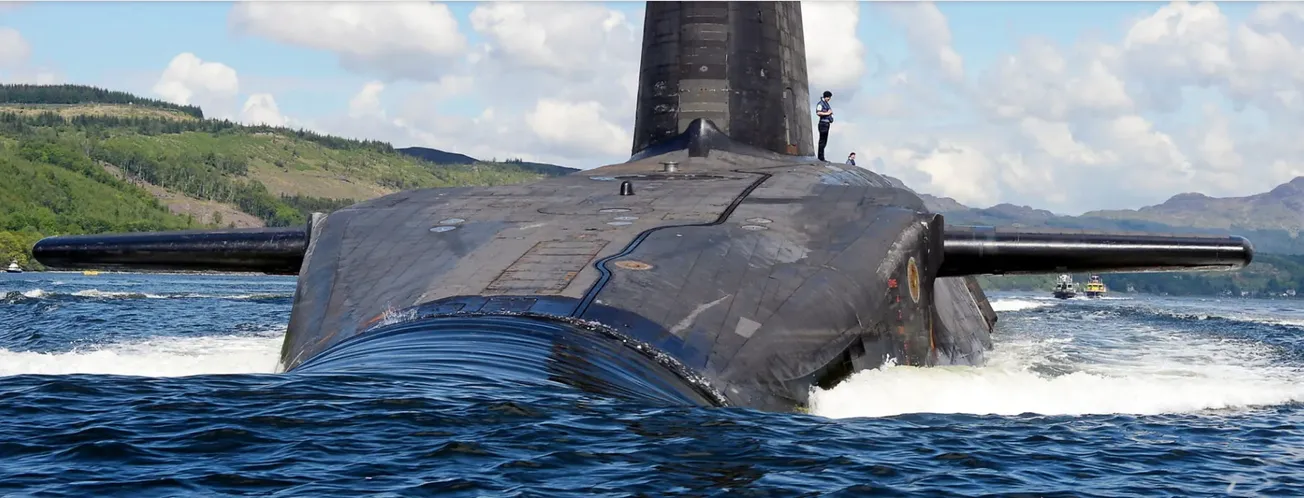
Besides spending time staring out the window of the gilded Oval Office at his nonexistent big, beautiful ballroom, our Outlaw Prez has repeated a half-dozen “reasons” he launched a war on Iran — which the White House avoids calling a war. A key claim is his assertion about the Islamic Republic’s nuclear intentions. To wit: "If we didn't hit within two weeks, they would've had a nuclear weapon. When crazy people have nuclear weapons bad things happen."
Tempting as it is to focus all the attention on Donald Trump’s connection to that second sentence, the first is what truly matters. Combined with the claim that Iran posed an “imminent” threat to the United States, the assertion that Tehran “would’ve” had a nuke by the end of March if it wasn’t stopped might seem a powerful justification for the thousands of targets that Israel and the United States have struck in Iran so far. Targets that might continue to be blasted until September, according to CENTCOM. Powerful, that is, if it were true.
But the Trump team did absolutely nothing to convince congressional leaders it briefed after the fact that an Iranian attack on the United States was imminent, especially a nuclear attack. After all, the team declared in June that Iran’s nuclear program had been obliterated, right?
Many people believe the war is just a wag-the-dog distraction, a personal grudge, some fresh grift, a kowtow to Bibi Netanyahu. A combination of those is likely, but the nuclear program is real, and the global impacts of this billion-dollar-a-day war on Iran are real.
Two issues are at hand: Whether Iran was on the verge of building a nuke and whether the war launched against it was justifiable under international law.
The key purpose of the 2015 nuclear agreement with Iran negotiated by President Barack Obama’s team and five other countries was to slow Iran’s nuclear development — which it asserted then and now was meant only for peaceful purposes. Those purposes are specifically allowed in Article IV of the Nuclear Non-Proliferation Treaty to which Iran is signatory. Enriching uranium was allowed in the agreement only to the level required to fuel electricity-generating power plants, 3.67%. A huge stockpile of low-level enriched uranium was reduced, and other restrictions also applied.
Compliance with this was verified by compliance monitors at the International Atomic Energy Agency. And, according to six quarterly IAEA reports, Iran was complying right up to when Donald Trump unilaterally withdrew from the agreement in 2018 and reimposed previous sanctions, making them even stiffer.
This spurred Iran gradually to accumulate, by its own count, nearly a half-ton of uranium to the 60% level. This has no civilian purpose, but that amount could be relatively quickly turned into 90% weapons grade, enough experts say, for about nine nuclear bombs. How quickly?
Hui Zhang, a physicist and a senior research associate at the Project on Managing the Atom in the Belfer Center for Science and International Affairs at Harvard University, writes that China managed after acquiring enough fissionable material to build two nuclear bomb cores in just four months. But from the time that China had enough highly enriched uranium, it took a year to the first test. The whole process, of course, used the technology of 60 years ago.
At least one Pentagon official has also suggested that in a sprint Iran could produce basic nuclear weapons in a few weeks. Not everyone agrees. After the U.S. struck Iranian nuclear facilities in June, Amy Sherman at PolitiFact wrote:
The U.S. intelligence community said for more than a year that Iran was weeks away from enriching uranium further to bomb grade, said Daryl Kimball, executive director of the Arms Control Association.
"That is extremely worrisome but that is not weeks away from having a nuclear weapon and not weeks away from having a nuclear weapon that can be loaded on a nuclear missile," Kimball said.
It is one thing to have raw material but it is another thing to fashion into a nuclear device that can be loaded on a truck, transported and be small enough and light enough to be launched by a ballistic missile as a nuclear weapon.
"My understanding from non-governmental sources and the internal assessment of the (intelligence community) is that they believe it would take several months or more to fashion the highly enriched uranium bomb grade into a nuclear device, and one to two years to manufacture a small light nuclear device," Kimball said.
Under the late Supreme Leader Ali Khamenei’s fatwa, nuclear weapons were called “unIslamic” and he forbade the making of any. But from 1999-2003, development of a nuclear weapon was undertaken. Details of the operation, Project AMAD, were later revealed in IAEA reports and in documents pilfered by Israeli intelligence, which knows a few things about hiding secret nuclear development. Caught, under pressure Iran cut back on various parts of its program. Thus, “trust but verify” — the Russian proverb made famous by President Ronald Reagan in discussing with Mikhail Gorbachev a deal to reduce America’s and the USSR’s nuclear arsenals — was also applied in practice to the 2015 nuclear agreement with Iran.
If the mullahs decided to go ahead and build a nuke, there is no reason to believe decades of assassinations of Iranian nuclear scientists that Israel’s Mossad has not admitted it carried out would be more than a temporary hindrance. Once you’ve got the knowledge and the raw materials, you can’t stuff the nuclear genie back in the bottle. Iran has been enriching uranium to 60% since April 2021, so you can bet that for three or four years they’ve been capable of building a few nukes rather quickly. They could have, but they didn’t. There is a big difference between Trump’s would’ve and could’ve.
In June, Julian Barnes at The New York Times reported:
U.S. intelligence agencies continue to believe that Iran has yet to decide whether to make a nuclear bomb even though it has developed a large stockpile of the enriched uranium necessary for it to do so, according to intelligence and other American officials.
That assessment has not changed since the intelligence agencies last addressed the question of Iran’s intentions in March, the officials said, even as Israel has attacked Iranian nuclear facilities.
Senior U.S. intelligence officials said that Iranian leaders were likely to shift toward producing a bomb if the American military attacked the Iranian uranium enrichment site Fordo or if Israel killed Iran’s supreme leader.
The “two weeks” frame wasn’t just repetition of a notorious Trumpism. In this case it served the rhetorical purpose of bolstering “imminent.” That’s where legality comes in.
The Senate — or rather Republicans plus John Fetterman and minus Rand Paul — voted to absolve themselves of their constitutional duty to rein in the presidency as the Founders intended. So much for any appeal they make to patriotism.
Internationally, it’s another matter. Two relevant concepts are treated as synonyms in everyday conversation — preemptive and preventive. A preemptive strike is one that responds to an imminent attack. A preventive war goes after the targeted foe on the belief that perhaps, someday, someway, somehow, it will attack.
Preemptive attacks against an immediate threat are universally viewed as self-defense that every nation has a right to. Preventive wars are widely considered aggression. Conflate the two, and almost any war can be justified.
The modern legal order governing war emerged from the ashes of World War II. Determined to prevent another catastrophe, the architects of the United Nations created sweeping restrictions on the use of force. Article 2(4) of the U.N. Charter prohibits states from using force against the territorial integrity or political independence of other countries. The only explicit exception appears in Article 51, which recognizes the “inherent right of individual or collective self-defense if an armed attack occurs.”
Yet the reality of international politics raises an obvious problem. What happens if a country knows an attack is about to happen? Must it wait passively until missiles land or armies cross its borders?
That question produced the doctrine of anticipatory self-defense, commonly associated with the 19th century Caroline incident. In that case, British forces destroyed a U.S. vessel they believed was aiding Canadian rebels. The legal defense articulated afterward became a foundational principle in international law. As scholars point out, the necessity for such action must be “instant, overwhelming, leaving no choice of means, and no moment for deliberation.”
That is the classic threshold for preemption. Imminent threat. Overwhelming necessity. No alternatives. It is a deliberately narrow standard designed to prevent governments from manufacturing excuses for war. Preventive war does not meet that standard.
Instead of responding to imminent danger, it attempts to eliminate a potential future threat. The reasoning is simple: fight now while victory is easier, before a potential foe becomes more militarily and/or economically stronger. Strategists sometimes frame this as closing a “window of vulnerability.” But legally and morally it remains deeply controversial because it rests on prediction rather than proof.
International law offers little support for such action. As analysts note, the U.N. framework was deliberately designed to prevent states from attacking one another based on speculative fears. Looking the other way in case of preventive war undermines the entire prohibition on aggression. After all, every government can imagine a future threat.
You may remember an example of this when the United States invaded Iraq 23 years ago this month. The Bush administration framed the strategy as part of a new doctrine of “preemption.” But many legal scholars and diplomats pointed out that Iraq posed no imminent threat to the United States. The war wasn’t preemptive, it was preventive. And, as it turned out, it prevented nothing since the weapons of mass destruction that were the justification for the “cakewalk” didn’t exist. The war unleashed massive human and geopolitical costs. Estimates of war-related deaths range into the hundreds of thousands. Regional instability intensified. The episode blurred the already tenuous distinction between preventive and preemptive war.
And here we are with the Trump regime engaged in a global free-for-all. The Iran war is also preventive, illegal under a U.N. Charter that in no way will be enforced. The worst part of this? Unless very different leaders come to power in Iran, keeping that country from getting nukes may not even have been prevented.
Iran shouldn’t build a nuke. But then the world should follow the advice of Harry Truman, Dwight Eisenhower, John F. Kennedy, Ronald Reagan, Bill Clinton, George W. Bush, and Barack Obama, each of whom proposed or at least suggested at one time or another eliminating all nuclear weapons. Here’s Reagan: “We seek the total elimination one day of nuclear weapons from the face of the Earth.” Here’s Obama: “America’s commitment is to seek the peace and security of a world without nuclear weapons.”
When he wasn’t yet a teenager, the Nuclear Non-Proliferation Treaty came into force with an ultimate goal in mind that has mostly been forgotten. Article VI says each party:
...undertakes to pursue negotiations in good faith on effective measures relating to cessation of the nuclear arms race at an early date and to nuclear disarmament, and on a Treaty on general and complete disarmament under strict and effective international control.
Instead, today as you read this, the United States, Russia, China, France, and the United Kingdom are currently spending trillions of dollars to upgrade and expand their nuclear arsenals.
See also:









Comments
We want Uncharted Blue to be a welcoming and progressive space.
Before commenting, make sure you've read our Community Guidelines.