


Five days into a war with Iran, Americans still don't know why we are there.
Are we dropping bombs and firing missiles into cities because Iran was close to making a nuclear weapon despite having their program "obliterated" last year? Was it because Iran was building a missile that could hit America, even though intelligence reports said they could do that for at least a decade?
Was it because Iran was about to strike first? Or because Israel was about to strike first? Or because we forced Israel to strike?
Maybe Israeli Prime Minister Benjamin Netanyahu got on the phone with Donald Trump and convinced him that this was a perfect time to kill a lot of foreign leaders all at once. That sounds as likely as anything.
But there's bound to be a new excuse any minute now. Republicans don't even seem to know we're in a war.
RAJU: You'll concede this is war? MARKWAYNE MULLIN: We haven't declared war. They declared war on us RAJU: The president called it war and Secretary Hegseth called it war REPORTER: When you walked up just now, you called it war MULLIN: Okay. That was a misspoke.
— Aaron Rupar (@atrupar.com) 2026-03-03T23:14:30.626Z
Of all the stupid things about this blisteringly stupid war, the stupidest may be that, far from building a case beforehand that convinced a significant fraction of Americans that there was some legitimate reason to start a conflict that was guaranteed to destabilize an entire hemisphere, they still can't come up with a consistent answer days after the bombs started falling.
To quote a line from Andor, "They don't even bother to lie badly anymore. I suppose that's the final humiliation."
It's not surprising that the war is hugely unpopular in poll after poll. Americans can see that people are dying. They can see that buildings are falling — along with our military's stockpile of missiles. What they can't see is any possible benefit to going to war with Iran.
Trump is unable to provide them with a reason. Or even a set of goals. According to part-time Fox host Pete Hegseth, America is "just getting started" with this conflict that has already spread to more than a dozen countries and killed over 1,000 civilians, including 180 school girls.
But don't worry. The war will only last four weeks. Maybe four or five. Or maybe far longer. But this is definitely not a "forever war" unless it is.
For the last year, Americans may have looked at Gaza with an occasional shake of the head and the comforting knowledge that, even if we provided most of the weapons, we weren't putting our lily-white fingers on the buttons that blew up all those sad little brown children. Well, surprise, bitches. We're back in the slaughter game, and it's like we never left.
In this war, Trump and Hegseth have a very simple philosophy. We don't know why we're there. We don't know what we want. We don't know when it ends. And f**k you for asking.
Pete Hegseth suggested this morning that reporting on the 6 U.S. service members who were killed in Trump's Iran war is an example of the news media 'trying to make Trump look bad.'
— Kyle Griffin (@kylegriffin1.bsky.social) 2026-03-04T15:15:18.499Z
But wait! There's still another way in which this war is forehead-meet-brickwall stupid.
On day one, Trump was insistent that there would be no issue with having plenty of gear to fight this war. After all, he had magically built the biggliest military ever through the magic of saying so in speeches and giving Hegseth lots of money to spend on makeup studios and personal jets.
“It won’t be difficult,” Mr. Trump added. “We have tremendous amounts of ammunition. You know, we have ammunition stored all over the world in different countries.”
Uh huh. Except that, just a couple of days later, Trump was complaining that the pantry was already looking less than full.

That's nice. But there are some things that Trump might have noticed about Ukraine if he were paying attention to anything other than making Vladimir Putin happy and blaming all problems on Joe Biden.
In only the first two years of its invasion, Russia fired 11,466 missiles at targets inside Ukraine. Since then, the number has only risen as Russia intensified its attack, with most of those missiles going into civilian targets and infrastructure. But Ukraine is still there.
That's an astounding number of missiles. However, that pales beside the number of strategic drones that Russia has sent against Ukrainian targets. In 2025 alone, an estimated 54,000 drones were launched from sites in Russia or occupied areas of Ukraine to explode in neighborhoods to the west. But Ukraine is still there.
Most of the larger drones were made in Iran. Shahed Aviation Industries has been producing versions of its armed drones since at least 2016. Not only do they have multiple factories scattered across Iran, they reportedly have two replacement sites for each current factory in case one is damaged.
Everyone in the region around Iran should be grateful to the citizens of Ukraine. They've already suffered from the assault of drones that would otherwise be flying across the Middle East today. And Ukraine is still there.
Iran's drone stockpile likely contains at least tens of thousands of Shaheds. They are far slower than missiles. However, they carry significant amounts of high explosives, they can fly at altitudes up to 60,000' or skim the treetops, and they have an average range of about 1,500 miles.
Shaheds are good enough that the U.S. has modeled its own kamikaze drones after them.
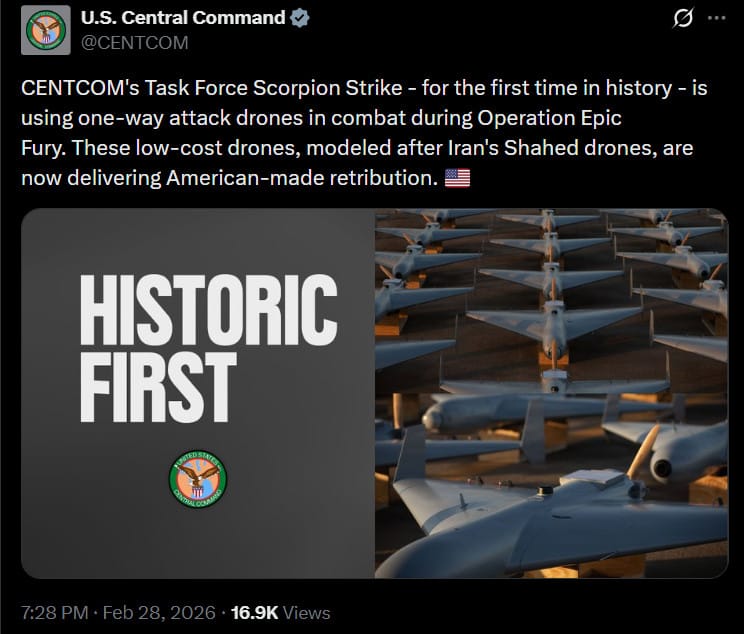
As Ukraine has demonstrated, these drones can be taken down by skilled operators using anti-aircraft guns, by fighter planes, or by missile defense systems. However, using missile defense systems against these drones is a good way to expend a lot of $4 million missiles on $20,000 drones.
Ukraine's forces have increasingly relied on ground-based guns as well as helicopter crews hunting Shaheds in the sky. They've become very good at this task. They've even developed anti-drone drones.
Meanwhile, Ukrainian drone operators are intercepting Shahed kamikaze drones using STING systems produced by @wildhornets.bsky.social
— 🦋Special Kherson Cat🐈🇺🇦 (@specialkhersoncat.bsky.social) 2026-03-02T14:41:03.852Z
All these systems—missile defense, anti-aircraft guns, jets, helicopters, and hunter-killer drones—allow Ukraine to intercept an estimated 80-90% of all Shaheds launched by Russia. Meaning that thousands of drones each year are still getting through to murder people in their homes, schools, and churches.
No one in the Middle East shares the skill, overlapping systems, and experience that Ukraine has put together. Iranian drones have already hit the U.S. embassy in Saudi Arabia, the consulate in Dubai, and a civilian port in Kuwait. The first group of U.S. casualties in this war came as a result of an Iranian drone.
Footage of possible Iranian Shahed attack drone directly impacting the US Consulate in Dubai
— Shipwreck (@shipwreck75.bsky.social) 2026-03-03T19:48:34.767Z
High-end anti-aircraft systems alone can do a decent job against these drones, but they are costly, limited, and cannot be everywhere. Cheap drones … can be everywhere.
The task of clearing the skies is already getting harder as the United States has reportedly lost a second Terminal High Altitude Area Defense (THAAD) unit in two days. These are anti-missile defense systems with a 120-mile operating range. They are a key component of America's missile defense, and Iran reportedly taking out two of them is bad news. And the bad news doesn't stop there.
These claims follow the Qatari Ministry of Defence’s rare public confirmation that a US-operated AN/FPS-132 Block 5 Upgraded Early Warning Radar (UEWR), installed in 2013 at a cost of approximately US$1.1 billion (RM4.18 billion), was destroyed in a separate Iranian strike, underscoring both technical vulnerability and political exposure.
Collectively, the reported neutralisation of a second THAAD battery, its ground-based radar in the UAE, and the AN/FPS-132 Block 5 UEWR in Qatar constitutes a sequential dismantling of the United States’ integrated air and missile defence (IAMD) network in the Gulf, with cascading implications for force posture, logistics resilience, and strategic signalling.
For four years now, Ukraine and Russia have been redefining modern warfare. They have illustrated day-by-day how the standard tactics that both Russia and the United States have refined since World War II are increasingly worthless.
Trump and Hegseth launched "Operation Epic Fury" under the assumption that the same plans that powered America through the shock-and-awe phase of the Iraq invasion could be dusted off and used again. But this isn't that world. This is the drone world; a world where Iran could easily send 10,000 Shaheds in all directions, comfortable in the knowledge that hundreds, or thousands, will get past defenses.
There's no risk that these drones, or the Fath-360 close-range ballistic missiles that Iran manufactures in large numbers, can reach the United States. There never was. However, Iran can keep sending them against its neighbors indefinitely, and they can keep pecking away at defensive systems.
That's going to make life uncomfortable for a lot of people, including U.S. forces in the region. It's also going to make shipping through the Strait of Hormuz a roll of the dice for some time to come. If someone isn't already making a new set of those "I did this!" stickers for gas pumps, featuring Trump's orange mug, they should get on that. Because prices are headed up.
There's no doubt that the United States military is superior to that of Iran in every category and by a wide margin. But this is not a fight between the U.S. military and the Iranian military. This is attempting to break an opponent only through aerial attacks. And that last worked ... never.
Air power can damage infrastructure and cause significant hardship, but it can not control a population or eliminate ground forces. Even if Trump is correct that we can keep shooting at Iran forever, they can keep shooting back.
Russia may have fired tens of thousands of missiles and drones into Ukraine, but Ukraine is still there. Volodymyr Zelensky is still there. The Ukrainian military is still there. The only areas of Ukraine where Russia can enforce its will are those where it has occupied the territory, at a cost of over 1 million men.
Iran is a nation of 93 million people with an area of over 636,000 square miles. That's three times the population and three times the area of Ukraine. The majority of Iranian citizens may be ready to throw off the oppressive, murderous government, but tens of millions of Iranians also support that government–including the 610,000 members of the Iranian military.
Maybe we will get very, very lucky and some ambitious colonel or general will seize power, murder his opponents, and make a deal with the United States that ends this conflict on terms that keep Iran quiet for a handful of years. Trump can then kick the can down the road and let someone else suffer the consequences.
More likely, those missiles and drones will keep flying until someone is willing to commit enough ground forces to make them stop. Trump should have known that. Hegseth should have known that. What remains of military leadership after Trump's purges certainly knew that.
Nobody may like the Pottery Barn Rule, but you broke it, and now you own it. Stupid.









Comments
We want Uncharted Blue to be a welcoming and progressive space.
Before commenting, make sure you've read our Community Guidelines.