
With all the bad news about the climate crisis, a July report from the International Renewable Energy Agency focuses on a giant bright spot, the fantastic global growth of renewable energy. (You can read the executive summary here.)
In short, the report says, the total installed costs for renewable power fell by more than 10% in all technologies between 2023 and 2024, excepting offshore wind and bioenergy. While various factors led to small increases in the levelized cost of electricity for photovoltaic solar and onshore wind, concentrated solar power fell by 46%, geothermal by 16%, and hydropower by 2%. Solar power, according to the report, is now around 40% cheaper than the next cheapest fossil fuel, while offshore wind is more than 50% cheaper.
Additionally, according to a July report from the International Energy Agency (executive summary here), renewable energy from all sources will surpass coal to become the world’s single largest source of electricity “by 2026 at the latest.” I am not typically a user of exclamation points, but in case all the crap flowing out of the Trump administration has boggled your time sense, that’s next year!
Worldwide, all sources of electricity generated 30,850 terawatt-hours (TWh) in 2024. Of that, wind and solar generated 4,000 TWh globally (15% of the total), and the IEA says this will exceed 6,000 TWh in 2026. Together, the two sources will provide “more than 90% of the increase in global electricity demand out to 2026.”


For those of us who’ve been on the energy beat for decades listening to the naysayers ridicule renewables as never being able to cover more than a dribble of our energy needs, it’s exciting times. Unfortunately, in the United States, we’re stuck for now under the rule of fossil fuel lickspittles who are hellbent on blocking additions of cheap and clean wind and solar installations.
As Jonathan P. Thompson at The Land Desk notes, Donald Trump repeatedly accused President Obama and President Biden of making war on fossil fuels. A rather disputed accusation given that oil and gas production soared to its highest levels ever under both of them despite their blocking of drilling in a few select places. But there’s no question the Trump administration is making war on energy, under the banners of “energy dominance” and “energy emergency.”
The war includes prematurely killing solar and wind tax credits, blocking all new offshore wind installations, heightened reviews of solar and wind projects on federal land, and requiring the personal sign-off of any solar or wind farm by Interior Secretary Doug Burgum, a patsy and shill for the fossil fuel industry during his two terms as North Dakota governor. All part of an effort to end alleged preferential treatment for approving solar and wind and clearing the path for still more fossil fuel development.
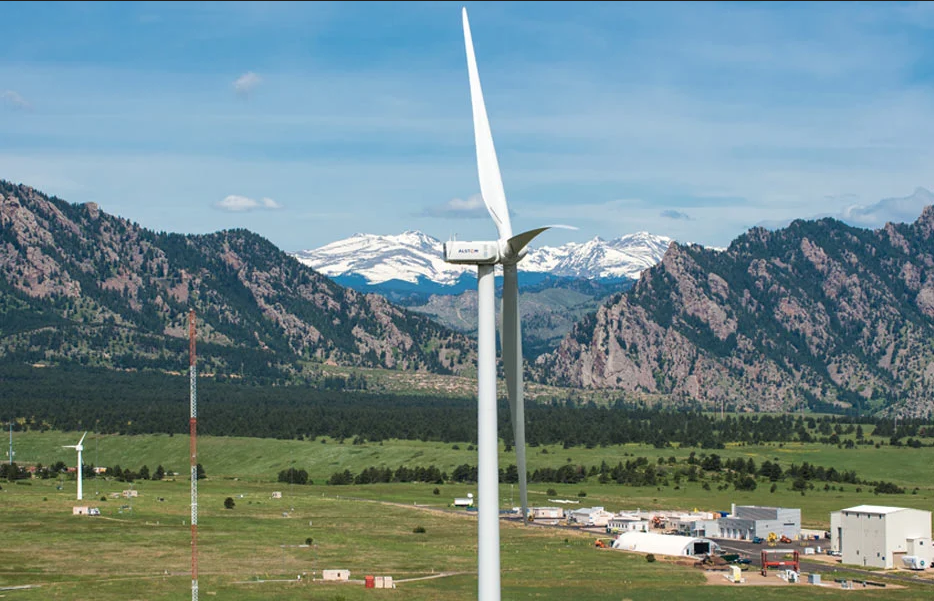
For the record, a report from the National Renewable Energy Laboratory found that after taking into consideration social, environmental, and technical concerns, there’s solid potential on federal land for installing 1,750 gigawatts of solar and 70 gigawatts for wind. Currently, total U.S. capacity from all energy sources is around 1,400 gigawatts. (It’s important to note that because of intermittency, solar and wind capacity isn’t a perfect match for the capacity of other sources.)
Burgum last Friday escalated the war on renewables with an executive order under which the Interior Dept. will issue energy project permits based on “capacity density.” That’s defined as the amount of energy a project can generate per acre. There are huge differences between the per acre capacity density of a solar array and an advanced nuclear reactor.
However, Thompson points out, some of Interior’s calculations seem “fishy,” especially since they are based on a report that is not about capacity density:
The supercritical coal plant referenced in the report, for example, would require a mere 600 acres. Yet, the Four Corners coal plant in northwestern New Mexico — along with its associated Navajo Mine (current mining areas as well as reclaimed areas), Morgan Lake, and coal combustion waste disposal facilities — covers (and wrecks) some 15,000 acres. That acreage will continue to grow for as long as the plant operates, since the mine and waste dumps will continue to expand. Compare that to the 2,400 acres covered by the nearby San Juan solar plant.
I’d also argue that if the goal is to get the most energy out of every acre of public land (which is a silly goal, but whatever), then they should figure in the amount of energy the proposed project consumes. Coal mining and oil and gas drilling require large amounts of electricity and petroleum (along with human labor, which is also a form of energy), as does transporting coal and gas by train and pipeline. Uranium enrichment, which is necessary to produce reactor fuel, is extremely power-intensive.
In a press release accompanying his executive order, Burgum stated:
“Gargantuan, unreliable, intermittent energy projects hold America back from achieving U.S. Energy Dominance while weighing heavily on the American taxpayer and environment. By considering energy generation optimization, the Department will be able to better manage our federal lands, minimize environmental impact, and maximize energy development to further President Donald Trump’s energy goals.”
A guy who thinks coal mines, uranium mines, and oil and gas wells weigh on the environment less than solar and wind installations has no business running the Interior Department, but we knew that before he was confirmed. The numbskullery here, combined with Trump’s jackassery, is phenomenal. As the world moves inexorably, if too slowly, toward clean and green, promoting the idea that the United States will be energy dominant by focusing on developing more of yesterday’s polluting, climate-busting energy sources is financially and geopolitically as stupid as putting arsonists on the fire brigade. But then arsonists are exactly who we’ve got running the Interior and Energy departments and the Environmental Protection Agency. That’s our real energy emergency.











Comments
We want Uncharted Blue to be a welcoming and progressive space.
Before commenting, make sure you've read our Community Guidelines.