
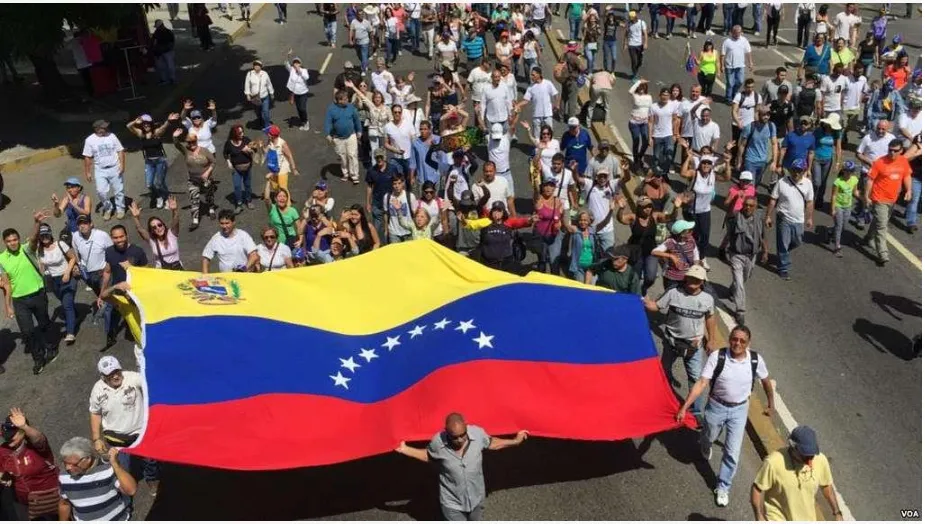
Donald Trump said on Truth™ Social that Venezuela “stole oil, land, and other assets” from the United States and that the U.S. will take them back. He has also ordered a “total and complete blockade” of sanctioned Venezuelan oil tankers entering and leaving Venezuelan ports until Venezuela surrenders these assets. One tanker from Venezuela has already been seized, with Trump saying the U.S. would keep the oil it was transporting. Meanwhile, the U.S. is cruising the Caribbean with the largest armed presence since the Cuban Missile Crisis.
•••••
The guy who campaigned on stopping America’s “forever wars” and challenging elements of neoconservative foreign policy and now claims he has ended eight conflicts — five of which are still aflame — appears to be on the precipice of war with Venezuela in what could be a return to the worst days of direct U.S. intervention in Latin America.
In addition to its murdering people at sea, Washington’s approach to Venezuela is reminiscent of the Nixon administration’s covert actions against Chile under leftist Salvador Allende in the 1970s — to make the economy scream with the hopes that this will drive Maduro out without having to parachute troops into Caracas. In Chile a half-century ago, the tightening of economic screws wasn’t enough, and it took a bloody coup to topple Allende, with disastrous consequences that included the torture and murder of thousands of his supporters and others on the left.
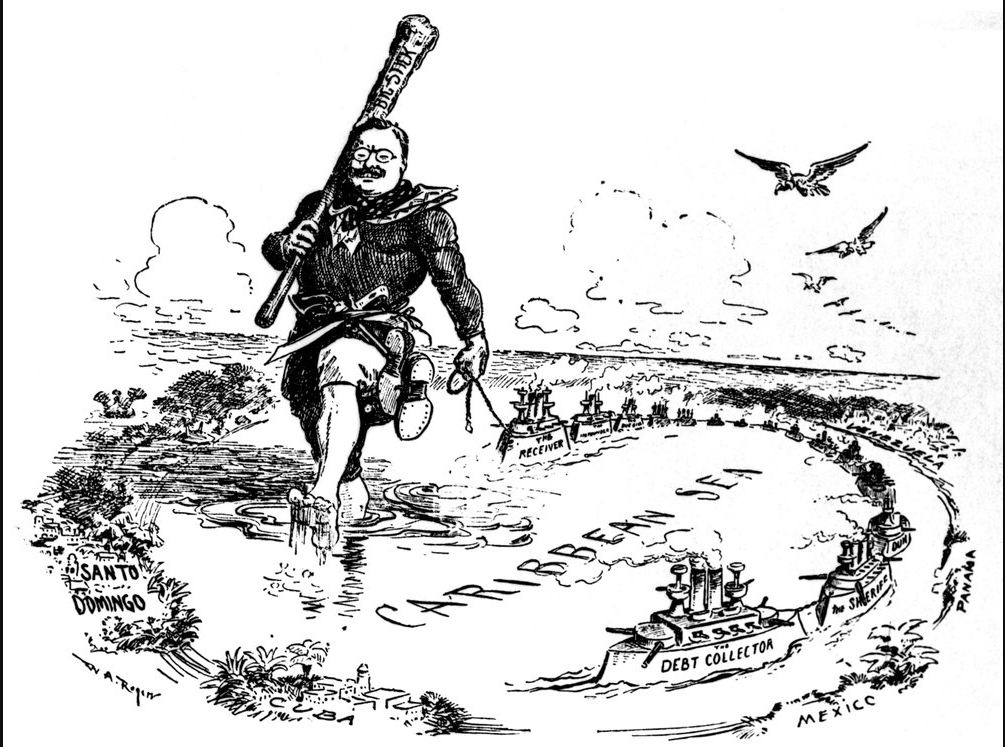
To be sure, what we see now is much different than in 1973, but it appears that the Trump Duplicity is going to be added to the Monroe Doctrine and Roosevelt Corollary as the foundation of a new world order in which the U.S. tells everyone in the Western Hemisphere how to run things and everyone else to keep out. (See my Nov. 5 Trump's Venezuela saber-rattling reprises old U.S. diplomatic trope of Caribbean as a 'Yankee lake'.)
Before Trump blathered this week about taking back “our” oil, his team offered various rationales for its aggressiveness against the Venezuelan government since it started flinging missiles at alleged drug smugglers. Regime change, that favorite of the neocons enshrined in the Bush Doctrine, is suddenly okay with self-declared peacemaker Trump as he is determined “pretty soon” to initiate land attacks on Venezuela with the intent of dumping President Nicolás Maduro, whose “days are numbered.” Asked whether he would send ground troops into Venezuela, Trump refused to rule it out. Last Friday, in a jingoistic screed calling for toppling Maduro, The Wall Street Journal editorial board noted that “Having committed the U.S. to oust Mr. Maduro, Mr. Trump is obliged to follow through.”
What portion of Trump’s Venezuela motives are tied to wagging the dog to suppress the releasing Epstein files is anybody’s guess, and I’m not going to.


A former bus driver and union organizer, Maduro rose through the left-populist chavista movement after the death of President Hugo Chávez in 2013 and has ruled ever since through a system that most international observers no longer recognize as democratic.
Maduro first won office in a narrow, disputed election following the death of Chávez — who had become prominent from being involved in a failed coup in 1992. Maduro consolidated power through a combination of loyalist courts, a pliant electoral authority and elections widely criticized by various international entities, including the Organization of American States and the European Union for lacking basic guarantees of fairness, media access and opposition participation.
By the time Maduro claimed victory again in 2018, much of the international community — including much of the left — labeled the election process illegitimate, citing barred candidates, jailed opponents. censored media, and turnout figures that reflected mass abstention rather than popular consent. In this telling, Venezuela is no longer merely misgoverned. It’s ruled by a strongman who has hollowed out democratic institutions while presiding over economic collapse and mass emigration. Some 8 million Venezuelans have left the country.
Maduro’s supporters offer a sharply different account. They argue that Venezuela’s democratic crisis cannot be separated from relentless external pressure, especially U.S. sanctions. According to reporting by The New York Times and analyses by economists affiliated with the Center for Economic and Policy Research, sanctions against Venezuela have sharply reduced revenues from its world’s largest oil reserves, constrained imports, and worsened shortages of food and medicine. From this perspective, elections held under conditions of economic warfare were always going to be distorted, and Maduro’s turn toward centralized authority is framed not as a lust for power but as an attempt to keep the state functioning under tough conditions. That point of view gives a pass to Maduro’s crushing of dissent.
The U.S. threats, naval blockade, killing of civilians, and expansion of military operations around Venezuela have all been done without congressional authorization — conduct the Constitution squarely assigns to Congress, not to presidential impulse.
Under both the War Powers Resolution and longstanding constitutional practice, a blockade is not diplomacy but an act of war. Under international law, the conclusion is the same. The threat or use of force against the territorial integrity or political independence of a state is prohibited by Article 2(4) of the United Nations Charter, and naval blockades and forcible seizures are recognized in customary international law as hostilities, not law enforcement. Absent a claim of self‑defense against an actual or imminent armed attack, such measures are unlawful — regardless of the policy rationale offered to justify them.


Although the Constitution vests war power authorizations in Congress, not in the personal judgment of a president, among those who have lied to get those authorizations are Lyndon Johnson and George W. Bush. But, despite their deceptions, they at least acknowledged where the authority resides.
The impact when lethal military force is deployed totally absent of authorization is corrosive. Such actions derive from an Article II theory so expansive that Congress becomes irrelevant except as a funding mechanism for wars it has not declared. They lay the ground for any president to unilaterally decide who constitutes a threat and unleash the armed forces accordingly. This is an invitation to permanent, unaccountable war — precisely the danger the framers sought to prevent by vesting the war power in the legislative branch.
So far, at least, nobody is repeating the claims of a “cakewalk” if the U.S. were to invade Venezuela. In fact, overthrowing Maduro by force would not likely produce a clean transition or a grateful population. Venezuela is not a hollow state waiting to be swapped out. The government controls a substantial military — more than 100,000 regular troops — along with extensive paramilitary forces. Beyond that, there are numerous armed actors, many of them political, some criminal, and not all reducible to drug-trafficking organizations. While none could defeat the U.S. military in a conventional confrontation, that is not the relevant test. The question is whether they would accept a U.S.‑installed regime.
Experts who study post‑intervention collapses converge on the same conclusion. The violent removal of Maduro might not yield order but fragmentation, bloodshed, and long‑term U.S. entanglement. With a population of roughly 30 million — larger than Iraq’s in 2003 — and a land area twice as large, Venezuela presents precisely the conditions that turned regime change in Iraq into protracted civil war. The United States could not plausibly police such a country at a reasonable cost, politically or militarily. The more realistic outcome would be prolonged instability, and a humanitarian disaster whose spillover could destabilize the region.
And an intervention in Venezuela would not necessarily remain neatly contained. A collapse into anarchy — what Marcus Stanley and Lee Schlenker call a “supersized Libya” in the Western Hemisphere — would demand years of U.S. security spending, trigger mass displacement, and invite precisely the kind of transnational criminal consolidation Washington claims to oppose.
The drug‑war rationale cannot withstand even minimal scrutiny. Military force against Venezuela is neither effective nor justified as a response to narcotics trafficking. The U.S. government’s own 2025 National Drug Threat Assessment identifies Mexico as the primary source of opiates driving U.S. overdose deaths and Colombia as the principal source of cocaine. Venezuela appears, at most, as a secondary transit route — not a supplier of the substances responsible for the overwhelming majority of U.S. fatalities. Drug trafficking is a law‑enforcement problem, not a casus belli — and invoking it here is not strategy but pretext. It is best addressed through policing and international cooperation, not cruise missiles and blockades that empower non‑state armed actors.
A Venezuelan civil war would not reduce drug flows. As decades of conflict in Colombia demonstrate, prolonged internal war creates ungoverned spaces, strengthens armed groups, and ultimately costs the United States billions in security and development assistance with little to show for it. Repeating that model on a larger scale would be strategic malpractice.
Nationalization Is Not Theft — It Is a Sovereign Act
When Donald Trump claims Venezuela “stole” U.S. oil, he is not merely rewriting history; he is repackaging a century‑old American pattern of calling other nations’ sovereign decisions “crime” when those decisions affect U.S. commercial interests.
In 1976, under President Carlos Andrés Pérez, Venezuela nationalized its oil industry and created Petróleos de Venezuela, S.A. (PDVSA), extending state control over its own subsoil resources after decades of foreign concession agreements that had delivered massive export revenues to foreign corporations. That nationalization — part of a global wave in which oil‑producing states asserted the principle of permanent sovereignty over natural resources — was not a clandestine theft but a legislated assertion of authority over a resource international law recognizes as belonging to the host nation. Consequently, U.S. companies lost the operating control they had through concession agreements.
The record shows arbitration, not plunder. (See timeline below.) Companies pursued claims through international tribunals; some accepted payments, others litigated for years. Multibillion‑dollar awards followed — corporate judgments enforced globally — but these were disputes between firms and a foreign state, not injuries to the United States itself. Treating those outcomes as grounds for military coercion erases the distinction between contract law and war.
This is not about democracy, drugs, or even oil. It is about power without restraint. A president who claims the authority to blockade a country, seize its property, and unleash military force without congressional approval is not enforcing law — he is nullifying it. When nationalization is recast as theft, arbitration as injury, and unilateral force as restitution, the vocabulary of legality is hollowed out and replaced with the logic of domination.
Republics do not usually collapse in a single dramatic rupture. They erode when exceptions become habits, when emergency rationales harden into doctrine, and when the public is told that law must yield because the target is unsympathetic or foreign. This is how constitutional limits are not merely ignored but reversed — turned into inconveniences to be brushed aside whenever power demands it.
If this course continues, the precedent will not be confined to Venezuela. The new National Security Strategy sets the stage. No resource, no border, and no act of war is beyond presidential reach, Congress be damned.
See also:
- The ‘Trump Corollary’ in the US security strategy brings a new focus on Latin America – but it is a disordered plan (Chatham House)
- 49 Years Later, Nixon's Knowledge of Pinochet Coup Remains Secret (History News Network)
- 63% of US Voters Oppose Attack on Venezuela as Trump’s March to War Accelerates (Common Dreams)
- Venezuela: Political Persecution a Year After Elections (Human Rights Watch)
Timeline of Venezuelan Oil Nationalizations and Compensation
1971–1972 – Venezuela passes a Reversion Law saying that after concession terms expire, foreign oil assets would revert to the state. This laid legal groundwork for nationalization.
August 29, 1975 — President Carlos Andrés Pérez (first term, 1974–1979) signs the law officially nationalizing Venezuela’s oil industry and creates the state oil firm PDVSA.
January 1, 1976 — Nationalization takes effect. PDVSA takes over operations from foreign firms such as Exxon, Conoco, Gulf Oil, Mobil and Shell. Many companies become PDVSA subsidiaries.
Late 1975–1976 — Venezuela offers $1.03 billion in compensation to the expropriated firms, covering most of the major companies. The amounts are based on book value, which the companies argued is far below market value.
1980s–1990s: Partial Foreign Re-Entry
In the late 1980s and early 1990s, Venezuela re-opens parts of the oil sector to foreign capital under joint ventures — and some foreign majors return as minority partners.
2007: Chávez Orinoco Nationalization
February–May 2007 — Under President Hugo Chávez, Venezuela orders new nationalization of key oil projects in the Orinoco Belt, especially heavy-oil projects operated by foreign firms — ExxonMobil, Chevron, ConocoPhillips, Total, and Statoil. Chávez requires PDVSA to hold a majority stake.
Many firms refuse the terms and pull out, leading to disputes and international arbitration.
International Arbitration & Compensation Cases
After the 2007 Orinoco nationalizations, several major arbitration cases unfold over the years.
- A World Bank-administered ICSID tribunal ordered Venezuela to pay Exxon-Mobil roughly $1.6 billion, though Venezuela expected to pay closer to about $1 billion after taking into account previous awards and offsets.
- In 2023 Exxon received a further award of about $77 million in an adjusted claim related to Cerro Negro and La Ceiba projects.
- ConocoPhillips receives in 2024 one of the largest outstanding awards from its ICSID arbitration over 2007 expropriations — roughly $8.5 billion to $8.7 billion (with added interest) from a World Bank tribunal.
- Scores of other disputes were filed by foreign firms (more than 20 total), with a mix of partial awards, negotiated settlements, or enforcement fights across courts and arbitration forums.






Comments
We want Uncharted Blue to be a welcoming and progressive space.
Before commenting, make sure you've read our Community Guidelines.