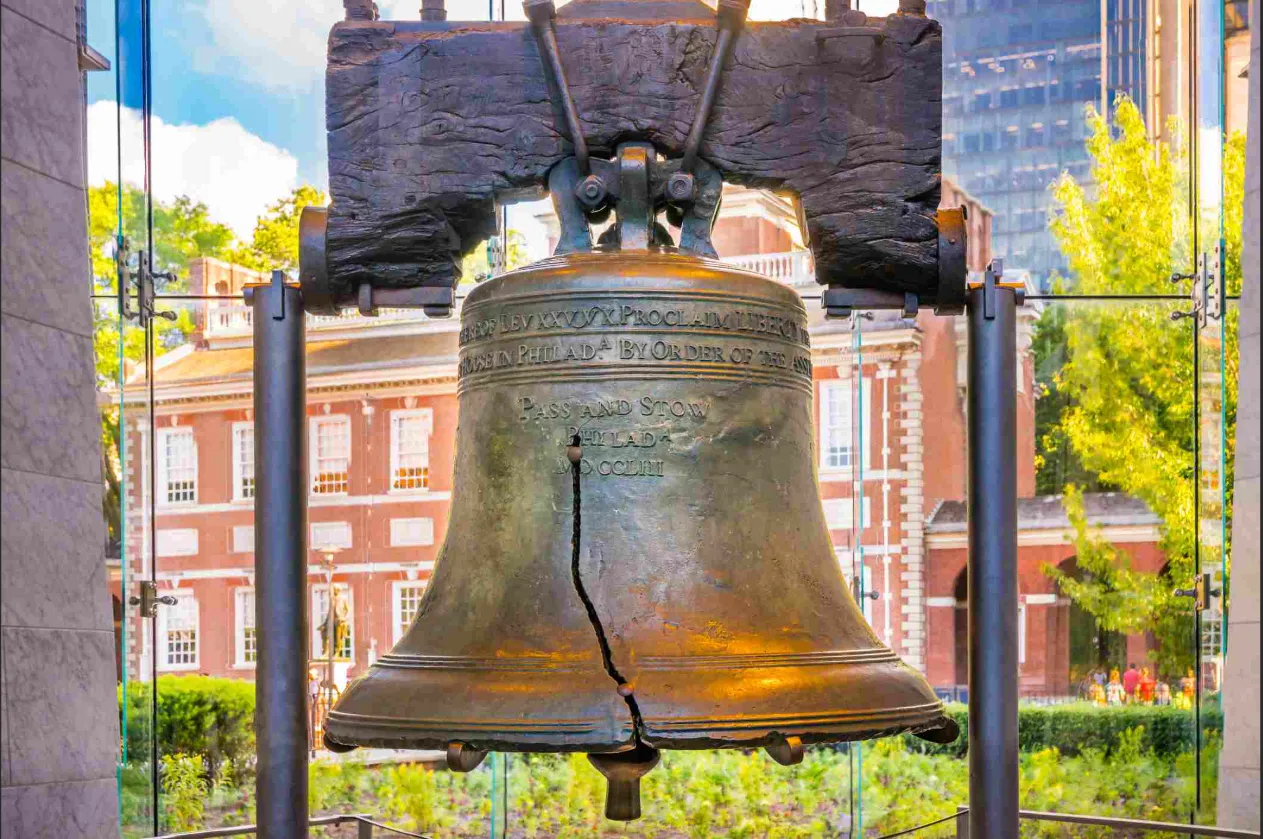
In the shadow of the Liberty Bell in Philadelphia and just steps from where the Declaration of Independence was secretly debated 250 years earlier, workers from the National Park Service used wrenches and crowbars last Thursday morning to dismantle history. One by one, 13 interpretive panels from six exhibits at the President’s House Site — exhibits documenting the lives of the nine enslaved people held there by George Washington — were unscrewed, loaded into a government pickup truck, and driven away.
Staff, area residents, and tourists looked on in disbelief. This was not some bureaucratic misunderstanding on display, but rather the Trump regime’s rancid policy of erasure. Perhaps the panels will be replaced by a giant copy of the movie version of the Ten Commandment tablets as a ploy to staunch the ongoing shrinkage in the numbers of MAGA faithful.
The President’s House was designated a National Underground Railroad Network to Freedom site under a 1998 act of Congress. In removing exhibits referencing slavery, the Trump regime acted without statutory authority, according to Philadelphia officials who are suing.
Heather Richards at E&E News reported the removals were carried out under Donald Trump’s executive order — “Restoring Truth and Sanity to American History” — which, at best, is an infernal project to brainwash people about the nation’s history with lies of omission. The order commands staff at federal historic sites to emphasize America as a “consistent progressive force” and purge what the administration deems “negative” or “corrosive” interpretations of the past. Interior Secretary Doug Burgum reinforced the order in May, instructing the Park Service to conduct a sweeping review of exhibits that might “inappropriately disparage” the nation or its founders.
By mid-afternoon in Philadelpia, panels titled “Life Under Slavery,” “The Dirty Business of Slavery,” and “The House and the People Who Worked & Lived In It” were gone. The carefully researched story they told was swept away in hours. Not tweaked. Not rewritten. Not even debated since crowbars don’t argue. All to give a big boost to Americans’ already notoriously short memories, a collective amnesia that benefits the powers-that-be.


Across the federal landscape, our Outlaw Prez’s minions are systematically scrubbing the record of anything that complicates patriotic mythmaking. Signs explaining climate change have been stripped from Fort Sumter, a coastal monument already menaced by rising seas, according to The New York Times. Internal Park Service reviews have flagged exhibits on Japanese American incarceration during World War II and images depicting the physical torture of enslaved people.
As previously reported, the Trump team is also scrutinizing several Smithsonian museums — including the National Museum of African American History and Culture — for portraying America too honestly. The aim is not balance, but obedience.
Trump’s vision for the Park Service includes an ousting of all programs and references to diversity, equity, and inclusion. This applies to plaques and explanatory signage in the parks as well as exhibits. Thus did we have the ludicrous removal of all transgender references at Stonewall National Monument in New York City, famous for a 1960s gay rights protest that came about partly because of police mistreatment of several transgender people.
In addition to installing Trump-approved histories in federal facilities, National Parks Traveler reported that the Department of Interior sent a Nov. 25 memo ordering NPS staff to conduct a December review of all “retail items” for sale at park stores, whether run by the government or concessionaires. This, it said, is to ensure nothing being sold is out of compliance with the Trump administration’s executive orders on DEI and gender. Material that violates the rules should be removed immediately, the memo stated. That includes books. Censorship by memo rather than bonfire.
Says Alan Spears, senior director for cultural resources at the National Parks Conservation Association: “Banning history books from park stores and cracking down on park T-shirts and keychains is not what National Park visitors want from their Park Service. Going after gift shops is just one part of the administration’s deeply troubling pattern of silencing science and hiding history in our parks. It’s a bad idea that has proven deeply unpopular with the millions of people who come to our national parks to learn about America’s natural wonders and unique diverse history.”
As one senior NPS official told E&E News, speaking anonymously to avoid retaliation, park employees are being ordered to rewrite or dismantle hundreds of exhibits even as staffing has been slashed. The Harpers Ferry team that produces much of the Park Service’s educational material has been gutted, shrinking from roughly 100 people to about 60 after buyouts. Fewer historians. Less institutional memory. More amnesia.


The administration insists this is about “accuracy” and “honesty.” Unsurprisingly, given how much the regime lies about what’s happening right now, those claims collapse on contact with the historical record. The exhibits at the President’s House did not invent George Washington’s slave-owning. They documented it.
As historian John Garrison Marks — author of Thy Will Be Done — explained to Dana Munro at The Philadelphia Inquirer, Washington’s presidency in Philadelphia between 1790 and 1797 offers one of the clearest windows into the moral rot at the heart of the founding. The first president lived in the executive residence with a rotating group of enslaved people, including Hercules, Christopher Sheels, Richmond, Moll, Joe, and Oney Judge.
Pennsylvania law stipulated that enslaved people residing in the state for six months would be freed. Washington knew this. He wrote about it. And he deliberately schemed to evade it. At regular intervals, his enslaved workers were sent back to Virginia or briefly out of state, resetting the legal clock. This was not the behavior of a reluctant slaveholder trapped by circumstance. It was the behavior of a man using the administrative machinery of the early republic to preserve ownership of human beings.
“There have always been Americans who want to sweep this history under the rug. They want to ignore or silence it. They don’t want to acknowledge that the father of his country, as they call him, was so involved in the institution of slavery,” Marks said. “We see that very clearly today, that there are still Americans who are unwilling to kind of recognize this flaw, much less reckon with it.”
When the enslaved Oney Judge escaped in 1796, Washington did not accept her self-emancipation as a moral reckoning. He pursued her. For years. He expressed outrage not at slavery, but at what he described as her ingratitude. To acknowledge his entanglement with slavery is not to suggest that Washington was all villain. Like another of the many slave owning founders, Thomas Jefferson, he was a complex human being, although he was less publicly introspective about slavery than Jeffersion. But removing these exhibits defends a lie: that American freedom unfolded after the revolution unsullied, without blood, theft, or coercion.
According to Fallon Roth and Maggie Prosser atThe Philadelphia Inquirer, as the panels were taken down last week, a passersby muttered “damn shame” and asked whether this was happening “because of this administration.” Seventy-four-year-old Jali Wicker recorded the scene, visibly shaken, saying, “You can try to erase our history, but we’re still going to survive.”
Others were less restrained. Michael Coard, a civil rights attorney and leader of the Avenging the Ancestors Coalition, called the removal an “abomination” and described Trump as a “monstrosity in the White House.” Jack Williams, shouting as workers loaded the panels into a truck, urged federal employees not to become instruments of historical fraud. Community organizer Mijuel Johnson spoke of the bitter irony of compliance at a site dedicated to resistance against tyranny.
The administration, as has become its habit on a range of matters, responded with contempt. The Interior Department accused Philadelphia of filing a “frivolous lawsuit” aimed at “demeaning our brave Founding Fathers,” as though documenting slavery were an act of vandalism rather than scholarship.
There are several messages conveyed by this dismantling. An unmistakable one: uncritical reverence is mandatory for true patriots. On the contrary, in an opinion column, Philadelphia Inquirer columnist Jenice Armstrong called destruction of the exhibit a moral obscenity:
None of this makes America great again. It doesn’t bring down the cost of groceries. It doesn’t help Americans whose healthcare premiums have skyrocketed. It doesn’t make our streets safer. It doesn’t do anything but rile up Confederate flag-waving racists in Trump’s base. They had an awful lot to say about preserving history when monuments honoring traitorous soldiers who fought for the Confederacy and the right to own Black folks were torn down. But not so much when it comes to the destruction that happened at Sixth and Market Streets Thursday afternoon.
I hope the spirits of the enslaved Africans whose stories had been immortalized in that display adjacent to the Liberty Bell will forever haunt Trump. It is my sincere wish that he and the henchmen who took down signs and dismantled the panels documenting the sad history of the nine enslaved Black people owned by our nation’s first president will never forget what they’ve done. [...]
The exhibit at the President’s House was the first I’d ever seen that, instead of glorifying the nation’s first president, humanized the poor people Washington held in the worst kind of bondage. The offices of The Inquirer are right across the street, and I’ve walked through the free outdoor exhibit many times. I used to enjoy seeing the expressions of tourists as they learned about the side of Washington that’s left out of most history books.
By blotting out mention of slavery from the birthplace of American democracy, the regime is not healing national wounds. A nation that cannot tell the truth about its past and cannot look at its scars also cannot claim moral leadership in the present. Over the past 60 years, we have made some progress in telling that truth. That is something else the regime wants to erase or at least alter in the way Winston Smith did under Big Brother’s orders in Orwell’s 1984.
Today, at the President’s House Site, there are gaps where words once stood. Blank walls where truth once breathed. This emptiness tells us who fears history and who we should fear. A nation that cannot honestly acknowledge and confront its past — flaws along with triumphs — sabotages its future.



Comments
We want Uncharted Blue to be a welcoming and progressive space.
Before commenting, make sure you've read our Community Guidelines.