

By this point you have probably heard of Deciding to Win, a white paper written up by one particular wing of the Democratic Party's strategy and consulting class, a report that lists in its acknowledgements people like James Carville, David Axelrod, and several dozen clones of James Carville and David Axelrod because I swear they grow these people in big vats underneath DNC headquarters—or, slightly more realistically, because you're only going to be financed by Important People if you espouse an excruciatingly small set of political views that amounts to just sit there and don't touch anything.
The 59-page main report, which you can also read here, is mostly being met with eye-rolling in online spaces. You can read an extended thread about it here, but since it's 59 pages long most other criticisms have focused on the "Executive Summary," the short-version advice that the strategists give for tweaking Democratic Party values and word-saying in order to win in 2026 and 2028.
The core criticism is that despite the United States being in a time of unprecedented federal corruption, rampant executive lawbreaking, a media environment that has largely collapsed, massive propaganda campaigns funded by even more massive wealth, and take-your-pick, the advice remains what the advice always turns out to be, win or lose, federal or local. Democrats should stand for popular things, should avoid talking about less popular things, and above all else must cede ground wherever Republican strategists come up with a new invented panic.
To give ourselves the best chance to win, we recommend the following changes to our approach. Democrats need to:
Focus our policy agenda and our messaging on an economic program centered on lowering costs, growing the economy, creating jobs, and expanding the social safety net.
Advocate for popular economic policies (e.g., expanding prescription drug price negotiation, making the wealthy pay their fair share in taxes, raising the minimum wage to $15 an hour) rather than unpopular economic policies (e.g., student loan forgiveness, electric vehicle subsidies, Medicare for All).
Convince voters that we share their priorities by focusing more on issues voters do not think our party prioritizes highly enough (the economy, the cost of living, health care, border security, public safety), and focusing less on issues voters think we place too much emphasis on (climate change, democracy, abortion, identity and cultural issues).
Moderate our positions where our agenda is unpopular, including on issues like immigration, public safety, energy production, and some identity and cultural issues.
Embrace a substantive and rhetorical critique of the outsized political and economic influence of lobbyists, corporations, and the ultra-wealthy, while keeping two considerations in mind: First, voters' frustrations with the status quo are not the same as a desire for socialism. And second, criticizing the status quo is a complement to advocating for popular policies on the issues that matter most to the American people, not a substitute.
In summary, the authors say they have done a great deal of polling and determined that the most effective Democratic message is what every Democratic campaign already does, while avoiding doing what Republican talking heads falsely claim Democrats do.
I'm not going to spend a lot of time on that snippet. I'm sure everyone reading this already has many interjections they're eager to pipe up with and I won't tell you not to.
But I, for one, wanted to come into this thing with at least some semblance of an open mind. If these assertions as to how to win elections were truly grounded in evidence, then fair enough; I'm not quite so lowbrow as to assume anything that a particular gaggle of people has put their hand to can automagically be dismissed, even if in general it can be quite the time saver.
Does the full 59 page report back up the authors' claims? Is it truly a fair look at the current political landscape? Or is instead yet another post-hoc rationalization of the authors' longstanding beliefs, one that relies on cherrypicked claims to prop up predetermined conclusions?
Unfortunately, the answers are no, no, and yes, and now I'm pissed off I spent all that time combing through the thing when I could have just typed "this is yet another sales pamphlet for enforced mediocrity" by the end of page 5 and not bothered with the rest. But I did spend that time, so now I'm going to make it everybody's problem.
Data poisoned. If forced to describe the core flaw of the report, the conceit that renders it unsound from top to bottom, I would call it data poisoned. In A.I. circles "data poisoning" refers to something slightly different, but the version I'm referring to is strictly biological: I mean the natural human tendency to make decisions based on alleged "data" without sufficiently questioning whether the "data" you've collected means what you think it means.
There is a common belief that "data doesn't lie," and it is a belief held exclusively by people who don't know how to read data because if you've ever spent any time around data you know that it lies its pointy little head off at every opportunity, in every situation. You should treat "data" with the same skepticism that you would use when discovering an unmarked, burning paper bag on your porch.
Data is a scheming ratbastard, and any scientist or statistician knows that when interrogating data you should do it with a loaded gun in each hand. "Data" is how you prove every scientific advancement; it is also how worm-brained professional assholes convince themselves that wind farms cause autism.
It is impossible to overstate how often even smart people data poison themselves into thinking bizarre things. It is one of the most prevalent causes of human screw-ups through all of human history. Wars are lost, businesses fold, and economies collapse because some group of allegedly informed people look at a sheet of numbers, draw a line going up or down, and bet everybody else's livelihoods on a flawed theory of what it all means.
And now I've digressed, because that's a particular sore point of mine and I couldn't help it. But if I had to sum up the core Democratic strategist screw-up that causes them to prescribe the same remedy in every situation and in every decade, whether the patient is suffering from mild economic malaise or a fascism-laced constitutional crisis, it is that that they have data poisoned themselves to the point of jaundice.
While the 5-point executive summary is getting the most attention, the fundamental flaw in the authors' logic—the thing that brings the whole argument crashing down—can be found on page 12. On page 11, we get a (bubble-sort?) prioritization of what voters say they most want the Democratic Party to focus on, or at least what they most wanted Democrats to focus on April, when the survey was conducted. Economic concerns top the list.
In a separate poll, voters were similarly asked what they thought the Democratic Party was most focused on. The two data sets are then compared to, in theory, identify which issues voters believe Democrats prioritize too much and which aren't prioritized enough.
Here's the result. And here's my question to you: What do you think these results are measuring?
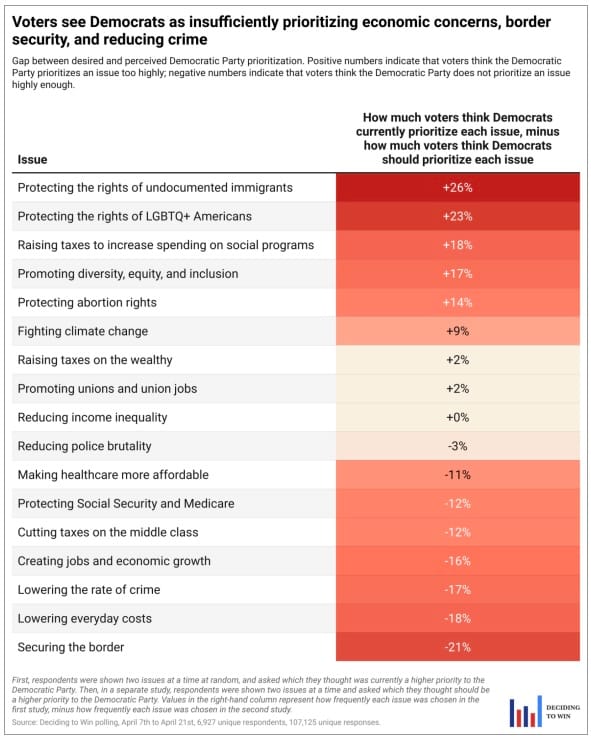
The authors' interpretation of this table is a humdinger. By the authors' estimation, we now have clear evidence that Democrats are prioritizing the wrong issues, and must therefore "place less emphasis" on the things Democrats allegedly focus too much on.
These results tell a clear story. Voters see Democrats as insufficiently prioritizing issues like the cost of living, the economy, immigration, health care, taxes, and crime, which are all top concerns for voters. At the same time, voters see Democrats as putting too high a priority on climate change, democracy, abortion, and identity and cultural issues.
Going forward, it will be critical for our party to reduce the gap between what voters want Democrats to focus on and what voters think we do focus on. This will likely require making issues like the cost of living, the economy, health care, border security, and reducing crime a higher priority for our party—both in our communications and in our approach to governance—and placing less emphasis on issues like climate change, democracy, abortion, and identity and cultural issues.
I am trying very hard to be diplomatic about this, but the flaw in this data analysis is so egregious that a first-year statistics student would be expected to identify it. The authors took voters' stated issue prioritization. It then asked them their perception of what Democratic Party priorities were, based on media and political coverage, and compared the two.
The authors find that media-driven perceptions of Democratic priorities are waaaaaay off, and are conspicuously most off on issues like "the rights of undocumented immigrants," "the rights of LGBTQ+ Americans," "raising taxes" and "DEI"—mirroring, precisely, the the most-repeated Republican media assertions of the moment—and that the way to fix this is to not talk about it, which will patch up the problem nicely.
Let me ask you again. What do you think that chart up there is measuring? I don't think anyone is too confused by it. The chart is measuring media-driven perceptions of Democratic priorities. The thousands of voters polled have not, assuredly, immersed themselves in Democratic strategy papers, party platforms, or other party minutiae. It would not have helped even if they did, since none of it means a damn thing to the actual candidates on the ballots or the legislators who are then elected—none if it is binding.
Literally the only thing you are measuring, when you ask a random assortment of voters what they believe "Democratic Party" priorities to be, is what mass media, social media, and cultural assertions the participants have been exposed to. And it turns out that voters very reliably repeat Republican strategists' most-pushed assertions of what "Democrats" stand for, no matter what Democrats have actually done or what campaigns Democrats actually wage.
If that's what you wanted to measure, then by all means. It would seem to point to a quite serious problem!
But it takes an impressive amount of stubbornness to pull together a report showing that media coverage of Democrats tends to hew closely to whatever opinions Republican-allied media groups spend the most time and money pushing, and from that conclude that the problem is that Democrats are focusing too much on those things.
We know quite a bit about the current mass media environment. We know that scams and false information are omnipresent. We know that major media companies have shifted hard right in recent years, mirroring and absorbing Republican extremism, and that corporate heads have specifically been seeking out those more extremist views so as to stay in good graces with conservative leaders. We know that academic freedoms are collapsing due to heavily networked attacks on professors, on institutions, and on ideas. We know the sitting president of the United States is an unhinged and shameless liar, about everything, all the time.
Specifically, though, we know from many, many studies that voters are astonishingly misinformed about the issues and even the most basic facts about their own government. We know that, and have repeatedly seen examples of, the same voters voting for substantive new abortion protections, worker protections, or new programs while simultaneously voting for arch-conservative representatives who oppose (and subsequently sabotage) those initiatives.
Of all the things we most know about the electorate, the thing we most know the mostest is that voters vote against their own stated priorities all the damn time, often to the point of incoherency. Basing the whole future of the party on the assumption that they do not do that is insanity. It shows a willful disregard for data even as it asserts superior data knowledge.
This would be a plausible report if voters indeed were proven to vote according to their stated priorities, which is known to be false. The premise that ceding ground wherever Republican strategists most want to battle on would be plausible, if we assumed that once that ground was ceded those ever-more-extreme conspiracy pushers would be flummoxed, unable to easily come up with a new group or issue to demonize on Fox News evening shows.
Indeed, if prioritizing popular economic ideas while disengaging on any front conservatives inflated into an absurd caricature of actual Democratic policies was a sure path to success, Democrats would have not lost an election for the last forty years. Because none of these ideas are new. It's the path forged by nearly all party members, save those who are in outlier districts that require more explicit nods to the left or the right.
Nearly all Democratic campaign rhetoric revolves around the same theories of the five-step plan quoted above. Say things voters like to hear, don't say things they don't like to hear, make a nod towards reformations that might actually Fix Some Shit while not touching the status quo in any way that any critic could possibly label "socialism."
And this approach has, since the year 2000, resulted in coin-flip elections between adherents of this approach and increasingly radical, scenery-chewing liars, conspiracy cranks, and purity-obsessed nationalists, despite polled voters insisting that they don't want any of those things and would prefer cautious economy-focused bipartisanship of the sort Democratic campaigns have so stubbornly offered up.
At the very least, a group insisting that their data-founded premises of how campaigns should work should have a track record of winning campaigns. They don't.
It is impossible to take any political analysis seriously if it is unwilling to grapple with the massive, structural dominance of right-wing agitprop in mass media markets. To the advocates of muddy middle-ism, though, it rates no discussion at all.
While Joe Biden was not the favored choice of progressives in the 2020 Democratic primary, as president he embraced progressive positions on most issues. And between when Biden was inaugurated and when he left office, polling shows that the share of voters seeing Biden as "too liberal" skyrocketed.
Really now. For some mysterious reason, the number of voters who announced Biden to be "too liberal" went sharply up in four years and we're just going to all assume that happened because voters were compulsively following his every act as president, as opposed to ... other reasons.
The whole report is riddled with this view. Voters think the Democratic Party has gotten more liberal! Voters tend to believe Republicans aren't "too conservative," if you throw out the September poll that shows the opposite!
But there are other parts of the report that veer close to dishonesty—another sign that data is being marshaled to prove a viewpoint, not inform one.
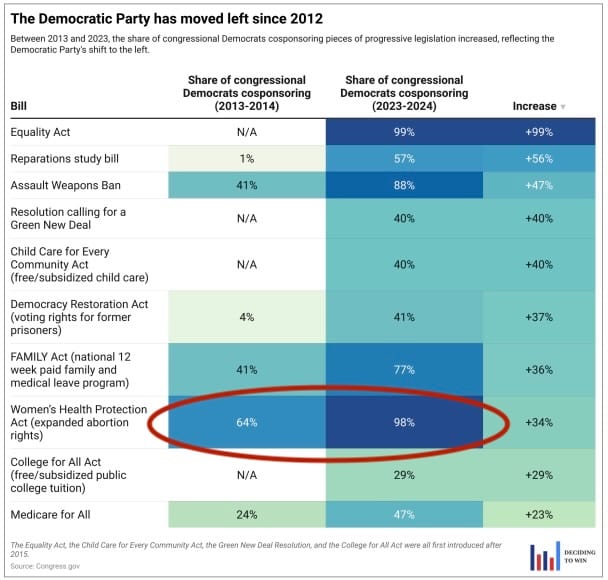
Look, if you can't think of a single reason why federal abortion rights would be a more salient issue in 2023 than it was in 2013, I don't know what to tell you.
Republicans also moved toward the center on several issues, including moderating their stances on Medicare and Social Security and dropping pledges to repeal the Affordable Care Act, ban abortion nationwide, and pass a constitutional amendment to prohibit same-sex marriage.
Whoo boy.
There's a whole section dismissing base mobilization as a strategy, instead emphasizing the need to appeal to swing voters. But Dem-leaning irregular voters were the ones staying home in 2024, which doesn't square. The report at one point lists "Unpopular Democratic policies" like "Abolish the police," "Abolish prisons," and "Provide free health care to undocumented immigrants," none of which are within a mile of being actual Democratic "policies" but which instead were cribbed from far-right monologues. Left-leaning critiques of Democratic campaigning are shoved off into their own section, derided as "The New Politics of Evasion," where the discrepancy between Republican and Democratic media reach is brushed off with assertions like "legacy media is less powerful than ever."
And the embargoed version of the report (it appears to have been patched up in the current, web-based version) offers up this graph that I'm going to present solely as an object lesson in the perils of extrapolation.
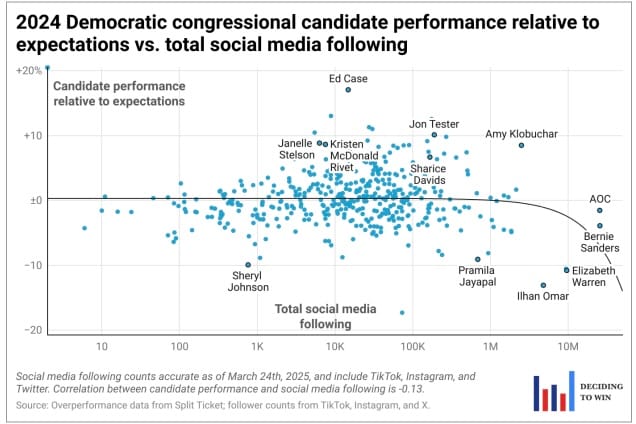
Hmmmm. Yeah, I'm just going to leave that one there. If you can see the problem, good for you.
At the end of the day, I'm disappointed in myself. I spent a great deal of time combing through this report in the hopes of finding a useful bon mot here or there—I came in with all the skepticism required when a group mentions David Axelrod positively, but still thought a collection of this much data would be useful in bits and pieces.
But it's largely not, because every bit of data used is being used to prop up a narrative of flaccid passivity. Republicans will set the narrative for what Democratic candidates believe, and Democrats will set their narratives according to what Republicans say about them, and this is an unchangeable dynamic that we can do nothing about because it is just how the nation works.
But the "DEI" panic was nonexistent until a specific far-right propagandist invented it. No American knew to be afraid of supposed "migrant caravans" until it was presented as the latest conspiracy prop; the word "caravan" disappeared from the public lexicon soon afterwards, and new ones appeared that supposed all immigrants to be gang members. Trump supporters ransacked the Capitol—only to have it become a non-issue before the next year was out. Government accounts are now regularly posting neo-Nazi and white supremacist content. And, of course, the current ever-ranting president is engaged in both anti-democratic aggression, the militarization of American cities, and omnipresent, open corruption.
At the very least, even if we all agree that Democrats could not possibly set and erase such public narratives with such curious reach and precision, it is not a normal information environment. Attempts to treat it like a normal information environment will fail. You cannot seriously claim that every election from that of Bill Clinton onward would have been best served by following the same advice as was given the election before that—that there is no substantive difference in the electorate from the days Newt Gingrich was inventing new slurs to call Democrats and an extremist president literally tearing down a third of the White House to construct a bribe-funded party room.
But mostly, you can't base all campaign and government policy around the theory that voters have precise lists of policy preferences that determine which candidates they vote for—not in the face of a quarter-millennium's worth of history in which they very demonstrably do not vote according to those preferences. It's ridiculous. Voters are not Sims.
To get from the normal arc of American history to Donald Fking Trump tearing down the White House, bombing random boats in Central America, and announcing that Tylenol probably causes autism now, there is something other than straight voter policy preferences going on.
Dig into that, and maybe some new option might present itself. Because if a party can't wipe the floor with openly crooked opponents zip-tying crying children, breaking the ribs of old men, imposing gargantuan new taxes on Americans based on who insulted who on the president's social media feed, shutting down the government and locking the House doors to prevent the release of information about powerful child sex predators, then maybe the status quo isn't working nearly as well as your little charts say it should.










Comments
We want Uncharted Blue to be a welcoming and progressive space.
Before commenting, make sure you've read our Community Guidelines.