

From Farmington to Red Lake, from Kayenta to Teec Nos Pas. the Navajo Nation is packed with places of astounding beauty. At dawn on Black Mesa, the light reveals every contour of land and memory alike. First the dry wash. Then the old fence lines, half-bent and half-buried. Then the silhouettes of sheep and the quiet movement of people whose ancestral families have lived there since long before the United States had a name. I spent much time there in the distant past.
Amid the beauty, if you know what to look for, you can trace the layers of extraction etched into the land where Peabody Coal sucked up billions of gallons of groundwater to mine and slurry coal from Black Mesa to generate electricity further west. That drawdown of fossil water from ancient aquifers still negatively affects Navajo ranchers and farmers even though mining on Black Mesa ended in 2019, and tribal restoration efforts are now being undertaken in parts of the reservation.
Early last year, however, the hydropower company Nature and People First set its sights on the mesa. With its steep drop, they saw it as a perfect spot to build pumped-storage projects. Each project would use flowing water from a reservoir atop the mesa to spin a turbine to generate electricity. That water would then be held in a lower reservoir to await the time of day or night when electricity demand is lower. Then the water would be pumped back to the upper reservoir to start the process over again.


Reporting in Grist, Miacel Spotted Elk writes: “Pumped-storage operations involve moving water in and out of reservoirs, which could affect the habitats of endangered fish and require massive groundwater withdrawals from an already-depleted aquifer.”
Native and environmentalist opposition to these hydropower projects was vigorous. In the past, the Federal Energy Regulatory Commission would have given a preliminary green light to such projects while they were reviewed. But the Biden administration had altered that, noting that the commission would no longer “issue preliminary permits for projects to use Tribal land if the Tribe on whose land the project is to be located opposes the project.” As a result, FERC denied the permits.
At the time, Nicole Horseherder, executive director of the Navajo nonprofit Tó Nizhóní Ání, or Sacred Water Speaks, said in a statement, “It is encouraging to see federal decision-makers honoring the trust responsibilities to Native American Tribes.”
This October, however, Energy Secretary Chris Wright wrote to FERC urging a reversal of that policy change, arguing that the veto power tribes holds was hindering the “development of critical infrastructure” and creating an “untenable regime.” As Wright put it, “For America to continue dominating global energy markets, we must remove unnecessary burdens to the development of critical infrastructure, including hydropower projects.” The language echoed the familiar script of extractive capitalism — an insistence that tribes are obstacles, not sovereign nations with legal rights and lived experience.
More than 20 tribes and tribal associations, environmental groups, and elected officials pushed back, demanding that Biden’s FERC policy be reinstated.
Like so much U.S.-Native interaction. the building of water projects on Native land is filled with ugly stories. Here’s an example:
In February 1954, the U.S. government grabbed land from the Yankton Sioux Tribe to build the Fort Randall Dam and Reservoir in southeastern South Dakota. That dam and four others built on the Missouri River by the Army Corps of Engineers from 1946 to 1966 were approved for flood control, pollution and sediment control, navigation, conservation, recreation, hydroelectric power and enhancement of fish and wildlife under the Pick–Sloan Missouri Basin Program, a part of the Flood Control Act of 1944.
Construction of the dams and consequent flooding forced the relocation of more than 1,500 Indian families on seven reservations, including some 136 on the Yankton Reservation. The tribes lost more than 350,000 acres. Besides at Yankton, fertile bottom land was condemned on reservations at Fort Berthold, Cheyenne River, Standing Rock, Lower Brule, Crow Creek, and Santee.
The tribes didn't only lose their land but also any timber, wildlife, and native plants plus homes and ranches. In the case of Fort Thompson on the Crow Creek Reservation, an entire town was inundated. As a consequence, the Bureau of Indian Affairs and Indian Health Service offices were moved off the reservation to Pierre, making it far more difficult for the Indians to use them. The losses also included spiritual ties to the land and the intangible benefits that came from living along the Missouri.
The tribes were never consulted about the project during the planning stages. No America Indians were asked to testify during hearings on the projects in Congress. The Bureau of Indian Affairs, which supervises Native land held in trust by the Department of Interior, raised no objections.The Corps of Engineers handled negotiations. Tribal sovereignty and treaty rights, including the Yankton Treaty of 1858, were completely ignored. So also was the Winters Doctrine, a Supreme Court ruling that Indians have inherent rights to water resources on their lands.
Philleo Nash, who had advised Presidents Roosevelt and Truman to integrate the armed forces and later served as BIA Commissioner under JFK and LBJ, would later say that Pick-Sloan "caused more damage to Indian land than any other public works project in America."
The amount of money offered to owners of individual Indian land allotments was often significantly less than the amount offered to non-Indian land owners. Likewise, as the dam projects began in a time when termination of reservations was in full swing, government compensation for damages caused by the taking of communally owned tribal land was well below its market value. Land at North Dakota's Fort Berthold Reservation of the Mandan, Hidatsa and Arikara people was condemned and bought for $33 an acre. It took decades—and four Government Accountability Office reports—for Congress to even acknowledge the harm, let alone consider reparations.
Of today's situation, Spotted Elk writes:
If the commission decides to retract tribes’ ability to veto hydropower projects, it will mark a shift in the relationship between Indigenous nations and the federal government. Horseherder described such a move as the “first step in eroding whatever’s left between [these] relationships.” She is pessimistic about the commission’s decision and expects it will retract the current policy.
“The only thing I’m optimistic about is that Indigenous people know that they need to continue to fight,” she said. “I don’t see this administration waking up to their own mistakes at all.”
But, of course, the Trump regime sees this move as a blessing, not a mistake.
—Meteor Blades
WEEKLY ECO-VIDEO
GREEN BRIEFS
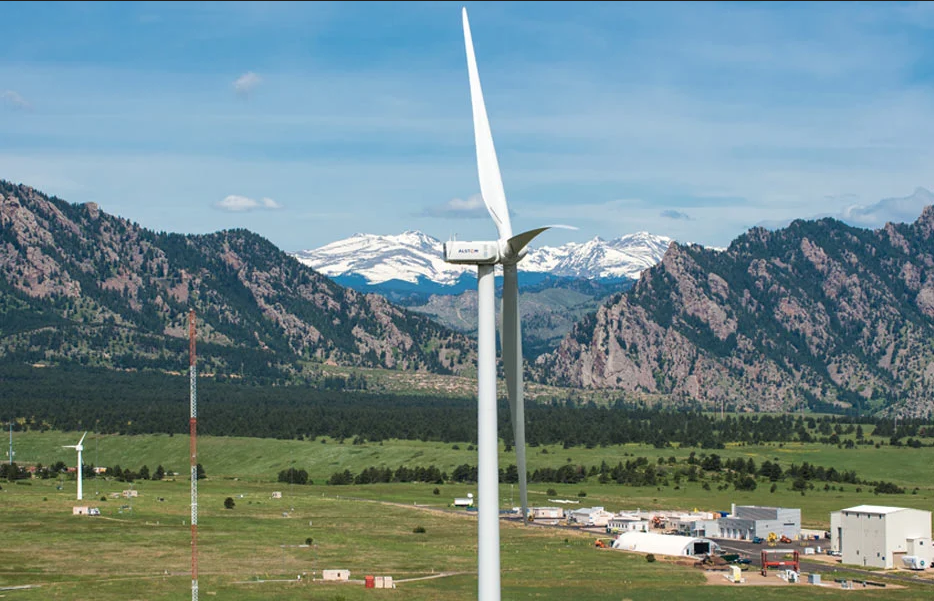
Federal Judge Vacates Offshore Wind Order, Says Wind Foes Are “Tilting At Windmills”
If he could, Donald Trump would stop the installation of a single new wind turbine anywhere in the world. Fortunately, he cannot, so the UK, the Chinese, and other nations continue to move ahead planting turbines where they can, with more and more going offshore, where they are bigger, more powerful, and more efficient.


From the moment he stepped into the Oval Office, Trump showed he would far be more aggressive than in his first term, turning grumbling into policy. One of those was his dreadful Offshore Wind Order Jan. 20. This barred all future offshore wind leases and suspended for review those already in the pipeline.
U.S District Judge Patti B. Sariss responded Monday for the plaintiffs who sued in the matter: “After review of the parties’ submissions and a hearing, the Court concludes that the Wind Order constitutes a final agency action that is arbitrary and capricious and contrary to law,”
Tina Casey at CleanTechnica wrote:
Of course, just because a judge exercises the US judiciary’s authority as a co-equal branch of government under the Constitution to order something to be done, it doesn’t mean that President Trump will do it. After all, he’s gotten away with rule-breaking every year of his adult life, why should 2025 be any different. Besides, who’s gonna make him obey the law? Certainly not the half-dozen toadies currently posturing as the majority voice of the US Supreme Court, where the case is all but certain to go on appeal. [...]
The December 8 ruling is a bittersweet victory for the US offshore wind industry, which has already been disrupted all up and down the Atlantic coast. Even if the decision is upheld on appeal, the damage is already deep and widespread (see more wind order background here).
—MB
TRUMP REGIME ORDERS PURGE OF DEI, GENDER REFERENCES AT NATIONAL PARK SHOPS
Our Outlaw Prez is keen to get everything whitewashed and sanitized for the celebrations next year of the 250th anniversary of the Republic. As he made clear with orders to the Smithsonian’s museums, he wants to emphasize the positive and eliminate the negative about the United States during this historic milestone.
That vision he also visited on the National Park Service, demanding an ousting of programs and references to diversity, equity, and inclusion. The exclusion applies to plaques and explanatory signage in the parks as well as exhibits. Thus did we have the ludicrous removal of all transgender references at Stonewall National Monument in New York City, famous for a 1960s gay rights protest that came about partly because of police mistreatment of several transgender people. References to slavery at the Harriet Tubman National Monument in Maryland are probably headed for the chopping block too.
In addition to installing Trump-approved histories in federal facilities, National Parks Traveler reports that the Department of Interior sent a Nov. 25 memo ordering NPS staff to conduct a December review of all “retail items” for sale at park stores, whether run by the government or concessionaires. This, it says, is to ensure nothing being sold is out of compliance with the Trump administration’s executive orders on DEI and gender. Material that violates the rules should be removed immediately, the memo states.
Says Alan Spears, senior director for cultural resources at the National Parks Conservation Association: “Banning history books from park stores and cracking down on park T-shirts and keychains is not what National Park visitors want from their Park Service. Going after gift shops is just one part of the administration’s deeply troubling pattern of silencing science and hiding history in our parks. It’s a bad idea that has proven deeply unpopular with the millions of people who come to our national parks to learn about America’s natural wonders and unique diverse history.”
At Greenwire, Heather Richards writes:
In the broader review, which is ongoing, parks submitted content for potential noncompliance to leadership at headquarters in Washington.
After an opaque decision-making process, leadership ordered parks in some cases to remove or change content, such as panels that talk about climate change at the Acadia National Park in Maine and the reproduction of a photo from the Civil War era of an enslaved black man scarred by whippings that was on display at a national monument in Georgia. After public backlash, it was unclear if the photo would be taken down, however.
—MB
HALF A DOZEN OTHER THINGS TO READ (OR LISTEN TO)
BLM nominee draws criticism from conservation groups over support for selling public land by Micah Drew at the Nevada Current. Conservation groups across the West are raising concerns about Steve Pearce, a former New Mexico representative who is President Donald Trump’s newest nominee to lead the Bureau of Land Management. The nomination has reignited a fight over the management of public lands which was highlighted during negotiations over Trump’s “One Big Beautiful Bill” due to proposed amendments to sell off federal land. The fight also spawned two new bipartisan caucuses in Congress, both co-chaired by Montanans, and predicated on public land access and management. In Nevada, the BLM manages nearly 48 million acres of federal land, about 67% of the state. Nationwide, the BLM oversees 245 million acres of federal land, along with 700 million acres of subsurface rights for extraction and energy development, putting the position directly in the crosshairs of energy developers and outdoor industry groups. According to the Center for Western Priorities, Pearce amassed a “lengthy anti-public lands record,” sponsoring bills to shrink national monuments and increase extraction on national forest land.


Indigenous Dayak sound alarm as palm oil firm razes orangutan habitat in Borneo by Hans Nicholas Jong at Mongabay. Indigenous Dayak communities report wildlife encroaching into villages, land grabbing, and loss of cultural and livelihood resources as a palm oil company begins clearing forests on their customary lands — in some cases without consent or even prior notification. PT Equator Sumber Rezeki (ESR) has already cleared nearly 1,500 hectares (3,700 hectares) of rainforest inside this region that’s designated a UNESCO Biosphere Reserve and orangutan habitat, with much of the deforestation occurring this year and signaling far more destruction to come. The company’s parent group, First Borneo, is driving widespread deforestation across Kapuas Hulu with two other plantations, yet its palm fruit is still entering global “zero-deforestation” supply chains through intermediary mills despite corporate no-buy pledges. Environmental groups are urging the government to halt or revoke ESR’s permits and protect the orangutan-rich landscape, warning that continued clearing undermines Indonesia’s climate commitments and threatens both biodiversity and cultural survival.
Related: Save This Species: Bornean Orangutan. (The Revelator)
Child Farmworkers: To Protect Underage Farmworkers, California Expands Oversight of Field Conditions by Robert J. Lopez at Capital & Main/Los Angeles Times. California officials said they are launching new enforcement actions to protect underage farmworkers, including enhanced coordination among two state agencies charged with inspecting work conditions in the fields. The actions follow an investigation by Capital & Main, produced in partnership with the Los Angeles Times and McGraw Center for Business Journalism, which found that the state is failing to protect underage farmworkers who labor in harsh and dangerous circumstances. Thousands of children and teenagers work in California fields to provide Americans with fresh fruit and vegetables. While laborers as young as 12 can legally work in agriculture, many described being exposed to toxic pesticides, dangerous heat and other hazards.
Related:
- California’s Child Farmworkers: Exhausted, Underpaid and Toiling in Toxic Fields (Capital & Main/Los Angeles Times)
- Lax Oversight, Few Inspections Leave Child Farmworkers Exposed to Toxic Pesticides (Capital & Main/Los Angeles Times)
An Alaskan Village Confronts Its Changing Climate: Rebuild or Relocate? by Scott Dance at The New York Times (gift article). From the beige confines of Room 207 at the Aspen Suites Hotel on the outskirts of Anchorage, Maggie Paul and her daughter, Jamie, struggle to envision the future. A little more than a month ago, the women were evacuated along with about 1,000 others from Kipnuk, their remote coastal village in western Alaska that was destroyed by the remnants of a typhoon. They were airlifted to safety; there are no roads to their community. Many landed in hotels about 500 miles away in Anchorage, which might as well be a different planet for all the ways the city differs from their tight-knit rural community. It’s here the Pauls are wrestling with the kind of uncertainty facing more communities as the planet warms, weather grows more destructive and vulnerable places face repeated disasters. Maggie Paul, 64, wants to return to Kipnuk and the way life used to be, before a series of floods and storms repeatedly bashed the village, with the most powerful blow yet landing on Oct. 12. However long it takes to put the decimated village back together, Ms. Paul said, “I will wait.”
Related: As millions face climate relocation, the nation’s first attempt sparks warnings and regret (Floodlight News)


FEMA’s terrible, horrible, no good, very bad year by Rebecca Egan McCarthy at Grist. As 2025 draws to a close, the departure of the beleaguered acting director of the Federal Emergency Management Agency, David Richardson, caps a tumultuous year for FEMA. In January, President Donald Trump took office and vowed to abolish the department. Though the administration subsequently slow-walked that proposal, its government-wide staffing cuts have led to a nearly 10 percent reduction in FEMA’s workforce since January. Now it faces a long-awaited report issued by a review council, commissioned by the president and Homeland Security Secretary Kristi Noem, just as a new interim FEMA chief prepares to take the reins in December. Although some expected the review council to recommend further cuts or try to fulfill the president’s suggestion of disbanding FEMA entirely, a leaked draft of the report, obtained by the New York Times, recommends preserving the agency. “There’s been a need for emergency management reform for a while,” said Jeffrey Schlegelmilch, a professor at the Columbia Climate School and the director of its National Center for Disaster Preparedness. “But the wrecking balls came in before there was a blueprint for what to do.”
Related: Trump’s Katrina Is Coming (The American Prospect)
Congress urged to reform “nearly complete moratorium” on U.S. solar projects by PV USA magazine. A letter signed by 143 prominent solar companies in the United States has been sent to the U.S. House of Representatives and the Senate, urging congressional leaders to make reforms to permitting. Donald Trump’s executive actions this year have led to “near complete moratorium on permitting for solar projects,” said the letter. As of July, per a Department of Interior (DOI) memo, solar projects seeking leases, rights-of-way, construction and operation plans, grants, consultations and biological opinions have been subject to approval by Trump-appointed Interior head Doug Burgum’s office. [...] “This extends well beyond projects on public lands,” said the Solar Energy Industries Association (SEIA). “Many solar and storage projects located partially or entirely on private property are now being entangled in a myriad of federal reviews.” SEIA estimates that over 500 projects in the development pipeline across the country are in danger of delays or cancellation as a result of political attacks, based on its analysis of data from the Energy Information Administration.
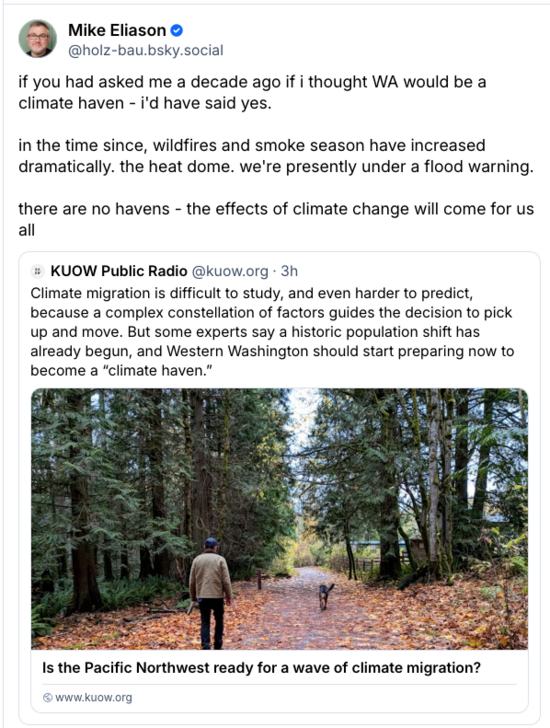
ECOPINION
A National Security Strategy with no strategy for managing existential risks by Alexandra Bell at The Bulletin of the Atomic Scientists. The authors of the NSS assert that “the purpose of foreign policy is the protection of core national interests” and uses that logic to justify a policy of isolationism. They then state that “[n]o adversary or danger should be able to hold America at risk.” But there are basic problems with both assertions. The core national interests of the United States are undeniably affected by human-caused existential risks that have no respect for sovereign national borders and cannot be mitigated by any one country. Further, America is at risk every day, all day from these threats. The looming, multi-player nuclear arms race, the increasingly devastating effects of climate change, and the exponential growth of disruptive technologies are all part of an inescapable reality—one with which any serious foreign policy thinker is intimately familiar.
The future of farming depends on supporting young farmers by Jeff Tkach at Fast Company. Across America, a new generation of farmers is reimagining what it means to work the land. They are engineers, ecologists, and entrepreneurs—people who see farming not only as a way to grow food, but as a form of innovation. In fields across the country, these farmers are harnessing soil science, biodiversity, and technology to restore what decades of extractive agriculture have depleted. Their work represents one of the most powerful opportunities of our time: The opportunity to regenerate our planet from the ground up. Yet, the odds they face are immense. Land prices have soared, access to capital is limited, and isolation comes with choosing a career path few understand. Farmland continues to disappear, and for those eager to farm differently, access to resources and mentorship remains limited. These farmers are proving that the next era of agriculture can be both economically viable and ecologically sound. They are experimenting with cover crops to build soil health, integrating renewable energy into operations, and rethinking distribution through community-based models. Their work underscores a truth we must all recognize: The future of farming depends on our ability to empower the people willing to reinvent it.
Corn’s clean-energy promise is clashing with its climate footprint by Ames Alexander at Investigate Midwest. A growing body of research reveals that America’s obsession with corn has a steep price: The fertilizer used to grow it is warming the planet and contaminating water. Corn is essential to the rural economy and to the world’s food supply, and researchers say the problem isn’t the corn itself. It’s how we grow it. Corn farmers rely on heavy fertilizer use to sustain today’s high yields. And when that nitrogen breaks down in the soil, it releases nitrous oxide, a greenhouse gas nearly 300 times more potent than carbon dioxide. Producing nitrogen fertilizer also emits large amounts of carbon dioxide, adding to its climate footprint. Agriculture accounts for more than 10% of U.S. greenhouse gas emissions, and corn uses more than two-thirds of all nitrogen fertilizer nationwide — making it the leading driver of agricultural nitrous oxide emissions, studies show.
What's going on in electricity world? by David Roberts at Volts. With load growth projections all over the map and politicians zeroing in on high electricity prices, I take a step back in this audio essay to ask how we should build the grid in the face of massive uncertainty. The answer lies in modular, distributed technologies that strengthen the system regardless of whether the AI bubble eventually bursts.
RESEARCH & RESOURCES
The Illegal Trade Bulletin is the Environmental Investigation Agency’s periodic report on the illegal trade in (ozone-eating) substances controlled under the Montreal Protocol. You can now see Issue 3 at the link.
Trust in science is low among minorities for a reason, according to research published by Nature Human Behavior. Historically, at least some of that distrust has been a function of medical experiments and undisclosed sterilizations, among other atrocities. No surprise that people who by race or sex/gender are under-represented in most scientific fields are more trusting of someone whose has the same characteristics as they. The study noted that not just sex/gender and race/ethnicity but also “rurality and economic status” of a scientists made a difference among underrepresented groups’ trust levels.
Researchers explore dangers of ‘forever chemicals’ on babies. Published at PNAS, the study found that mothers in New Hampshire who were downstream of sites contaminated with “forever chemicals” experienced triple the rate of infant deaths and had more premature births or babies with low birth weights. The chemicals, polyfluoroalkyl substances known for short as PFAs have been detected in the drinking water supplies of half the nation and in the blood of nearly every American.
OTHER GREEN STUFF
- Data centers for AI could nearly triple San Jose’s energy use. Who foots the bill?
- US solar tops 11.7 GW in a huge Q3 despite political roadblocks
- Global Scientists Anticipate Less Reliance on the US in Future Carbon Monitoring
- Citing “serious ethical concerns,” journal retracts key Monsanto Roundup safety study
- From commitment to reality: how Chinese cities are delivering on climate goals
- Almost Half of China’s First Time Car Buyers Want an EV, BI Says
- Trump admin invests $800M in latest move to bolster US nuclear industry
- In A Contest Between Solar & Ethanol, There Is One Clear Winner
- IEA Report Reveals Slow Transition Away From Fossil Fuels
- West Coast Chinook salmon denied federal protections
- In New York City, Congestion Pricing Leads to Marked Drop in Pollution









Comments
We want Uncharted Blue to be a welcoming and progressive space.
Before commenting, make sure you've read our Community Guidelines.