
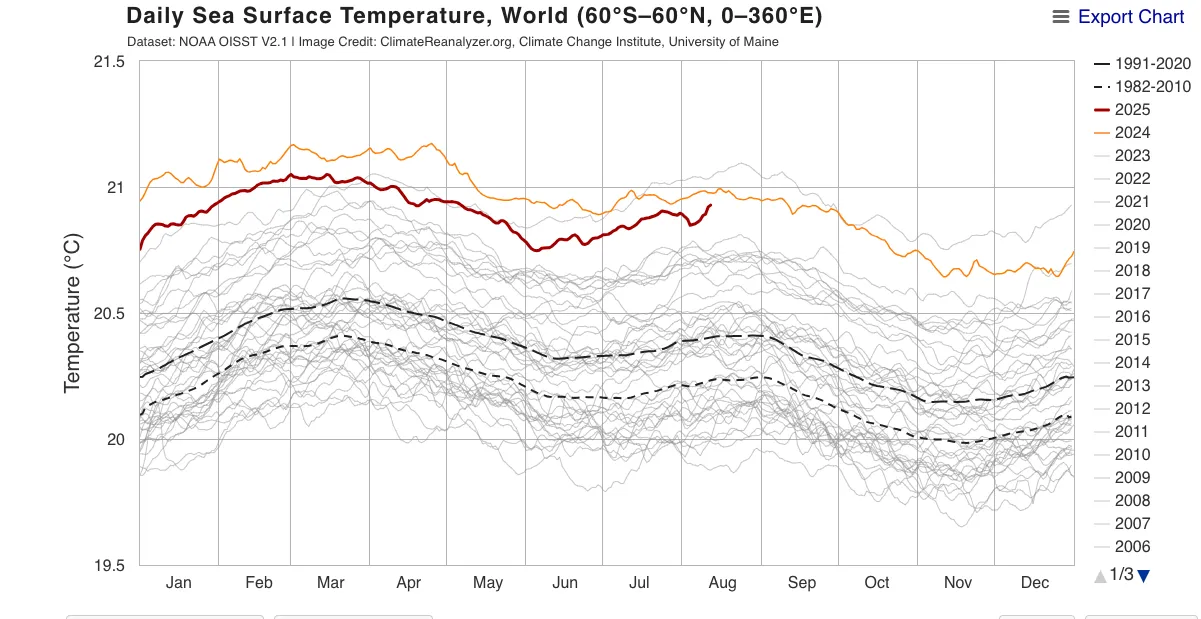
Two summers ago climatologists greeted data showing a big surge in ocean surface temperature with curiosity and trepidation. Was this a new paradigm? Or just the temporary impact of a particularly strong El Niño, the warming phase of a recurring warming-cooling cycle? Would the temperature return to its more gradual annual rise or was this leap an omen of the new normal? We still don’t know because although the evidence of an emerging La Niña is stronger than ever, it’s not quite here yet.
What has arrived, which I’ve written about here and here is the Department of Energy’s deceptive “A Critical Review of Impacts of Greenhouse Gas Emissions on the U.S. Climate.“ The message in the review written by five of the most notorious climate science “skeptics” will now be broadcast far and wide with federal imprimatur.
That’s a bloody shame because it will confirm some people’s bias while bringing doubt to others. The whole effort is an anti-scientific endeavor driven by greed, fueled by willful, perilous ignorance, and funded by the same interests that for decades funded climate lies to holding at bay serious action to address it. Yes, this science denial has gotten pushback, and fewer people have accepted the propaganda over time, but repeated lies can become truth, as Goebbels well knew. Countering the lies means repeating the facts repeatedly, too, even though we know that many people are unmoved by facts these days.
That doesn’t make them useless. UK climatologist John Kennedy, with a résumé of impressive length and relevant credentials, is one of the roster of scientists who have reiterated climate facts and vivisected the DOE’s critical review. “The whole thing is a step up from a blog post, but not a big one,” he said.
No excerpt can possibly do justice to his Kennedy’s critique. But here’s a bit to whet your mental tastebuds:
The exclusion of relevant information [in the DOE review] is, in some sense, inevitable; one can’t quote the whole of the IPCC but the selective quoting of IPCC is a widely used tactic by sceptics, because it serves two purposes. First, they can say “look we’re using the most authoritative report13 there is, so you can’t get mad” and, second, with some mental gymnastics, they can pretend the great truth they are sharing has been hidden from you somehow14 e.g. “What the media’s not telling you about the IPCC report“. Roy Spencer, one of the authors, has made this point on one of several blog posts on the topic – “maybe they should look at what we actually wrote, and the “consensus” sources we relied upon.” The word “consensus” being in quotes is pulling attention away from the much more contentious phrase “relied upon”. In what sense do they rely on these sources? They don’t. In fact, they want their readers to dismiss the IPCC and the (recently disappeared) National Climate Assessment reports as unreliable. What they rely upon (once again) is the reader’s credulity and willingness to take their word that they’ve told not just the truth but the whole truth. Is that all the IPCC says? Hell no. [...]
This is thin stuff. What this report adds up to is, at best, something like a minority report (without a majority report), as long as we are very clear that the minority is absolutely tiny (5 authors vs several hundreds for something like IPCC and many thousands for climate science at large) and that the report lacks coherence, a meaningful body of evidence, rigour, and intellectual depth. In short, it feels like another big old waste of time.
Kennedy goes deep and long without getting too technical, and he created useful charts to accompany his critique. These show that no matter what bogus denial the DOE’s critical review asserts, the Earth is warming and faster than we once thought. Below are three of Kennedy’s charts showing us, once again, where things are headed.


Tick, tick, tick.
—Meteor Blades
RESOURCES & ACTION
Freedom of Voice: The Newcomer’s Guide to Organizing A Peaceful and Effective Protest. Are you ready to organize your first event on behalf of the planet?
GREEN BRIEFS
The Amazon Rainforest Approaches a Point of No Return
For the past dozen years, the folks running the Yale Environment 360 Film Contest have annually honored the best environmental documentaries from a horde of entries. The idea is to recognize work that in our fragmented and corporate-dominated media ecosystem don’t usually get widely seen. Chosen by Pulitzer Prize-winning author Elizabeth Kolbert, Academy Award-winning documentary filmmaker Thomas Lennon, and e360’s editor-in-chief Roger Cohn, 2025’s winning films came from 613 entries from more than 80 countries.
The third-place winner was “Amazon Tipping Point.” Last summer, Brazilian filmmakers Fernanda Ligabue, Jacqueline Lisboa, and Solange Azevedo filmed aerial views of eastern Matto Grosso, which is tucked up against Bolivia, showing where the forest has been burned to make way for agriculture. They interviewed scientists who study how the forest is dealing with the situation. The still shot below is from the 17-minute film, which you can click here to view in full.


Cohn writes:
Under increasing threats from rampant deforestation and climate change, portions of the Amazon now emit more carbon to the atmosphere than they absorb. The southern Amazon, in particular, has become hotter and drier, with less soil moisture, lowered water tables, and a higher than normal rate of tree mortality. Scientists now believe the Amazon could reach its tipping point — when it loses its natural ability to regenerate and will become permanently degraded — as soon as 2050. The impacts will reverberate globally.
—MB
Why can’t we have nice, speedy passenger trains?
The United States boasts the world’s largest rail network. But since the late 1940s, passenger rail service, intercity in particular, has dwindled to a tiny fraction of what it used to be. What remains is government subsidized, yet tickets are still not cheap, and customer service gets mixed reviews. Cross-country trips on Amtrak are plagued with late arrivals and are incredibly expensive.
And slow. The 2,450-mile run from New York City to Los Angeles is meant to be a 70-hour trip. Layovers can extend that. The longest trip served by bullet train in China is the 3,100-mile run from Guangzhou in Guangdong Province to Lhasa in Tibet. It takes 53 hours. Layovers and other delays are rare.
China now has nearly 30,000 miles of bullet train routes, all built in the past 17 years. Most of trains on these routes are designed to run at 217 miles per hour. The fastest operating bullet train in China is the one running from Shanghai to its international airport at 268 mph using licensed German magnetic levitation technology. At the 17th Modern Railways Exhibition in Beijing last month, the China Railway Rolling Stock Corporation presented a new 373-mph maglev model. It deploys rubber wheels up to 93 mph, then transitions to magnetic levitation. That is likely to be deployed long before the operational date for Japan’s similarly speedy maglev train from Tokyo to Nagoya in 2034,
The closest the United States has to a bullet train is the Amtrak Acela run from Washington, D.C. to Boston, rated at 160 mph. David Alf writes about NextGen Acela trains here. There is also Brightline, which runs from Orlando and Miami at the lowest speed still considered “high speed" — 125 mph. They call it privately developed, but the investors got a $33 million federal grant and the contribution of a railway easement already owned by the state.
At Vox, Jonquilyn Hill delves into The curse of America’s high-speed rail. The U.S. struggles to get passenger rail projects that run anywhere near the 200-mph trains of China, Japan, and some European countries. Currently, the highest speed for a bullet train under development in the United States is the Cascadia from Vanocouver, B.C., to Portland, Oregon, at 250 mph. It’s waiting for government funding. Also looking for funding or additional funding is a line from Dallas to Houston, Las Vegas to Rancho Cucamonga, and California with its notoriously over-budget bullet train project from Los Angeles to San Francisco.
Many critics dismiss much of what gets built in China, including infrastructure, as “tofu.” Meaning shoddy construction contributes to early decay and collapse. How true that may be for other matters in authoritarian China, it’s not the case for bullet trains. The Economist has repeatedly complained that China has built too much high-speed rail, and routes to remote areas of the country is a “waste.” That perspective is the opposite of the views of the nation’s Chinese Communist Party leaders. They see ultra-high-speed passenger rail replacing a chunk of aviation travel in the not-so-distant future to all parts of the country. Another green step ahead.
Want to take a curated trip in 2nd Class on a Chinese bullet train? Here you go.
—MB
U.S. CARBON EMISSIONS RISE; CHINA’S FALL
According to Carbon Monitor, China's carbon dioxide emissions fell 2.7% in the first six months of 2025 and U.S. emissions increased 4.2%. Whether this reversal of what’s been happening in the past marks a trend is not yet evident as it’s unclear at this point how much weather, battling over tariffs, and other short-term factors influenced the tally.
Certainly, one factor is China’s solar and wind installations. Last year alone, it added three times as much renewable energy capacity as the United States, and Chinese customers bought six times more electric vehicles in 2024 as the Americans did. While the country still burns lots of coal to make electricity — China still accounts for more than half of global coal consumption — some analysts think it’s on the verge of peak carbon emissions. In the first half of 2025, its coal use fell 2.6% while its electricity generation capacity increased by 5%.
In the United States, on the other hand, as Benjamin Storrow at Climatewire writes, soaring electricity demand and high natural gas prices “have helped revive America's ailing coal sector.” At the the same time, the Trump regime makes total war on renewables.
—MB
RESEARCH & STUDIES
- How bad are micro- and nanoplastics for our health? It depends on their concentrations and how we measure them. Published in Nature Reviews Bioengineering.
- Rapa Nui's iconic moai statues threatened by sea level rise. Study says that by 2080, rising sea levels could cause seasonal waves to reach Ahu Tongariki, the iconic ceremonial platform that is part of the Rapa Nui National Park, a UNESCO world heritage site. Published in the Journal of Cultural Heritage.
- Surprisingly diverse innovations can lead to dramatically cheaper solar panels The cost of solar panels has dropped by more than 99% since the 1970s, enabling widespread adoption of photovoltaic systems that convert sunlight into electricity. This new MIT study drills down on specific innovations that enabled such dramatic cost reductions, revealing that technical advances across a web of diverse research efforts and industries played a pivotal role. Published in PLOS ONE.
HALF A DOZEN OTHER THINGS TO READ (OR LISTEN TO)


Tribal nations scramble to save clean energy projects as federal support vanishes by Miacel Spotted Elk at Grist. Cody Two Bear, who is Standing Rock Sioux, served on his tribal council during the Dakota Access pipeline protests in 2017. Growing up in a community powered by coal, the experience was transformative. “I’ve seen the energy extraction that has placed a toll significantly on tribal nations when it comes to land, animals, water, and sacred sites,” said Two Bear. “Understanding more about that energy, I started to look into my own tribe as a whole.” In 2018, Two Bear founded Indigenize Energy, a nonprofit organization that works with tribes to pursue energy sovereignty and economic development by kickstarting clean energy projects. Last year, with nearly $136 million in federal funding through Solar for All, a program administered by the Environmental Protection Agency, the nonprofit launched the Tribal Renewable Energy Coalition, which aims to build solar projects with 14 tribal nations in the Northern Plains. But when Donald Trump took office in January, those projects hit a wall: The Trump administration froze Solar for All’s funding. That temporarily left the coalition and its members earlier this year without access to their entitled grant (it was later released in March). However, the EPA is considering ending the program entirely. The coalition is back on track with its solar plans, but now tribes and organizations, like the ones Two Bear works with, are bracing for new changes.
Trump's Trade War With China Threatens These Key Green Technologies by Coco Lui at Bloomberg Green. Even with a pause on a hike in US-China tariffs extended to early November, businesses on both sides of the Pacific Ocean are holding their breath. Donald Trump’s reciprocal tariffs, if imposed, would bleed Chinese exporters. They would also deal a fresh blow to an already troubled US climate tech industry, experts say. America’s battery installers and developers stand to lose the most, says Antoine Vagneur-Jones, head of trade and supply chains at BloombergNEF. China dominates the export of lithium-ion batteries and battery materials to the US, and supply chains can’t be quickly altered to change that.
Tesla Launches 515-Mile Model 3 in China by Zachary Shahan at CleanTechnica. China is different, and that is definitely the case with electric vehicles. China gets new EVs and new EV tech first, and sometimes it’s the only market that gets it. That’s even been the case with Tesla in the past several years, despite being an American company. Now we’ve got another example of that. Tesla has launched a new Model 3 option in China that has 830 km (about 515 miles) of range on a full charge. For comparison, the longest-range Model 3 in the US has only 363 miles (584 km) of range on a full charge, at a price of $35,000. Of course, that new 830 km range is based on the CLTC rating system, which is a bit more generous than the US EPA rating system. Still … that’s up from a range rating of 713 kilometers (443 miles) before July 1 and a range rating of 753 kilometers (468 miles) since July 1 (before this new trim’s release).
RELATED: Tesla Brand Loyalty Drops An Unprecedented Degree In USA
Ford’s Model T Moment Isn’t About the Car by Andrew Moseman at Heatmap News. In 2027, Ford says, it will deliver a $30,000 mid-size all-electric truck. That alone would be a breakthrough in a segment where EVs have struggled against high costs and lagging interest from buyers. But the company’s big announcement on Monday isn’t (just) about the truck. The promised pickup is part of Ford’s big plan that it has pegged as a “Model T moment” for electric vehicles. The Detroit giant says it is about to reimagine the entire way it builds EVs to cut costs, turn around its struggling EV division, and truly compete with the likes of Tesla. What lies beneath the new affordable truck — which will revive the retro name Ford Ranchero, if rumors are true — is a new setup called the Ford Universal EV Platform. When car companies talk about a platform, they mean the automotive guts that can be shared between various models, a strategy that cuts costs compared to building everything from scratch for each vehicle. Tesla’s Model 3 and Model Y ride on the same platform, the latter being essentially a taller version of the former. Ford’s rival, General Motors, created the Ultium platform that has allowed it to build better and more affordable EVs like the Chevy Equinox and the upcoming revival of the Bolt. In Ford’s case, it says a truck, a van, a three-row SUV, and a small crossover can share the modular platform.


Trump administration cancels solar grants for low-income communities, including Vermont by Austyn Gaffney at VTdigger. The federal government killed a program that was designed to reduce the cost of electricity for low-income Vermonters by installing millions of dollars worth of solar energy across the state. The state is set to lose $62.5 million in grant funding, according to a letter received by the state on Thursday evening from the Environmental Protection Agency. That grant was part of a $7 billion national initiative called Solar for All, introduced by U.S. Sen. Bernie Sanders, I-VT, as part of the 2022 Inflation Reduction Act. The program intended to pass on solar benefits to more than 900,000 households in low-income and disadvantaged communities across the country. Approximately 60 grant recipients, including 49 states and six Native American tribes, are affected. “The Department of Public Service, with the full support of Gov. Scott’s team, is working with our affected colleagues nationally, as well as the Vermont Attorney General’s Office, to pursue every opportunity including litigation to restore funding to this critical program,” Kerrick Johnson, commissioner of Vermont’s Public Service Department that received the grant, wrote in an email. “That work has just begun and so much more to come.”
Wolves’ continued spread in California brings joy, controversy & conflicts by Spoorthy Raman at Mongabay. California’s wolves, which naturally dispersed south from Oregon, are now further expanding their territories, with more frequent encounters — and conflict — with humans. “Almost every pack does overlap to some degree with an agricultural area with livestock,” said Axel Hunnicutt, a biologist who coordinates the wolf program for the California Department of Fish and Wildlife (CDFW). Almost every group has killed livestock. “That’s one thing that unites all of the packs in California, unfortunately,” he added. While conservationists hail the wolves’ return, ranchers are already losing livestock. Some residents, unaccustomed to living with the canids for nearly a century, worry about their safety. How wolves will change the ecosystem, where they’ll settle, how well they’ll survive and how they’ll coexist with people remains to be seen. “We’re at the beginning of this really exciting recovery … so there’s a lot of unknowns,” said Kaggie Orrick , director of the California Wolf Project at the University of California, Berkeley.
WEEKLY BLUESKY SKEET

ECOPINION


Stop saying "the clean energy revolution is inevitable." A little rant on a pet peeve. By Emily Atkin at Heated. The headline is hyperbolic; do what you want. But after my conversation with Bill McKibben last week, I’ve realized I’m not a big fan of the oft-repeated talking point: “The renewable energy revolution is inevitable/unstoppable.” The phrase has been everywhere since Trump’s re-election. It’s headlined news articles, press releases, and academic papers. Last month, U.N. Secretary-General António Guterres delivered an address alongside a new report on the growth of clean energy, focusing on the theme. “The clean energy future is no longer a promise. It’s a fact,” he said. “No government. No industry. No special interest can stop it.” There’s a good reason for the statement’s growing popularity: It’s technically true! Renewables—solar, wind, hydro, bioenergy and geothermal—have become astonishingly cheap in the last few years, and batteries to store renewable energy are getting amazing. [...] But the statement is also incomplete, so much so that it almost dips into paltering. Because while it’s true that special interests cannot stop the world’s shift toward renewable energy, they can significantly slow it. In fact, special interests in the United States are currently slowing the renewable energy transition to such a degree that, by time the world has largely weaned itself off fossil fuels, unthinkable and irreversible climate catastrophes will have already occurred.


We Need a Food Bill of Rights by Tambra Raye Stevenson at Civil Eats. Despite the fact that Oklahoma consistently ranks among the top 10 states for food insecurity, the political will to invest in equitable food systems is on life support. While Oklahoma lawmakers have enacted stricter regulations and oversight for the cannabis industry in recent years, they have not shown the same urgency or coordinated investment when it comes to strengthening the state’s food system. For example, for every food-related legislative bill, there are five for cannabis. By contrast, in my current home of Washington, D.C. — a 68-square-mile district without vast swaths of farmland or a state department of agriculture — only 10.6 percent of District residents face food insecurity. In D.C., food justice has a seat at the policy table through ever-growing, supportive infrastructure, including the D.C. Food Policy Council, which adopted the “right to food” as a policy priority around 2022. [...] Oklahoma and D.C. offer a tale of two plates: one undernourished by misguided politics but piled high with possibility, the other well fed through civic engagement and equitable governance (though there is, of course, room for improvement). The difference between the two isn’t land or resources—it’s participation, the heart of democracy. I believe we need to equalize these two plates by pushing for food democracy in places where it has eroded.
Saving FEMA. Actual natural disasters might provide a reprieve for the broken agency. By Gabrielle Gurley at The American Prospect. President Trump previously said that he wants to see FEMA dismantled by the end of the year, and that the states have to develop an “appetite to own the problem” of handling responses to natural disasters. But even that view has shifted perceptibly in the wake of an actual disaster, and the finger-pointing that followed, amid the realization that more lives could have been saved with the appropriate expenditures. It wasn’t a gargantuan hurricane that prompted this sudden realization, but a tragedy in a staunchly Republican state. The Central Texas floods woke up the administration to the reality of disaster response in the flood-prone region known as Flash Flood Alley. Kerr County had repeatedly failed to improve its warning systems: One request for FEMA funds for the warning system, which had to go through state officials, was turned down. But the state had to rely on FEMA to help coordinate recovery centers and funding, including the new $750 Serious Needs Assistance payments to individuals that were implemented in 2024. (Other conventional FEMA disaster services lapsed due to lack of coordination and new measures implemented by Trump officials.) In the wake of this disaster, FEMA has had something like a reprieve. Shortly after floods hit, Department of Homeland Security Secretary Kristi Noem said that “this entire agency needs to be eliminated as it exists today, and remade into a responsive agency.” But “remade” is better than “dismantled.”


The EPA Is Abandoning the 10 Commandments of Climate Policy by Rabbi Jennie Rosenn at Common Dreams. The Environmental Protection Agency’s decision last month to repeal the Endangerment Finding is like tossing out the 10 Commandments. That might sound hyperbolic. But sadly, it isn’t. After months of relentless anti-environmental regulatory efforts at the EPA, Administrator Lee Zeldin is now tearing out the foundation of our country’s climate regulatory framework. Known as the “Endangerment Finding,” this 2009 document is the scientific basis for regulating greenhouse gas emissions. By abrogating that finding, Zeldin and the EPA are essentially stripping away our government’s ability to regulate the emissions that are heating our planet. It is not only a profoundly misguided decision, it is one aimed at destroying the legal framework our country has developed to drive a coherent climate policy. Interestingly, back when he was a congressman, Administrator Zeldin supported some climate regulations. At Dayenu, the leading Jewish climate organization that I direct, we had actually hoped that the first Jewish head of the EPA might honor the most basic of Jewish values—like pikuach nefesh (saving a life)—and pursue environmental policies that support a more livable future in the face of a fast accelerating climate crisis. Instead, Administrator Zeldin has embarked on an almost unconceivable path.


50 Years Later: The Vietnam War’s Enduring Effect on the Tiger Trade by Rob Pickles at The Revelator. War’s impact often ripples far beyond the battlefield — setting off a chain of consequences that shape landscapes, cultures, and economies in ways no one could predict. As we mark the 50th anniversary of the end of the Vietnam War, we must recognize that its aftershocks are still playing out in some of the most unexpected ways. In Southeast Asia, the Vietnam War unleashed just such an effect, influencing the illegal tiger trade that today spans Vietnam, Malaysia, and beyond. What began as wartime survival and cultural resilience has, over time, fed a cross-border black market in tiger parts — one that these countries are now working to dismantle. Against that vast backdrop of lost lives, shattered communities, and devastated landscapes, focusing on something like the illegal tiger trade might seem oddly narrow, even trivial. And yet, that narrow focus reveals a surprising truth: what many might assume is a free-standing wildlife trafficking problem is intricately woven into the broader social, economic, and cultural histories of Vietnam and Malaysia.
RELATED:
- 4 laws that could stymie the Trump EPA’s plan to rescind the endangerment finding that underpins US climate policies at The Conversation
- Who Are the Climate Deniers Fighting the Endangerment Finding? at DeSmog
OTHER GREEN STUFF
Offshore wind leasing is officially dead under Trump • Two years after a wildfire took everything, Maui homeowners are facing a new threat: Foreclosure • L.A. has a plan to stop copper thieves: Solar-powered streetlights • World Elephant Day: Stories of conservation progress












Comments
We want Uncharted Blue to be a welcoming and progressive space.
Before commenting, make sure you've read our Community Guidelines.