
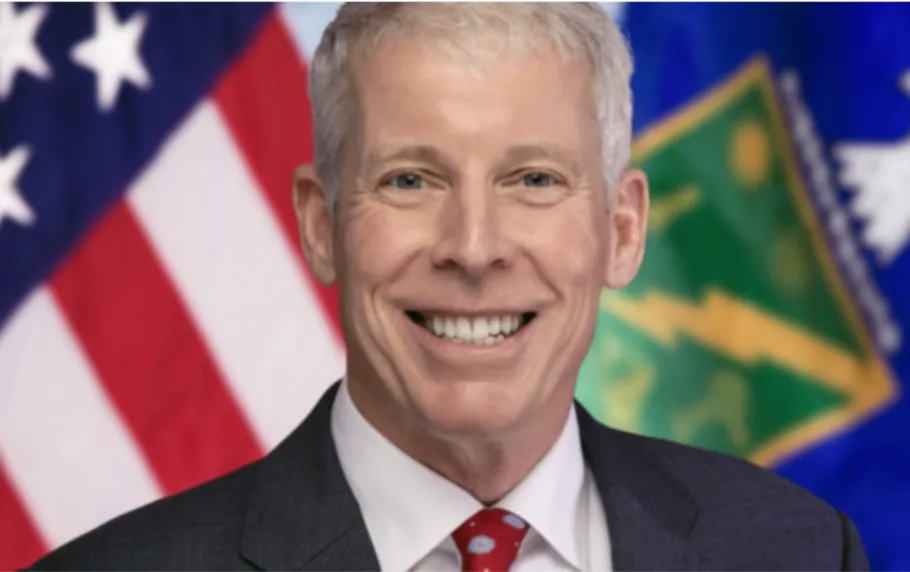
“I’m going to suggest you might, five years from now, give President Trump the hero of the climate award, because in the Trump administration, you will see more downward movement in greenhouse gas emissions globally and in the United States than any other leader in history.” —U.S. Energy Secretary Chris Wright, at a New York Times Climate Week event Wednesday
A golden award, no doubt, to match the numerous Nobel Peace Prize medals Trump will have received by five years from now along with the Nobel for Economics he’ll get for making tariffs great again. I’m not really a gambling man, but I’ll wager Wright $100 and give him 5:1 odds that no such climate prize will be awarded Trump unless the American Petroleum Institute funds and presents it.
You may have been so horrified and embarrassed and infuriated by the other gawdawful parts of the speech with which Trump hogged three other speakers’ time at the United Nations Tuesday that you missed the 10 minutes spent on climate. In case that’s so, know that Wright’s remark was a follow-up to the president’s saying the “‘carbon footprint’ is a hoax made up by people with evil intentions, and they’re heading down a path of total destruction.” Quite the performance. I wrote about that here if you can stomach it.
Given his history, Wright’s hero remark is scarcely a surprise. After all, in what seemed like an audition for a stand-up comedy act back in March, he said, “The Trump administration intends to be much more scientific and mathematically literate.” And it wouldn’t be a surprise if the first time the idea for such an award came into the secretary’s possession it was delivered oh-so-modestly from Trump’s lips.
Wright asserts he’s not a climate science denier and in practically the same breath says there is no climate crisis. He says he’s a “climate realist,” which persuaded 10 Senate Democrats to vote to confirm his seat on the Cabinet. He agrees the planet is being warmed by carbon emissions but shrugs this off as the “trade-off” from modernizing. He’s adopted one of the climate crisis deniers’ keystone fallback positions — that more carbon dioxide in the atmosphere is a good thing, spurring the growth of more greenery. That’s a stance Emily Atkins at Heated demolished. As did this: Plants Are Losing Their Ability to Absorb Carbon Dioxide as Emissions Rise.
You’re a denier if you claim to accept the science but then claim there’s no crisis. Because that’s not what the data scientists are collecting shows.
At events and a press conference Wednesday, Wright also stood up for the heavily criticized Department of Energy climate assessment produced by the Climate Working Group, his handpicked gang of five notorious climate “skeptics.”
Wright said, “There is no disagreement with what's in the report. It's just either changing the topic to models of what the future might bring. If the data and what we've said is wrong — as I read in countless newspaper articles, it's discredited data — what in the climate report is wrong?” He blew off criticisms as the complaints of “activists,” noting that “A lot of foot stomping and anger has been a response to that report.”
Lots of justified anger, it should be noted. And his jab at activists is typical sneer. In fact, a long roster of scientists gave the report a masterful whupping. The CWG has also been disbanded, though the report has not been withdrawn. Zack Colman at Climatewire reports:
The National Academies of Sciences, Engineering and Medicine said in its assessment last week that the DOE report’s overall conclusion was incorrect. While the DOE effort downplayed the role that rising emissions have in exacerbating weather extremes — even going as far to portray benefits as underrepresented — the 135-page National Academies’ findings “confirm unequivocally” every ton of greenhouse gas emissions threaten human health and welfare in the U.S.
Dozens of academics slammed the DOE report in a 453-page comment, offering a point-by-point rebuttal documenting misconceptions, misuse and misinterpretations of climate research and data. The American Meteorological Society, a professional organization for atmospheric scientists, accused the working group of violating basic scientific principles.
If Wright isn’t secretly smirking when he talks about climate “hero” Trump — who has abandoned calling climate change a “Chinese hoax” in favor of the simplified “hoax” — then the only possibilities are he’s delusional, super greedy, or thoroughly sycophantic.
Climate realism? Trade-offs? There’s nothing realistic about policies that eliminate support for renewables while paving the path for even more extraction and burning of fossil fuels than the record-breaking level we’re at already. Well, there is the realism that fossil fuels already kill 7-8 million people a year globally. As the planet overheats, they will kill a lot more. Nothing heroic about that. Notice how the supposedly mathematically savvy regime ignores that count. The industry Wright has been so much a part of for 30 years is determined to keep the profits flowing until the emissions from every last molecule of hydrocarbons on the planet have been added to the atmosphere. There will be a gargantuan trade-off from that.
—MB
GREEN BRIEFS
OCEAN ACIDIFICATION CROSSES PLANETARY BOUNDARY
Back in 2009 researchers published the first report on exceeding the boundaries of Earth’s “safe operating space.” In 2015, there was an update. They concluded that the Earth had crossed the line beyond safety on at least four of nine boundaries—climate change, land use, biodiversity, and nutrient flows. Two years ago, the researchers published an even more disturbing update assessing the planet’s health—Earth beyond six of nine planetary boundaries—in which they added fresh water and forests to the list.
In a new report released this week, scientists say a seventh boundary has been crossed, ocean acidification. This chemically breaks down calcium carbonate, which shell-forming species — including everything from plankton to coral — depend on. But it’s not only those species that suffer. The whole food chain is at risk.
As Matt Simon writes at Grist, “Think of a planetary boundary as a warning sign on a road. At the end of the road is a cliff, representing a tipping point, in which an Earth system dramatically changes, often irreversibly.”
Said Levke Caesar, co-lead of the Planetary Boundaries Science Lab at the Potsdam Institute for Climate Impact Research and a co-author of the latest report: “What this health check again and again shows is that we have one interlinked, interconnected Earth system. It actually would be fatal if we just concentrate on climate change, because, as we see, there are six other boundaries that have been transgressed. And we’re actually also increasing the pressure on all of these seven boundaries.”
Since the 1960s, and especially since the 1980s, we humans have been treated to countless wake-up calls. Yet all too many politicians remain determined to sedate us as they continue business as usual sprinkled with greenwashing.
—MB
See also:
- Ocean acidification threatens planetary health: Interview with Johan Rockström
- World’s oceans fail key health check as acidity crosses critical threshold for marine life
REVOLUTION WIND PROJECT HALTED BY TRUMP RESTARTED BY JUDGE


The Danish company Ørsted and partner Skyborn Renewables were just a few months from completing Revolution Wind when the Trump regime forced a work stoppage in August, claiming the company had failed to meet national defense concerns. On Monday, a federal district Judge overruled the order, telling government lawyers that “mandating the immediate pause of construction of a project whose approval the Bureau continues to defend in other cases is the height of arbitrary and capricious.” A senior regime spokesperson said the ruling won’t be the last word, hinting at an appeal.
When operational, the $6.2 billion, 704-megawatt wind farm 15 miles off the coast of Rhode Island would be capable on the best days of generating enough electricity to power 350,000 average households. Ørsted announced it will restart construction “as soon as possible.” At what the company estimated was $2.3 million in daily losses over the month-long shutdown, it took a $70 million hit. If the project were canceled altogether, the loss would be an estimated $1 billion. And it would play havoc with Rhode Island’s efforts to decarbonize.
Like many of his other wars, Trump’s war on renewable energy is erratic. While he’s ranted about wind turbines as if he were a 3-year-old squawking about the spinach, he’s accepted wind farm construction in offshore Virginia after House Speaker Mike Johnson pushed for it and offshore in New York after making a deal with Gov. Kathy Hochul. But other wind projects are still at risk. As Clare Fieseler reports, 12 lawsuits have been filed contesting Biden-era approvals for eight U.S. wind farms.
—MB
See also:
- Revolution Wind to resume construction after judge grants injunction
- Orsted Court Win Against Trump Lifts Wind Farm Maker's Shares
HALF A DOZEN OTHER THINGS TO READ (OR LISTEN TO)


The Uruguay Way: Achieving Energy Sovereignty in the Developing World by Sam Markert at Earth.org. Generating 98% of its electricity from renewable sources, Uruguay’s rapid adoption and expansion of sustainable sources of energy has been lauded internationally as a model for transitioning national power systems away from fossil fuels. Avoiding nuclear power entirely, Uruguay first embraced wind turbines as a source of cheap, reliable power; providing 40% of the country’s capacity in less than a decade. It then expanded its solar and biomass capacity to an almost fully decarbonized mix of energy sources, joining a very short list of high-income countries producing over 90% of their energy needs with low-carbon sources — including Iceland, Sweden, and France. Once a net importer of energy, Uruguay now exports its surplus energy to neighbouring Brazil and Argentina. In less than two decades, Uruguay broke free of its dependence on oil imports and carbon emitting power generation, transitioning to renewable energy that is owned by the state but with infrastructure paid for by private investment. Can such a feat be replicated elsewhere? Ramón Mendéz Galain believes so.
Nicholas Spada Spent Months Analyzing Smoke From the LA Fires. He Thinks People Have a Right to Know, and ‘Air Is Everything’ by Nina Dietz at Inside Climate News. Spada, a trim, energetic man with a close-trimmed beard and reddish hair, is a project scientist at UC Davis’ Air Quality Research Center. He is one of only a handful of scientists in the world proficient at using a nuclear method for detecting toxic substances in air particles to understand their impact on human health and the environment. Spada uses protons to peer at nanoparticles, one one-hundredth the size of a human hair. It might be hard to believe that something that small could hurt you, but in fact air pollution is four to five times more dangerous when it’s minuscule. At that size, particles can easily make their way deep inside the human body, penetrating into the cells of vital organs, such as the heart, lungs and even the brain. Since the fires in Los Angeles, Spada has made it his mission to determine just how much of an exposure hit Angelenos took in January. He’s concentrating both on aerosolized toxic substances—such as lead paint, weatherproofed items coated in PFAS “forever chemicals” and lithium batteries—whose particles are toxic no matter their size, and from nanoparticles, innately dangerous due to their size and readily formed in the extreme temperatures of wildfires.


The dismantling of the Forest Service by Jonathan Thompson at High Country News. The Forest Service has gone through various metamorphoses, shifting from stewarding and conserving forests for the future to supplying the growing nation with lumber to managing forests for multiple uses and then to the ecosystem management era, which began in the 1990s. Throughout all these shifts, however, it has largely stayed true to its first leader, Gifford Pinchot, and his desire to conserve forests and their resources for future generations. But now, the Trump administration is eager to begin a new era for the agency and its public lands, with a distinctively un-Pinchot-esque structure and a mission that maximizes resource production and extraction while dismantling the administrative state and its role as environmental protector. Over the last nine months, the administration has issued executive orders calling for expanded timber production and rescinding the 2001 Roadless Rule, declared “emergency” situations that enable it to bypass regulations on nearly 60% of the public’s forests, and proposed slashing the agency’s operations budget by 34%.
How Denmark Plans to Roll Out the World’s First Cow Burp Tax by Emma Court at Bloomberg Green. Denmark has created a plan to implement the world’s first livestock emissions tax. One of its main prongs: Helping farmers avoid it. Jeppe Bruus, Denmark’s minister for green transition, said his government is investing billions of kroner into technology that will help farmers reduce or offset their emissions, lowering what they have to pay. Solutions could include feed additives and pesticide alternatives. “The whole idea about the emission tax is obviously that it should not create any revenue,” Bruus said in an interview during Climate Week NYC, as part of a Partnerships for the Future event organized by Denmark’s consulate general. “The whole idea is that they shouldn’t pay the tax because they’re not polluting.” Last year, Denmark became one of the first countries to propose this kind of tax targeting livestock, a major source of planet-warming emissions.


What Native-held lands in California can teach about resilience and the future of wildfire by Nina Fontana and Beth Rose Middleton Manning at The Conversation. It took decades, stacks of legal paperwork and countless phone calls, but, in the spring of 2025, a California Chuckchansi Native American woman and her daughter walked onto a 5-acre parcel of land, shaded by oaks and pines, for the first time. This land near the foothills of the Sierra National Forest is part of an unusual category of land that has been largely left alone for more than a century. The parcel, like roughly 400 other parcels across the state totaling 16,000 acres in area, is held in trust by the federal government for the benefit of specific Indigenous people — such as a family member of the woman visiting the land with her daughter. Largely inaccessible for more than a century, and therefore so far of little actual benefit to those it is meant for, this land provides an opportunity for Indigenous people to not only have recognized land rights but also to care for their land in traditional ways that could help reduce the threat of intensifying wildfires as part of a changing climate. In collaboration with families who have long been connected to this land, our research team at the University of California, Davis is working to clarify ownership records, document ecological conditions and share information to help allottees access and use their allotments. (The authors are, respectively, a researcher and a professor of Native American Studies at UC Davis.)
Minority of nations deliver new climate targets ahead of climate summit by Louise Osborne at Deutsche Welle. With less than two months to go before the start of the international COP 30 climate summit, taking place in Belem, Brazil, only 47 countries had delivered their climate goals by time of publication — representing just 24% of global emissions. The world's biggest emitter, China, produces around a third of all greenhouse gas emissions and is under pressure to set an ambitious domestic reduction target. However, its pledge to cut emissions by 7-10% from peak is both "underwhelming and transformative," Andreas Sieber, associate director of policies and campaigns at climate group 350.org, said in a statement. He added that the reduction "falls short of what the world needs" but noted that it "anchors the world’s largest emitter on a path where clean-tech defines economic leadership." Donald Trump began the withdrawal process from the Paris Agreement for the second time as soon as he became president in January, essentially voiding the U.S. commitment. In a recent report, experts said the country had experienced its "most abrupt shift in energy and climate policy in recent memory." The report forecasts that the U.S. is nevertheless still on a path to reduce its greenhouse gases by 26–35% by 2035.
BLUESKY POST


ECOPINION
Democrats Bid to Become the Party of Cheap Energy by Robinson Meyer at HeatMap News. House Democrats introduced a new package of proposals on Wednesday taking aim at rising electricity prices. The move signals a shift in how the party plans to talk about the energy industry — and an even bigger change in how the party plans to talk about climate change in the Trump 2.0 era. After four years in which the party focused on climate change as an existential crisis, Democrats have reoriented to talking about energy chiefly as an affordability problem. The new package, sponsored by Reps. Sean Casten and Mike Levin, would encourage new power line construction and strengthen utility regulation in much of the country. It would also restore longstanding tax credits for wind and solar energy, which were repealed as part of President Trump’s partisan tax and spending law earlier this year. Many of the provisions, although not all of them, were first proposed in a Democratic bill called the Clean Electricity and Transmission Acceleration Act last year. This year, it’s been rechristened to something much simpler: the Cheap Energy Act. “The purpose of the bill is a longtime wish of mine — that we would have an energy policy that puts the interests of American consumers first, by making sure that American consumers have access to cheap, reliable energy,” Rep. Casten said. “We’ve never done that as a country.”
RELATED: Senate Democrats Blame Trump’s Assault on Clean Energy for High Electricity Prices
As China Goes, So Goes the Climate by David Wallace-Wells at The New York Times (gift link). Ten years since the landmark Paris Agreement seemed to promise a whole new era for climate politics, the rich world has mostly abandoned warming as a matter of political concern — and the spirit of global solidarity on which those climate goals were supposedly built. But renewables are storming forward anyway, thanks in large part to the spectacular rise of China as a green-industrial behemoth. By any objective measure, the pace of the global transition remains woefully inadequate. But last year, renewables accounted for 93 percent of global power additions — and as of July, 74 percent of wind and solar projects worldwide were being built by China. This isn’t just a story about climate action, of course, given that one global power now has control over several major sectors often casually described as the industries of the future. “The decarbonization agenda is not simply about reordering markets or industrial policies, but in fact represents the crucible for a new geopolitical order,” as Nils Gilman wrote suggestively this month in Foreign Policy. “The energy transition is likely to become the center of a new eco-ideological Cold War.”
Oil Change International Response to Trump’s U.N General Assembly Speech. In a press statement, Allie Rosenbluth, OCI’s U.S. campaign manager, said: “Trump’s speech at the U.N. General Assembly was a disturbing display of a white nationalist agenda, tying anti-immigrant racism to climate denial, and fossil fuel expansion. Trump pits people against each other to distract from those at the top who profit from tearing families apart and destroying the possibility of a livable future. While floods, fires, and heatwaves devastate our communities, Trump is doubling down on his support for the industries fueling climate chaos. He dismissed renewable energy as a ‘joke’ and a ‘scam,’ and claimed climate change is a ‘hoax,’ while bragging about U.S. fossil fuel production, showing exactly who he stands for: fossil fuel billionaires ready to let the world burn before giving up their profits. Trump and his fossil fuel megadonors are ensuring the U.S. stays stuck in a destructive, expensive energy system that belongs to the past. A new Oil Change International report shows that the U.S. government hands the fossil fuel industry $35 billion every year in subsidies, despite the fact that renewables are now the cheapest source of new energy worldwide.”


The New Nuclear Fever, Debunked by Andrew Nikiforuk at The Tyee. Politicians who push small reactors raise false hopes that splitting atoms can make a real dent in the climate crisis. Unfortunately … claims that nuclear power can provide cheap energy security or reverse the persistent failure of national and global policies to reduce CO2 emissions is an illusion. Even the 2024 World Nuclear Status Industry Report offers a reality check. It reports that apart from new reactors built in China (almost all over budget), “the promise of nuclear” has “never materialized.” It adds that there is no global nuclear renaissance and likely won’t be one. Furthermore, the report pours cold water on the ability of SMRs, a nascent technology, to play any significant role in reducing carbon emissions. That is not to say that nuclear technology won’t play a minor role in our highly problematic energy future. But what nuclear power can’t do is as luminous as a radium dial. Due to its cost and complexity, it will not provide cheap or low-emission electricity in a timeframe or scale that matters as climate change continues to broil an indifferent civilization.
Reclaiming the Udall Legacy: The Meaning of Conservation in Trump’s America by Glen Loveland at The Revelator. The Udall name once meant something in the American West. For anyone anchored in the arc of modern conservation and environmental protection, to say “I worked for Tom Udall” was to evoke a legacy that coursed through some of the nation’s boldest acts: the Alaska Lands Act, the Endangered Species Act, the Wilderness Act, the creation and expansion of our parks and wild places. Yet standing recently in a room at Arizona State University’s Pastor Center for Politics and Public Service, introducing myself as a former press secretary to then-Rep. Tom Udall, I was met with puzzlement. The same when I mentioned Reps. Mo and Stewart Udall: blank faces. The loss is not just one of memory but of a deeper severing from the traditions that once tethered Arizona and the West to the idea that government must be a steward — a protector — of the land and its wild inheritances. This is not an accident of history. It is the product of years of unraveling, a process on full display under the Trump administration’s second term — a litany of reversals, repeals, and budget cuts whose cumulative effect is not merely policy drift but a deliberate retreat from the standards of stewardship once defined by the Udalls and those they inspired.
RESEARCH & STUDIES
A tiny mineral may hold the secret to feeding billions sustainably. Scientists may have found a way to change the fact that rice is one of the most resource-hungry crops on the planet. Researchers at the University of Massachusetts applied nanoscale selenium directly to rice plants and dramatically improved nitrogen efficiency, boosted yields, and made grains more nutritious. This was achieved while reducing fertilizer use and cutting greenhouse gas emissions. Published by Proceedings of the National Academy of Sciences.
Fossil fuel burning poses threat to health of 1.6 billion people. A new interactive map from Climate Trace, a coalition of academics and analysts that tracks pollution and greenhouse gases, shows that soot — PM2.5 — and other toxins are being poured into the air near the homes of about 20% of the world’s population.
The promise and limitations of using GenAI to reduce climate scepticism. Mixed findings underscore the need for “cautious, evidence-based integration of LLMs” into climate communication strategies. Published at Nature Climate Change.
OTHER GREEN STUFF
- Shared blame, shared bill? Joint and several State liability as a proposed legal framework for climate reparations
- Revealed: ‘Chilling’ Surveillance of Activists by Meat and Dairy Industry
- Trump wants a stake in Nevada’s upcoming lithium mine
- Chicago Has Hundreds of Thousands of Toxic Lead Pipes—and Millions of Unspent Dollars to Replace Them
- Without China trade, what’s next for Upper Midwest soybean farmers?
- Electric Trucks Are Rapidly Approaching A Tipping Point — Just Not In The US












Comments
We want Uncharted Blue to be a welcoming and progressive space.
Before commenting, make sure you've read our Community Guidelines.