Just hours after U.S. forces extraordinarily renditioned Nicolás Maduro, our Outlaw Prez declared the 1823 Monroe Doctrine had been “superseded” by what he giddily named the Donroe Doctrine. it was vintage Trump — boastful, glib, historically illiterate, and determined to have his legacy remembered by plastering his name on everything.
It was also something far more dangerous: a candid statement of intent. The United States, he was saying, is done pretending. U.S. hegemony in the Western Hemisphere is no longer covered with humanitarian rhetoric. It is an imperial goal, openly pursued. It’s the kind of thing beloved by my foreign policy professors who, during my years working to get two degrees in Latin American studies, referred to the Caribbean Sea as a “Yankee lake.” (See here.)
Just as with other empires in humanity’s rise, the history of how the U.S. imposed and attempted to impose its will on Latin America is an ugly one, with hundreds of thousands of fatalities. One of the worst impacts of the CIA-engineered 1954 coup, for example, was the (at least) 200,000 Guatemalans killed in the civil war that sprang up as a consequence. One of dozens of bloody interventions, the most lucrative of which was the 1840s war that delivered 60% of what was then Mexico into U.S. hands. But that was a while ago.
The nabbing of Maduro is the clearest expression yet of the new foreign policy “vision” laid out in the Trump regime’s most recent U.S. National Security Strategy, which explicitly re-centers dominance in the Americas as a core national interest. Trump’s smirking satisfaction with the speed and slickness of the Venezuelan operation suggests not restraint but appetite. “We will deny non-Hemispheric competitors the ability to position forces or other threatening capabilities, or to own or control strategically vital assets, in our Hemisphere,” the NSS states.
For the rest of Latin America, Maduro standing handcuffed in the dock like the criminal the White House claims he is delivers the same message as the financial backing to President Milei in Argentina and the prisoner deal with Bukele in El Salvador. Play by the rules and everything will go well for you. If you don’t, things will go very badly. Not the international rules. Trump’s rules. Whatever those happen to be at the moment. He clearly likes being in a position to make offers nobody can refuse.
About now, I suspect, some readers are saying this is all about oil or Trump’s grift or a dog-wagging distraction from the Epstein files. Can we all just agree that there’s more than one motive at work here? Anybody in the White House who knew ahead of time what was coming in Venezuela likely made a killing on oil futures but doesn’t care about alleged narcoterrorists. Secretary of Defense Pete Hegseth loves himself shooting people for its own sake. Secretary of State Marco Rubio probably is smiling about the potential for turning the deaths of 32 Cuban soldiers stationed in Venezuela into a U.S. policy that creates many more dead Cubans if, as Trump has teased, the island is next on the intervention list. Who knows what National Intelligence Director Tulsi Gabbard is thinking. The real fabricators of this shift are not so visible.
The consequences of Maduro’s rendition obviously extend far beyond Caracas and the Caribbean. It’s not meant a one-off. After all, Greenland, which Trump is eager to absorb, which would destroy NATO, is in the Western Hemisphere, too, as is Canada. But it’s not just this hemisphere at risk of Trumpian hubris.
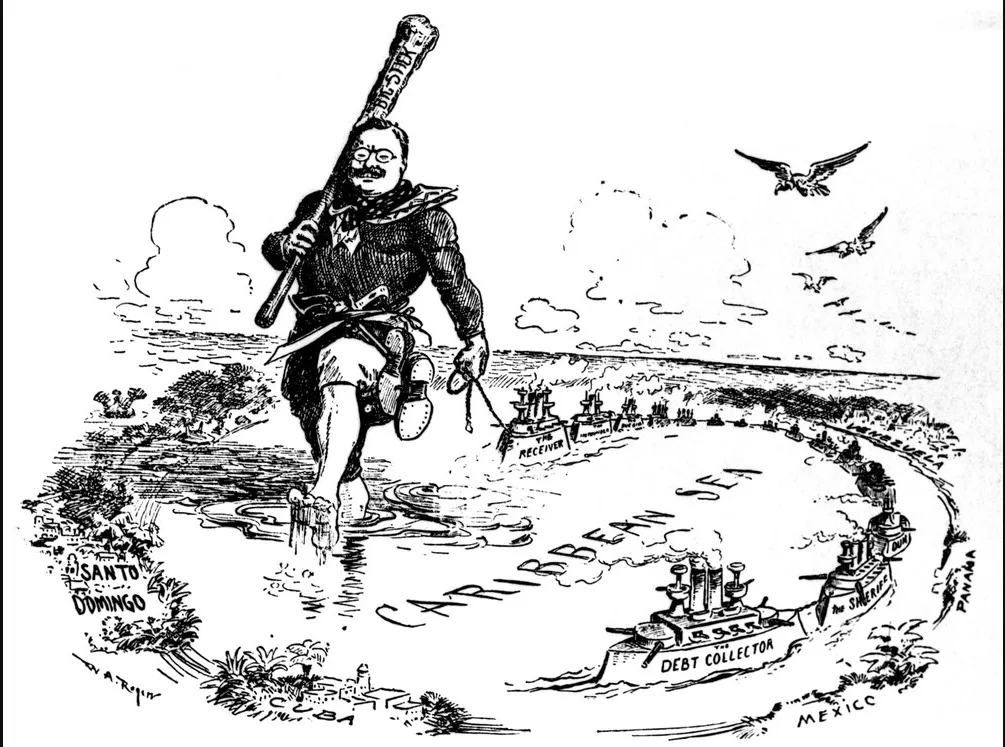
What’s taking shape is not merely a revived Monroe Doctrine (and its 1904 [Theodore] Roosevelt Corollary that laid the foundation for “gunboat diplomacy”). Rather, it’s a 21st Century version of the old spheres of influence — a world tacitly carved up among a few great powers, each granted license to dominate its “neighborhood” in exchange for a brittle form of strategic stability. It was a time when Rudyard Kipling, inventor of the “white man’s burden,” was idealizing and idolizing the imperialism of one of the great powers that divvied up the world — Great Britain.
Forgetting about how Russia and China will feel about the oil situation, the sphere of influence shift in the U.S. approach to the rest of the world could very much mesh with Vladimir Putin’s plans for Ukraine and places further west, as well as Xi Jinping’s plans for Taiwan and the South China Sea. Note: I am not predicting anything here, merely noting the complexities of global interests.
At the end of World War II with its gawdawful toll of death and destruction, the plan, led by the U.S., was to end more carve-ups and conflicts with a new international political order that included firm national boundaries, international cooperation to prevent new or bring peace to existing military conflicts, and economic cooperation as well. It also marked the beginning of the end for most of the colonial accretions the great powers had snatched. We haven’t had 80 years of world peace since then. And U.S. leadership on matters of foreign policy has been, let us say, a bipartisan mixed bag of blessings and curses. It was, after all, a new world order with primacy given to Washington and Washington-controlled institutions. And the new world order didn’t prevent wars in Korea, Vietnam, the Congo, Afghanistan, Nicaragua, Georgia, or … of course, Ukraine. There was, however, no World War III. And cooperation, however defective, expanded.
But all that is a long, long tangent with a plethora of nuances and Cold War distortions far too tangled to explore here. For the moment, here’s Ishaan Tharoor, who recently wrote in a Washington Post op-ed:
Christopher Sabatini, a senior fellow for Latin America at Chatham House, a leading British think tank, described the Trump corollary as “a baldly partisan effort to remake the region” in the guise of Trumpism, offering inducements to leaders who are not just “sympathetic to the U.S., but Trump personally.”
It also marks a departure in spirit and purpose from previous Republican and Democratic administrations. “This isn’t about supporting democracy, free markets, or tying together the region in a network of free trade agreements,” Sabatini told me. “It’s about ownership — very much similar ways to [Russian President Vladimir] Putin views his near abroad.” [...]
Trump’s Latin America policy is a “logical extension of everything MAGA,” Sabatini said, pointing to the ways in which the White House has melded domestic grandstanding over immigration and narco-trafficking with its turn back to the hemisphere, away from the Biden administration’s attempts to focus U.S. strategy on the challenge of China. [...]
One of the ironies of the Donroe Doctrine is that Latin America sees the least amount of terrorism in the world, suggested Jorge Heine, a veteran Chilean diplomat. But the White House is mustering a security argument to reassert a right to dominance in a region that has struggled to recover the economic dynamism of more than a decade ago.
“It’s very legitimate for the U.S. to say we would like to keep our primacy,” Heine told me. “But the way to do that is by competing,” by helping “build better ports, dams and so on” and taking a more proactive stake in the development of Latin America. China, the biggest trading partner of most countries in South America, has done that and even many governments aligned with Trump will not be able to shift away from Chinese influence.
Venezuela as Proof of Concept
The Trump regime has framed the operation against Maduro as a necessary act against narco-terrorism and authoritarian decay. The evidence for that we’ve seen so far is exceedingly sparse. No question that Maduro has presided over an increasingly repressive state, hollowed out democratic institutions, and governed amid staggering corruption and economic collapse. Frankly, with the (so far) exception of economic collapse, that sounds a lot like what Trump has been doing for 11 months.
From the outset, the White House has signaled that it intends to “run” Venezuela temporarily, prioritizing stability and rapid access to oil production over what will surely be an exceedingly messy, Venezuelan-led democratic transition at gunpoint. That posture points toward accommodation with remnants of the old regime and technocratic management from above, rather than serious engagement with the fragmented democratic opposition, labor movements, or civil society organizations that have borne the costs of both authoritarian rule and sanctions. And the five-member crew that Trump has assigned to oversee this “running” makes the crew that was tasked with handling the rebuilding of Iraq look like geniuses.
This is not a new pattern. As analysts at the Council on Foreign Relations have long noted, U.S. policy toward Venezuela has since the early 2000s oscillated between punitive sanctions and coercive diplomacy, producing economic strangulation without political resolution. What is new is the willingness to dispense with indirect pressure altogether and impose outcomes by force.
Venezuela, in this sense, is less an endpoint than a test case.
By now, most readers are surely acquainted with Trump’s scarcely veiled threats toward Colombia, accusing President Gustavo Petro of complicity in cocaine trafficking, and toward Mexico, where he praised President Claudia Sheinbaum even as he warned that drug cartels are “running the country.” These statements are not policy proposals, but they are not idle chatter either. We can sneer all we like about the likelihood of Trump’s grandiose territorial ambitions coming to pass, but nobody should believe he’s kidding.
For years, figures in Trump-aligned circles have floated the idea of unilateral U.S. military action against cartels inside Mexico. What previously restrained such ideas was risk. Venezuela may have lowered that barrier.
Cuba, too, is firmly back in Washington’s crosshairs. Rubio — whose personal history gives his pronouncements added political charge — has openly warned Havana that it is a “huge problem” and suggested further steps without elaboration. The fall of Maduro threatens the Cuban government materially as well as symbolically, cutting off subsidized oil flows that have long helped keep the island’s battered economy afloat.
And then there’s Greenland. Trump’s renewed insistence on acquiring the autonomous Danish territory, echoed enthusiastically by figures close to the White House, would represent a qualitatively different escalation: not regime change, but territorial annexation at the expense of a NATO ally. That such a move is now discussed openly is stunning. But the Trump regime has spent months laying rhetorical groundwork, accusing Denmark of neglect and failure. In a worldview defined by dominance rather than partnership, alliances become conditional and expendable. For decades, American politicians of both parties understood that and acted accordingly, though not without “tensions.”
Beijing and Moscow are surely watching all of this closely. Both condemned the overthrow of Maduro, but both also clearly understand the opportunity embedded in Trump’s thinking. A world organized around spheres of influence suits authoritarian great powers exceptionally well.
As Russian affairs adviser Fiona Hill of the first Trump regime testified to Congress in 2019 at Trump’s impeachment inquiry, Kremlin officials had floated the idea of a tacit bargain: Venezuela in exchange for Ukraine. The logic being this theorizing remains intact. Xi would gladly trade diminished influence in Caracas for a freer hand over Taiwan. Putin would make the same calculation regarding Eastern Europe.
Trump appears drawn to this logic. His stated pursuit of “strategic stability” with Russia and China rests on the assumption that great powers can carve out zones of control and reduce friction by respecting each other’s dominance. It is a vision of order rooted not in law, consent, or self-determination, but in hierarchy. The big boys decide.
The appeal of this model is superficial. It ignores the agency of smaller states and treats their sovereignty as negotiable. Ukraine’s dogged resistance to the Russian invasion is the most obvious rebuttal, but it is hardly unique. History brims over with examples of imposed order producing not stability, but backlash.
Even on its own terms, the logic collapses. The United States does not — and cannot — confine its interests to the Western Hemisphere. China regards Taiwan as a core national interest, but Washington views the island’s semiconductor industry and surrounding sea lanes as vital to global economic and security architecture. No quiet swap can reconcile those realities. Moreover, it’s obvious that the economic and ecological realities of the climate crisis demands extensive worldwide cooperation not isolation nor autarky.
Reforming the post-war world order has long been on the agendas of many movements and nations. Many seek a reduction in U.S. influence in that order and an increase of their own. Whatever changes ultimately are made, a return to imperial spheres of influence and chaos of a nuclear-armed world run by autocrats — whether they’re fakers or fascists or fossil fuel puppets — is one of inevitable, potentially apocalyptic conflict. It is not the way. The “Donroe” doctrine is nothing new. It has ancient roots that ought to remain buried.







Comments
We want Uncharted Blue to be a welcoming and progressive space.
Before commenting, make sure you've read our Community Guidelines.