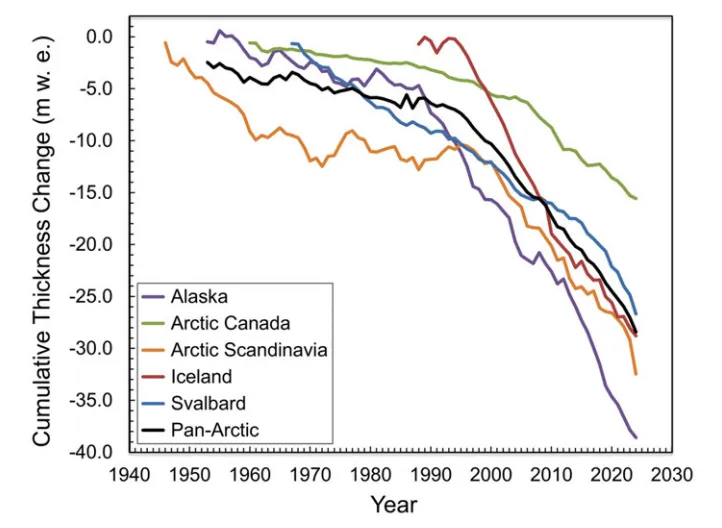
For the folks in a hurry amid the pounding of war drums, here’s the tl;dr on this subject. The Arctic Report Card 2025 from the National Oceanic and Atmospheric Administration was released just before Christmas and got minimal media coverage. As in the report’s previous 19 editions, the news is not good. In summary, it reconfirms that the Arctic is transforming rapidly and profoundly because of human-driven climate change. The findings, supported by hundreds of scientists from around the world, document dramatic warming, changing seasons, shrinking ice, shifting ecosystems, and new environmental hazards that are reshaping both the High North and global climate systems. If there is any surprise in the report’s 150 pages, it’s that it was published at all given the Trump regime’s determination to erase every mention of climate that isn’t attached to “hoax.” —MB
•••• ••••
In the summer of 2001, Ben Saunders, then just 23 years old, tried together with a friend to reach the North Pole. It was rough going over the ice, and they eventually turned back. But in 2003, Saunders made it to the Pole on his own. And in the spring of 2004, the freelance adventurer attempted a solo trip across the Pole from Cape Artichevsky in Siberia to Canada. Seventy-two days after starting out, he had to be rescued about 30 miles from Canada because open water blocked his way. He had trekked 599 miles, often without mittens or hat, logging temperatures as high as 15.5° Celsius (60° Fahrenheit) compared with two years previously when they had averaged 0.5°C (33°F). “The weather this year was the warmest since they began keeping records,” he told a reporter at the Ottawa Citizen before flying back to his U.K. home.
The warmest since they began keeping records. That 21-year-old remark, of course, has become the refrain of our age. Indeed, the week before Christmas, the Arctic Report Card 2025 — the 20th annual such report — was released by the National Oceanic and Atmospheric Administration. It pointed out that last year was the hottest ever recorded in the Arctic.
The scientists who put the report together concluded that the Arctic is getting wetter and stormier. To give just one example of a plethora of ensuing problems, this change in precipitation can create major problems for wildlife. Bison and caribou, for instance, break through the snow in winter to reach the plants they eat. But if rain falls atop snow, and then freezes, it can mean a thick layer of ice over the snow makes it difficult for the animals to break through, and they starve, as did a third of the Alaskan bison population in the winter of 2021-22.
For two decades, the Arctic Report Card has been the pre-eminent barometer of climate change in the region that should have worried everyone far more than it did. But for a good portion of those years, we had the legacy media and a big portion of social media amplifying the liars denying climate science. Twenty years ago, some deniers were still claiming that Arctic ice wasn’t dwindling but rather increasing. Today the fossil fuel interests that paid for those lies are looking at the melting Arctic as a source of more of the stuff the burning of which delivered us into our current predicament.
The findings in the 2025 report make one thing unmistakably clear: the Arctic has passed the threshold of gradual change and entered a regime of systemic failure. This is a structural transformation of planetary climate dynamics — a transformation with direct, escalating consequences.

Measured from October 2024 through September 2025 “the last 10 years are the 10 warmest on record in the Arctic” the report states, a statistic that now reads less like a trend and more like a condition. The region continues to warm at more than twice the global average, a phenomenon scientists call Arctic amplification — though the term feels increasingly inadequate for the scale of disruption now underway.
What stands out most in the 2025 report is not any single record broken, but the sense that the Arctic’s old rhythms are failing to reassert themselves. Winter no longer reliably restores what summer melts away. Precipitation is increasingly falling as rain rather than snow. And even the cold season is warming fast enough to destabilize systems once thought resilient.
Nowhere is this more visible than in Arctic sea ice. In March 2025, the Arctic reached the lowest winter maximum sea-ice extent ever recorded in the 47-year satellite record. That matters because winter ice used to be the Arctic’s reset button — a seasonal recovery that bought time. Today, much of the ice is thin, young, and vulnerable. The report notes that more than 95% of the Arctic’s oldest, thickest multiyear ice has vanished since the 1980s, leaving behind a fragile skin that melts more easily and reflects far less sunlight back into space.
As Scientific American puts it, the loss of sea ice means “less of the sun’s rays are reflected back to space and are instead absorbed by the ocean,” reinforcing a feedback loop that accelerates warming and makes recovery increasingly unlikely .This is not instantaneous collapse — but erosion, and erosion compounds.
On land, the changes are just as unsettling. June snow cover across the Arctic is now roughly half what it was 60 years ago, a shift that alters everything from river flows to wildlife behavior . Permafrost — the frozen ground that underpins Arctic ecosystems and infrastructure — is thawing more deeply and more widely. One striking symptom is the spread of so-called “rusting rivers” across Arctic Alaska. As permafrost thaws, iron and other metals leach into streams, turning them orange and acidic. According to researchers at UC Davis, more than 200 rivers and streams have changed color, most within the last decade.
And then there is the existential threat to the indigenous peoples of the Arctic who are seeing their way of life honed over millennia vanishing before their eyes, sending their coastal communities tumbling into the sea, hampering their sustenance hunting, and destablizing inland communities by melting the ground beneath them.
To put it plainly: the Arctic as humans have long known it is unraveling.
“This year was the warmest on record and had the most precipitation on record — to see both of those things happen in one year is remarkable,” said Matthew Langdon Druckenmiller, an Arctic scientist and editor of the 2025 report card. “This year has really underscored what is to come.”
What is coming isn’t hypothetical. The impacts have been infiltrating weather patterns, economic systems, and infrastructure risk profiles for years. So long have those report card researchers and thousands of other climatologists been telling us that what happens in the Arctic doesn’t stay in the Arctic that it’s become a cliché. But it’s also a reality.
In spite of that reality, there’s a big problem going forward for climate researchers. Here’s Grace van Deelen at EOS:
Data included in the report are collected by the Arctic Observing Network (AON), an internationally coordinated system of data observation and sharing.
But obstacles impede the system’s ability to monitor the Arctic, according to report authors. Sparse ground-based observation systems, unreliable infrastructure, limited telecommunications, and satellites operating beyond their mission lifetimes are hindering data collection and sharing. “Persistent gaps limit the AON’s ability to fully support Arctic assessments and decision-making,” the authors write.
Science agencies such as NOAA, NASA, and the National Science Foundation and the Interior Department contribute significantly to AON, but all faced staff and budget reductions in 2025. These changes could affect AON and its ability to publish the Arctic Report Card, “jeopardizing long-term trend analyses and undermining decision-making,” the authors write.


The region that used to reset itself every winter is no longer doing so. Scientists have been struck by how exceptional warmth in other seasons, particularly summer, is now becoming evident in winter too, affecting the annual growth of sea ice even in its coldest months. “There’s been a steady decline in sea ice and unfortunately we are seeing rain now even in winter,” Druckenmiller said. “We are seeing changes in the heart of winter, when we expect the Arctic to be cold. The whole concept of winter is being redefined in the Arctic.”
This matters because sea ice is not a cosmetic feature of a remote geography. It is a critical regulator of Earth’s energy balance and atmospheric circulation. When you erase the coldest part of the climate system, you weaken the temperature gradients that drive the jet stream and storm tracks across the Northern Hemisphere.
It’s a global matter, obviously, and I’ve had plenty to say about that in the past, but let’s just take at look at impacts in the United States for now.
We are living with a slower, weaker, wavier jet stream that allows weather systems to stall for days or weeks. Heat domes anchor over entire regions. Atmospheric rivers hover and regress instead of moving on. Cold air pours south when pressure gradients collapse. These are not isolated extremes; they are manifestations of a reorganizing climate system whose new baseline is fundamentally less stable than the one the modern U.S. was built upon.
Costs of this transformation are compounding.
Extended heat waves strain electrical grids and deepen droughts in the Southwest and Midwest. Agriculture, a pillar of U.S. economic strength since World War I, cannot plan around the old seasonal calendar. Infrastructure — roads, bridges, levees — designed under assumptions of a historically narrower range of climate variability, is being overwhelmed by extremes. Flood insurance pools are collapsing. Reinsurance rates are skyrocketing. In some markets, property has become simply uninsurable.
The Arctic’s disruption amplifies these stresses. “We are seeing cascading impacts from a warming Arctic,” said Zack Labe of Climate Central. “Coastal cities aren’t ready for the rising sea levels, we have completely changed the fisheries in the Arctic which leads to rising food bills for seafood. We can point to the Arctic as a far away place but the changes there affect the rest of the world.”
Other regions feel it too: Europe has seen persistent heat waves and anomalous flooding linked to jet-stream disruption, and East Asia has faced erratic monsoons and winter cold snaps tied to polar warming impacts. Heatwaves are frying Australia and Patagonia.
Politically and socially, the U.S. remains ill-prepared. Trump and his minions are making matters worse by retreating on climate policy that thanks to the Inflation Reduction Act and some other moves, had been making a modest attempt at getting on the right climate trajectory..
The Arctic Report Card makes it clear that the Arctic ecosystem that has existed throughout human history is likely to be largely unrecognizable by 2050. To reiterate, the impacts won’t be confined above 66.5° North Latitude. Given the intensity of methane and the resilience of carbon dioxide in the altering the chemistry of the atmosphere, it is undoubtedly already too late to prevent or even ameliorate many of the changes. However, the longer it takes us humans to phase out greenhouse emissions, the worse things will get.
There isn’t a singular, all-encompassing tipping point like a stray asteroid that will suddenly materialize. It’s a gradual but accelerating regime change that humans are forcing on Nature itself that is well underway — redefiniing baseline conditions.
The Arctic is a global climate control node, and the changes there are already transmitting stress through weather systems, commodity markets, migration pressures, and geopolitical risk worldwide. Jet-stream distortion doesn’t stop at borders. Neither do food price shocks, shipping disruptions, or insurance failures. What begins as thinning sea ice shows up as heat emergencies in Europe, crop losses in Asia, flooding in Africa, and budget crises everywhere governments are forced to clear the damage and rebuild faster than their tax bases can support. The Arctic’s breakdown is not a subplot of climate change to be ignored. It’s one of the main engines.
What makes these impacts especially damning is that they are not happening in a vacuum. Fossil-fuel interests — and the palm-greased government puppets that assist them — are not passive observers of Arctic change. They’re its co-authors. Decades of delay, denial, and dilution were not accidents, but strategies. From federal leasing decisions to state-level preemption laws, from regulatory rollbacks to subsidies that outlive their rationale, public policy has repeatedly bent to protect short-term fossil-fuel extraction over long-term, sustainable stability. The Arctic is warming this fast not because the science was unclear, but because the politicians and plutocrats chose to ignore the warnings in favor of greed. And because all too many citizens of the affluent countries brushed off the dangers as affronts to their comfort and “lifestyles.”
Every ton of carbon extracted under the pretense of what our former fracker Energy Secretary Chris Wright sanitizes as “climate realism” narrows the margin for adaptation everywhere. Every year spent pretending that markets together with technological breakthroughs will fully address our predicament locks in higher short- and long-term costs — paid not by the companies that profited, but by households and cities forced to respond to cascading failures. The Arctic is issuing the first invoices, and it is already clear who has been, in economic jargon, externalizing the bill.
The Arctic changes should strip away any illusion that climate change is manageable through half-measures, deferred accountability, and decades more of prodigious generation of greenhouse gases. The stabilizing conditions that underwrote global growth in the modern era are dissolving, and they are not coming back on political time scales. Treating this as a series of disconnected disasters is no longer credible. It is systemic risk, unfolding in real time, driven by choices that continue to be defended as pragmatic. History will not be kind to that defense — and the climate system will be even less forgiving.
See also (some of these may have paywalls):
The Arctic Is in Dire Straits, 20 Years of Reporting Show (Scientific American)
Arctic Report Card Marks 20 Years Amid Record Warming in 2025 (World Meteorological Organization)
Arctic Warming Is Turning Alaska’s Rivers Red With Toxic Runoff (The New York Times)
Arctic endured year of record heat as climate scientists warn of ‘winter being redefined’ (The Guardian)
Arctic Report Card 2025 (Rick Thoman at the Alaska and Arctic Climate Newsletter)
Amid the Arctic’s Hottest Year, Arctic Science Faces a Data Deficiency (EOS)







Comments
We want Uncharted Blue to be a welcoming and progressive space.
Before commenting, make sure you've read our Community Guidelines.