
There’s no way to create a complete listing of the litany of damage Trump and the Project 2025 chaos agents have delivered to our flawed republic in so short a time. That’s because every day there’s something new. The man’s erratic and fickle behavior colors just about any subject imaginable while he is motivated by vendetta, grifts, and obsessions. Reckless thievery goes on in plain sight at levels Roman and Chinese emperors would have flinched at, and our Outlaw Prez feeds his fixations, making potentially planet-altering decisions based on nonsense.
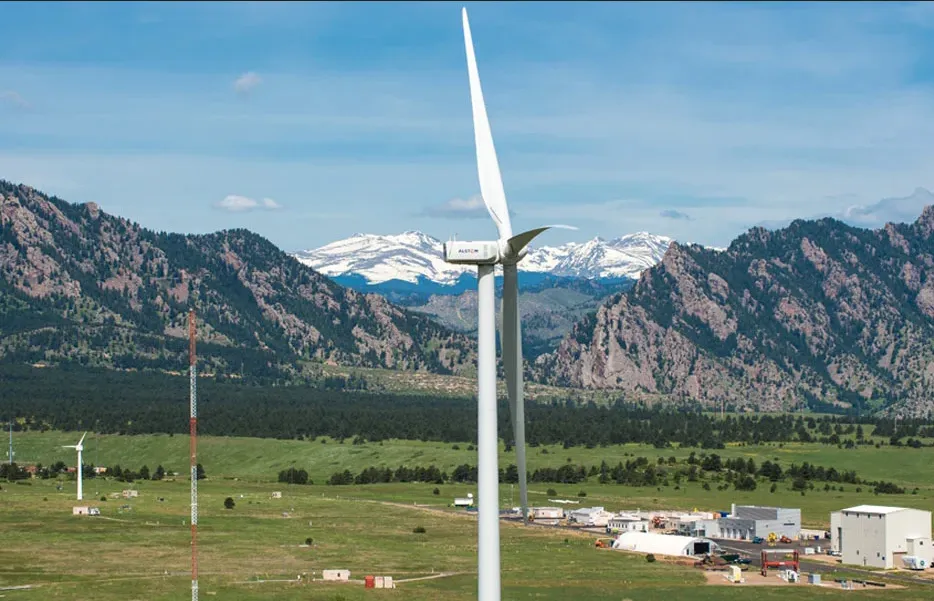
One of his many targets has notoriously been renewable energy. He has a particular loathing of wind turbines, the offshore ones being worse in his view because they are in his view. This seems to have got really rolling years ago in Scotland when he objected to a planned offshore wind farm near his planned golf course. Threats were made and there was media drama. But the wind farm was completed and started running in 2018, with the capacity to power 80,000 homes. Scotland now has so many wind farms that by 2022, it was generating more renewable electricity than it used.
Trump’s grievance about wind turbines has metastasized into a compulsion, the hostility explicit. He told a meeting of oil executives earlier this month, “My goal is to not let any windmill be built. They're losers." He dismissed wind power overall as “the scam of the century.”
Trump has gone after wind power with various verifiably false or misleading assertions, most recently including bogus national security concerns about the giant machines. If wind turbines are indistinguishable from attack craft by U.S. defense radars, then the nation definitely has some actual national security concerns. Nonetheless, on this justification, Trump’s Interior Department chief Doug Burgum paused all five leases for large-scale offshore wind projects that currently are being installed off the coasts of New England, New York, and Virginia. All part of his overall blockade of renewable projects on public land and the killing of federal incentives.


Then, in a single week, three judges — appointed by Ronald Reagan, Joe Biden, and Trump himself —struck down the regime’s effort to halt construction of three different wind projects. A fourth farm’s appeal will be heard Feb. 2.
In the most recent of the rulings, District Judge Jamar Walker acknowledged that claims of national security typically command judicial deference, but he said the Trump team failed to demonstrate the kind of immediacy that would justify such an extreme intervention. The government, he wrote, had not shown that the “national security risk is so imminent” as to warrant halting a project already well into construction. That project is Dominion Energy’s Coastal Virginia Offshore Wind project, which has installed 61 off the project’s 62 turbines. Walker rulers the builders could proceed while the litigation continues.
He characterized the Interior order as “arbitrary and capricious” and warned that it would cause “irreparable harm” if enforced. That goes to the heart of what is actually happening. These cases are not about safety but power, the political kind. Specifically, the executive’s effort to assert control over energy development by manufacturing uncertainty. To this end they are erecting obstacles to renewable projects while bending or weakening regulations on oil, gas, and even coal operations.
As reported in Climatewire, of Walker’s ruling Sen. Martin Heinrich of New Mexico — the top Democrat on the Senate Energy and Natural Resources Committee — said, “If you are a developer, the lesson is don't cower in the corner. You have to be willing to fight for your legal rights,”
Encouraging as the favorable court rulings are, they are not an unambiguous victory for renewable energy. Trump is losing in court. But he’s still succeeding at delay.
The wind power cases involved projects already billions of dollars deep, some nearing completion. Burgum’s security claims rang hollow to the courts — with judges citing his own public statements emphasizing cost and “aesthetics” rather than defense concerns. In another of the rulings. Across jurisdictions, the judges’ conclusion was consistent: ideological hostility masquerading as regulatory caution was driving the shutdown of further construction.
The impact?
...analysts warned the decisions are unlikely to stop Trump’s crusade, particularly as the rulings themselves could do little to calm the fears of companies looking to invest in future offshore wind development, a still-nascent industry in the United States.
The suspension orders may still “serve the long-term purpose of injecting significant uncertainty for offshore wind,” said Timothy Fox, the managing director of ClearView Energy Partners, a research firm.
“A future administration could support offshore wind, but we think the industry — and perhaps as importantly — financiers may be wary of investing in a capital-intensive sector with such demonstrable high election risk,” he said.
Offshore wind is only the visible edge of a broader campaign. The more corrosive damage is occurring inland, where administrative delay has proved more effective than overt bans. According to Maria Gallucci at Canary Media, more than 22 gigawatts of onshore wind and solar projects on public lands — enough capacity to power roughly 16.5 million average homes, which would be, technically speaking, enough for all of California — have been canceled or immobilized by an Interior memo mandating “elevated review” by Burgum. Nearly 70 categories of renewable permits now languish at the secretary’s discretion. Since July, only one project has moved forward.
“It’s created a choke point,” said Wood Mackenzie analyst Kaitlin Fung. Sen. Martin Heinrich of New Mexico translated the consequence: the cheapest electricity available in the country is stranded by political design.
Delay functions here as control. It requires no legislation. It leaves minimal paper trails. It exploits financial reality. Developers facing months of silence on approvals cannot secure financing. Projects miss tax-credit deadlines. Investors reassess exposure. The outcome is a de facto moratorium without the legal liability of declaring one. Foot-dragging has produced some of history’s most potent impacts.


The timing of attacks on renewables borders on lunacy. Electricity demand is climbing as data centers proliferate, vehicles electrify, and industry modernizes. Wind and solar remain the fastest and lowest-cost means of adding capacity. Grid operators and governors alike have warned that offshore wind delays will raise consumers’ already soaring electricity bills and undermine reliability.
Trump’s answer has been to falsify the economics of wind itself.
As Fast Company reports and numerous studies show — including one from the National Renewable Energy Lab* — wind has ranked among the cheapest sources of new electricity in the U.S. for much of the past decade. Trump nevertheless insists it is prohibitively expensive. On the contrary, restricting wind, the American Clean Power Association has warned, will further inflate electricity bills. Meanwhile, Trump tries to bolster his case by ranting falsely that turbines cause cancer. He repeats oil-industry BS about whale deaths while expanding offshore drilling that verifiably harms marine ecosystems.
Irony abounds. Eight of the 10 most wind-dependent states voted for Trump. Red Iowa generates roughly 63% of its electricity from wind, having had keen bipartisan support for this source since 1983. Red Texas has more wind turbines than any other state. Yet Trump proceeds with his war regardless. Renewables, after all, threaten the fossil fuel order his regime exists to entrench.
Rachel Cleetus reports on the documenting by the Sabin Center of nearly 300 actions aimed at dismantling climate and clean-energy progress taken in the first year of Trump 2.0. Grants clawed back. Agencies stripped of expertise. Scientific data erased from public view. Offshore wind paused. Onshore renewables suffocated. All while oil, gas, and coal receive expedited treatment under a contrived “national energy emergency.”
The courts have provided a partial restraint. Lawsuits have reopened projects, restored funding, and exposed legal violations. But litigation is reactive and fragile. It cannot substitute for durable policy.
As the tally of renewable projects on private land continues to rise in the U.S. and rapid growth of solar is happening across the planet — including in some places of Southeast Asia and Africa where people aren’t replacing their source of electricity but actually having one for the first time — we have proof the global changeover is inevitable. It’s going to happen with or without U.S. government participation.
But it will happen more slowly than it could and should and must. But in face of that essential need, for capital, the long-term signal of Trump’s assaults is unmistakable: federal support for renewables is contingent and reversible and fickle. Not the sort of circumstances that sends investors looking elsewhere.
The big risk is not collapse but stagnation. Delay clean energy long enough and fossil infrastructure locks in another generation of emissions — another generation of health burdens, climate disasters, and sacrifice zones borne disproportionately by low-income communities and communities of color. And, of course, making the unforced error of giving China a big advantage in the clean energy arena where it already leads, is quite the cognitive dissonance for all the talk of growing rivalry and tensions with Beijing. But then Trump is cognitive dissonance incarnate.
•••••••
*Contentiously changed to the National Laboratory of the Rockies to get Renewable out of the name.










Comments
We want Uncharted Blue to be a welcoming and progressive space.
Before commenting, make sure you've read our Community Guidelines.